Students today have a wide choice of sustainability-related programs that go beyond environmental studies and explore how ecology intersects with other areas, such as the Sustainability Studies minor at AUBG and the Ecomedia course. However, fifteen years ago, the interdisciplinary study of media and the environment barely existed.
At that time, Antonio López, now a Professor of Communication and Media Studies at John Cabot University in Rome, had a hunch that the two fields are deeply connected.
Teaching media literacy and journalism to Native American students in Santa Fe, Professor López began to question how Western media education approached digital storytelling and the natural world. That exploration would eventually lead him to become one of the first scholars researching and coining the term ‘ecomedia literacy’.
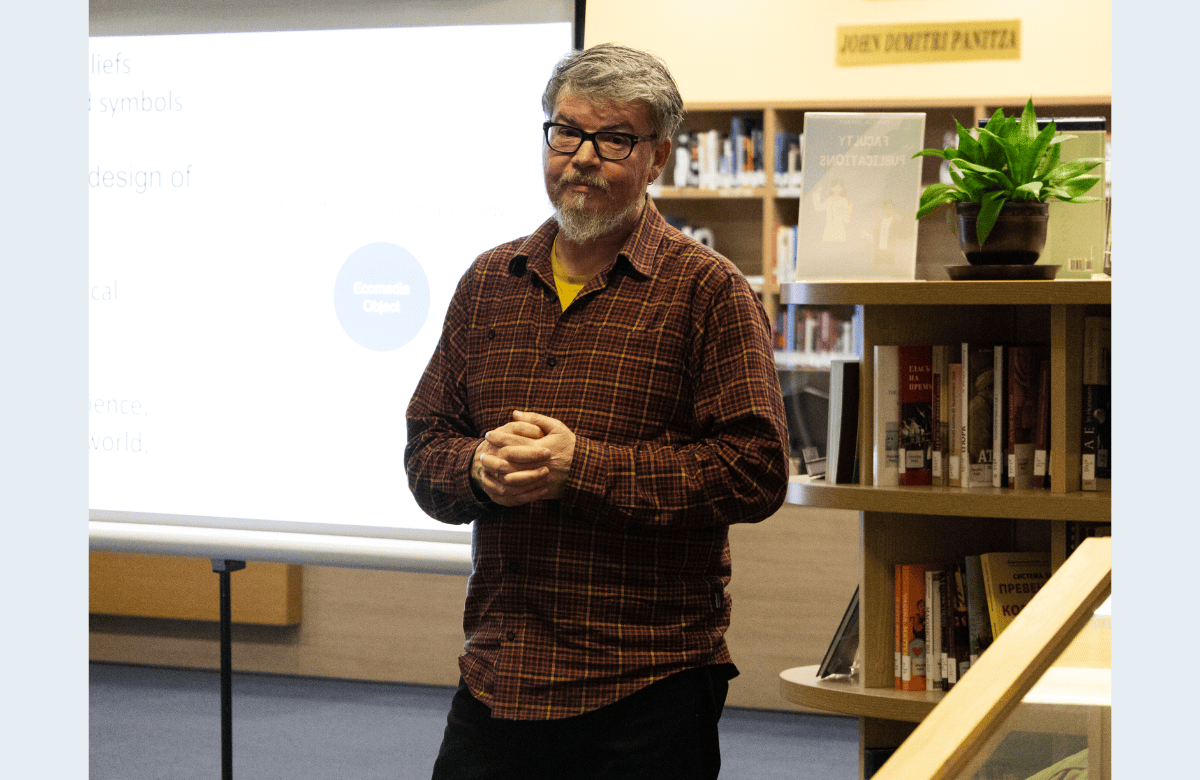
Today, he shares his knowledge across the world, a part of which is his recent lecture at AUBG, “Dirty Waters: AI’s Ecomedia Footprint in a Warming World”. It explored the hidden ecological footprint and mindprint of AI and digital media.

First encounter with environmental activism
As a Peace and Conflict studies graduate at the University of California, Berkley, and a Media Studies master’s graduate, Professor López spent years working professionally in media and journalism, but the environmental side of things has always been on the back of his mind.
He grew up amid the anti-nuclear movement in ‘80s Los Angeles and was very involved with the youth movement at the time, which marked the start of his environmental activism.
After graduating from University of California, Professor López spent nearly fifteen years working in the media business as an arts and culture journalist. “Our punk zine was called ‘ink disease,’” he said. “I always feel like I kind of have a disease of ink. I can’t help it; I’m attracted to it.”
A disconnect between media and nature
It was his teaching and consulting experience in the gifted and talented program at the Santa Fe Indian School in the early 2000s that changed his thinking about media and the environment.
“It was a community-based education model, which meant that this was a school that served 22 Native American tribes,” he shared. Professor López worked with students documenting environmental projects through journalism, video, and writing while also teaching media literacy.
“A lot of this media literacy was about anti-tobacco,” he said. “But what’s interesting is that Native Americans view tobacco as a sacred plant, as long as you don’t abuse it.”
Many students used tobacco as a spiritual tool in ceremonies. “They would have a little pouch of tobacco and sprinkle it on-site as an offering,” Professor López added. The elders would also ask him not to film certain rocks, sites, or ceremonies, because they’re sacred.
“It really got me thinking: how is the media world that I grew up in and was trained in disconnected from this reality? And I was experiencing kind of a conflict.”
This conflict eventually pushed him to deepen his knowledge about media and went on to pursue postgraudate studies at the New School for Social Research in New York. “It was the first media studies program in the United States, maybe even in the world,” he shared.


Coining the term ‘ecomedia literacy’
After completing his master’s degree, Professor López later pursued an online PhD at Prescott College while already working at John Cabot University in Rome. He proposed a PhD topic that explored the connection between media literacy education and environmental awareness. This was something no one had studied at a postgraduate level before.
Professor López discovered something that saddened him: “The media literacy movement was reproducing the biases of modernity and the sort of the belief that technology was inherently good.”
At the same time, he had witnessed communities that were both honoring the environment through everything they do and experiencing the environmental consequences of technology firsthand.
“Native Americans are victims of technology,” Professor López said. “The uranium mining, the e-waste, and the nuclear fallout – all that is in their land. They’re the ones who pay the price for our high technology.”
This realization led him to develop the concept of ‘ecomedia literacy’, which brings environmental awareness into the study of media.
AI and the hidden costs of digital media
During his lecture at AUBG, Professor López used artificial intelligence as one of the clearest examples of how media and environmental systems are deeply intertwined, and their negative footprint.
Many people perceive digital media and AI as intangible, as tools that are inherently good. “When people think of the media, they think of these shiny objects and of images and texts, but they don’t think about the infrastructure,” Professor López said.
However, with more eyes on AI and its potential negative impact on humans, its functions and effects have been examined from all sides, and hence, its environemntal impact is coming to light.
Behind the interface of what we know as ChatGPT or Midjourney lies an enormous physical infrastructure that keeps it alive. Vast networks of data centers that operate continuously are needed to train and run AI systems, and they consume incomparable amounts of electricity and water.
“AI, or data centers in general, produce much more carbon than the airline industry and about 7% of global electricity,” explained Professor López. “Water is necessary for cooling these massive servers. But not just any water; it has to be fresh water, because for some reason, distilled water or other types of water are too corrosive to this equipment,” he added.
Thinking about the eco footprint and mindprint
For Professor López, AI is an ideal case study for understanding the relationship between media and the environment. He describes this relationship through two concepts: the ecological footprint and the mindprint of media.
Rare earth minerals must be mined, often in environmentally sensitive regions, for the production and running of smartphones, servers, digital platforms, and AI tools. All the data needed in the world is stored and processed in resource-intensive data centers.
Professor López argues that media also has a second, less visible, but just as significant influence: its mindprint. “The ecomedia mindprint is the way that different types of media influence or impact our understanding or beliefs about the environment,” he shared. Examples include news and the discourses about the environment; advertising which promotes consumerism, “the primary cause of environmental degradation”; and popular culture, which has normalized fossil fuel usage and exploitation.
Reframing ecomedia literacy
“So my aim is to shift our thinking from thinking of media as sort of this futuristic, clean technology to something more akin to its actual reality,” said Professor López.
That shift in perspective is precisely what ecomedia literacy aims to achieve. Ideally, however, Professor López believes the concept should not need to exist at all. “Ecomedia is media that are a part of the environment and about the environment.”
Media literacy should naturally include ecological awareness, he says. “If the world decided we don’t need ecomedia literacy because media literacy already includes environmental awareness,” he said, “I would be totally satisfied.”
Until then, the concept exists to highlight certain issues and shift the focus to a more integrated thinking about nature and the media.