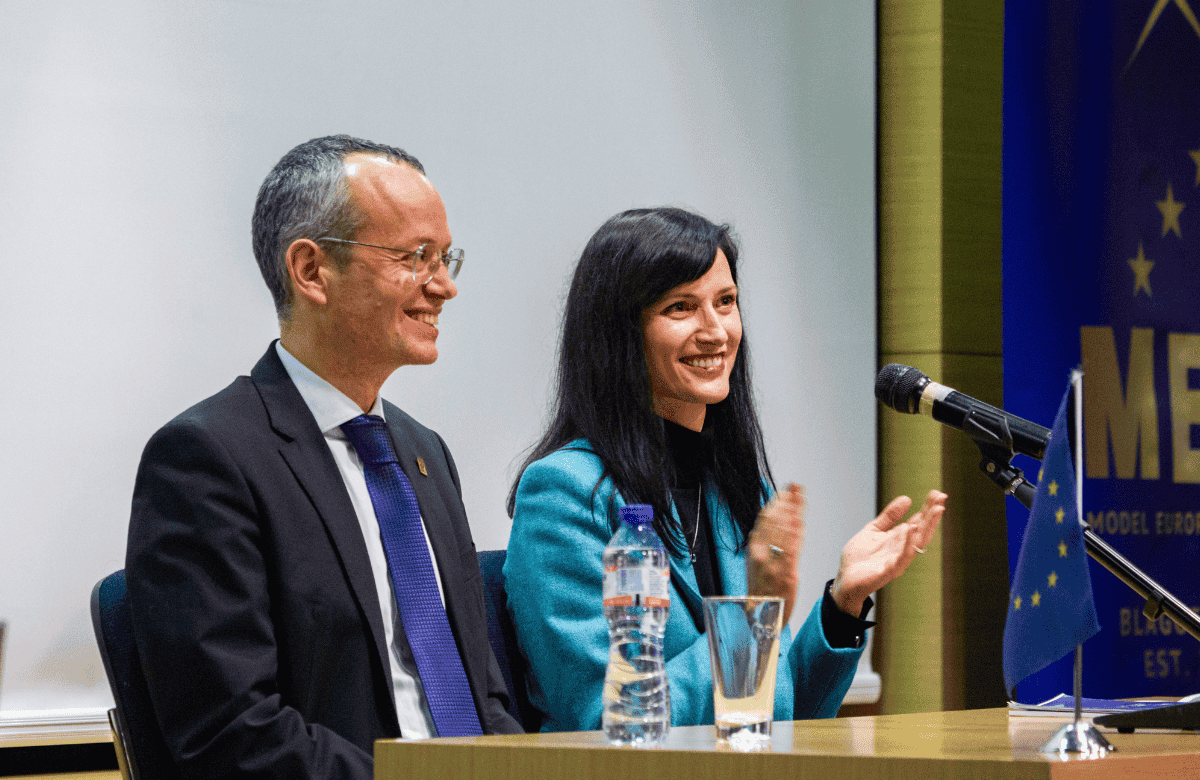
Who is shaping the agenda of your life? This was the questio posed to young people by Metodi Baykushev, Mayor of Blagoevgrad, and Mariya Gabriel, President of the Robert Schuman Institute, during their discussion on youth empowerment at AUBG. The event was organized by the Model EU (MEU) Blagoevgrad student club and moderated by Professor Jean Crombois.
“Young people want to be more involved in decision-making and policy implementation,” said Gabriel. “Resources, time, and policies are on your side,” added Baykushev. “You are already empowered.”
The key is recognizing the opportunities available to get involved. Gabriel and Baykushev shared practical advice for young people looking to make a difference.
Here’s a summary of the steps you can take towards youth empowerment.
Why get involved?
The answer is simple: to start rewriting the agenda of today’s world, including our geopolitical relations, climate challenge, democracy, and the spread of misinformation.
Mayor Baykushev emphasized: “Empowerment is about responsibility. But it’s also a competition”. He pointed out that young people are competing with older generations who currently set the agenda. “You’re up against the 50 and 60-year-olds – and they’re winning.”
Mariya Gabriel added: “We don’t need just one type of voice or opinion. We need real diversity – different perspectives, solutions, and ideas from young people”.
According to Baykushev, young people today have the ideal environment to make a difference:
“The EU is investing enormous effort, money, and resources into youth policies and education. You have everything you need to create a better world and make an impact in Europe.”
The challenge, he said, is to seize this opportunity. “How do we make use of it?”
Baykushev urged young people to engage with politics to win this “competition” and focus on what truly matters. “Don’t waste time on silly things and scrolling on your phones. Work on the important stuff. That’s how you gain responsibility.” Experience, he added, comes from getting involved – “and the time to start is now.”
Where does empowerment come from?
Mariya Gabriel outlined five essential layers of youth empowerment, the synergy of which can help you take control of your future:
- Individual empowerment: It starts with self-confidence and personal responsibility. “Do you know your strengths, weaknesses, and sense of responsibility?” Gabriel asks.
- The social environment: A supportive community is essential. “In Blagoevgrad, young people have strong support. Without it, achieving anything is difficult,” she noted.
- Educational empowerment: Education is central to European policies,” Gabriel emphasized, stressing access to quality education and smooth transitions into post-university life.
- Psychological empowerment: Mental health is often overlooked. Gabriel highlighted the need for open discussions, especially as digitalization affects well-being.
- Physical empowerment: Linking sports and healthy habits to overall well-being is vital. “It’s about fitness, balance, and supporting mental and emotional health,” Gabriel explained.
Awareness: How to stay informed
To get involved, the first step is awareness. “If you want to move beyond discussion and take action, you need access to information about the initiatives and programs taking place,” Gabriel emphasized.
- Who is the new European Commissioner for Youth?: It’s important to know who the key figures are in implementing ideas and projects at the European level.
- Follow the European Youth Portal: This platform offers numerous opportunities for volunteering, training courses, youth exchanges, internships, and jobs across Europe.
- Read European Commission papers: Understanding how EU institutions work is crucial for youth empowerment. As Baykushev noted, “EU institutions are evolving, and they will have an increasing influence on our lives. You can be part of that influence.”
How can we promote youth empowerment? Activities & programs
Youth empowerment is fundamentally about taking action. “The question is about leadership, and leadership is about taking responsibility for your own life and for the lives of those closest to you,” said Mayor Baykushev.
Here are several impactful projects and initiatives you can get involved in:
- Girls Go Circular: An EU initiative empowering young girls with digital and entrepreneurial skills focused on the circular economy. “I fully believe in the potential of girls and women, so this initiative is close to my heart,” shared Mariya Gabriel.
- Plastic Pirates: A youth-led project focused on collecting plastic waste from European riverbanks, helping to research water pollution. “Students also learn to use materials and develop new business models and solutions,” added Gabriel.
- European Solidarity Corps: An initiative uniting young people to build an inclusive society and tackle societal challenges.
- Deep Tech Talent Initiative: With a goal to skill one million people in deep tech fields such as science and engineering over the next three years, this initiative addresses global challenges. “Europe needs talent now more than ever, and this imitative is a great way to get involved,” said Gabriel.
- Horizon Europe: The world’s largest investment program for research and innovation, with public-private partnerships focusing on key industries.
- EU Youth Dialogue: A forum connecting young people, youth organizations, decision-makers, and researchers to shape the EU Youth Strategy. “What’s great is that you can participate online,” Gabriel noted.
- Get others involved in the conversation: Mayor Baykushev encouraged speaking to students and colleagues who aren’t engaged. “Influence three or more people to get involved – you’re the leaders. You are in one of the best universities in Central and Eastern Europe. What else do you need? What are you waiting for?” urged Baykushev.
- What’s next: A new youth stakeholders’ platform will launch at the European Commission, alongside a President’s Advisory Youth Board. “I very much hope that there will be a representative from Bulgaria, because I think that we have to be active here when things start to shape,” added Gabriel.
Follow-up: stay engaged
For Mariya Gabriel, the key to youth engagement is “follow-up.” She shared an insight from a recent conversation with a U.S. representative who said: “In Europe, you’re funding efforts. In the U.S., we’re funding ideas and solutions.”
Gabriel explained that follow-up means taking responsibility to turn discussions into action. One impactful method, she noted, is sending “a simple open letter with concrete ideas.”
She shared that the main topics of interest of the EU are innovation, climate, and mental health, so consider coming up with ideas related to these.
In the letter, outline the three key ideas discussed with your peers and propose integrating them into the European agenda. Make it clear that you’re ready to stay engaged. Address it to the Commissioner or the President of the Commission.
“Whenever I received a letter like this while working as a European Commissioner, I’d ask my team to contact the sender and involve them in the process,” Gabriel shared.
Find allies
Mayor Baykushev explained that people generally fall into two categories: those who dismiss the next generation as incapable or unworthy, and those who believe in its potential. “These are the people who plant a tree knowing they won’t benefit from it, but future generations will.”
He encouraged young people to seek out allies. “There are allies out there – you just need to find them, work with them, and for them. Collaborate on initiatives together. That’s how you’ll succeed.”
How to get involved in Blagoevgrad
Blagoevgrad offers several opportunities for local involvement. The council is working on initiatives such as a career event connecting companies in Blagoevgrad with potential employees. Another key project, in collaboration with prominent AUBG alumni, aims to attract more businesses to the city and create additional opportunities for current students, particularly in the context of the AUBG StartUP Conference.
“We also have probably one of the best youth centers in Bulgaria, with more than 60 free sports clubs and many in the artis and culture sector.” The Blagoevgrad Youth Parliament is another initiative that helps young people engage with municipal operations and get involved in arts, sports, and education causes.
With the rise of remote work and growing dissatisfaction with life in Western Europe and the U.S., more people are considering returning to Blagoevgrad.
“My aim is to create more reasons for people to come back to Blagoevgrad,” said Mayor Baykushev.