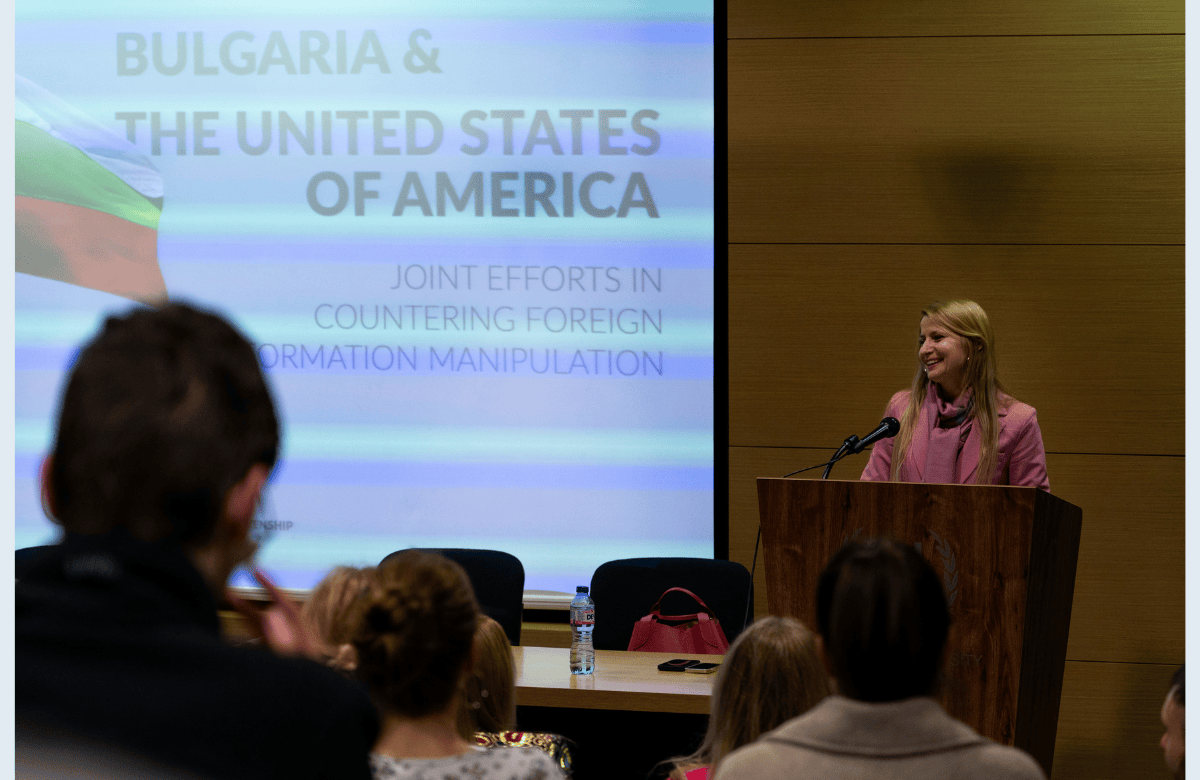
Can education help fight disinformation in the murky world of fake news and AI-generated content? And how can young, bright people influence ministries to adopt policies and procedures for countering disinformation?
These important questions were discussed during the insightful lecture Dr. Asya Tsvetanova, Director of the Americas in the Ministry of Foreign Affairs, delivered at AUBG. She set the stage by deciphering the key priorities and strategic goals of the U.S.-Bulgaria partnership and touched upon the tools and avenues that can help us in the pilgrimage to a more informed and critical world.
“This university is an embodiment of the U.S.-Bulgaria cooperation, and we are very grateful to AUBG for this opportunity to meet with you, the students, who are the future leaders of Bulgaria and the other countries represented on campus,” said Dr. Tsvetanova.
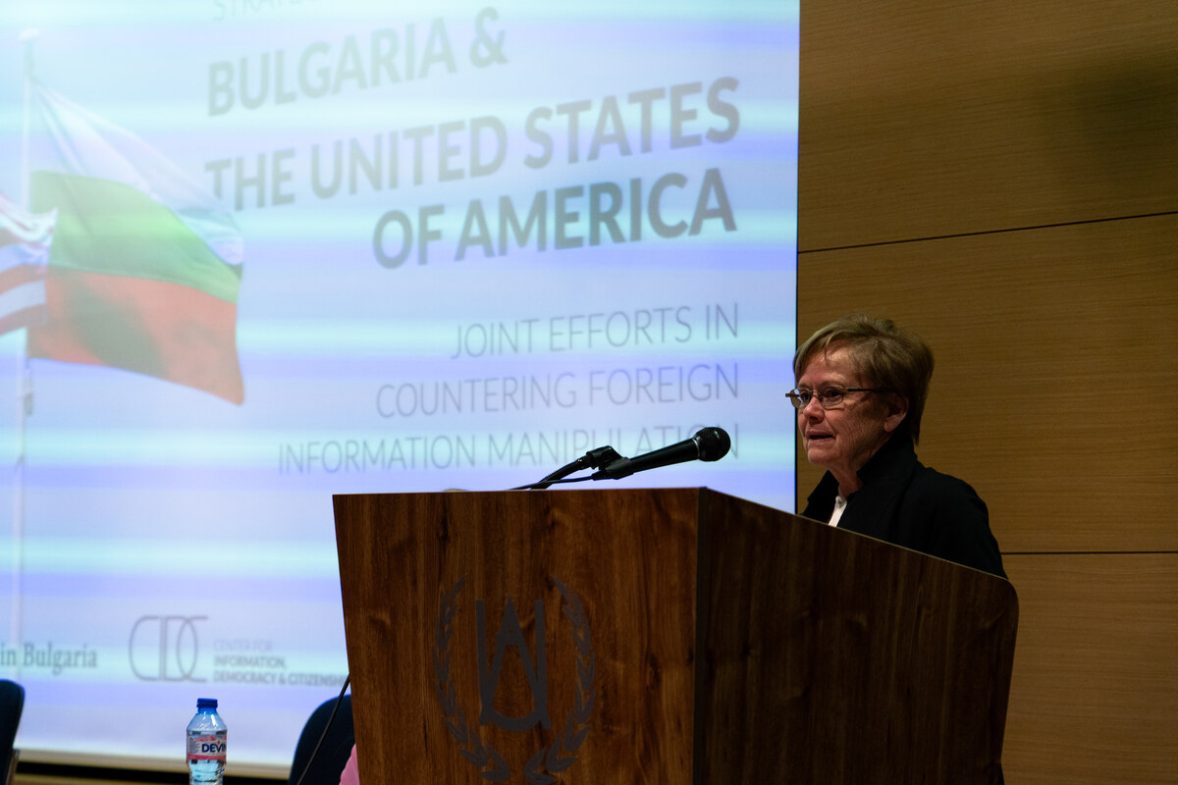
AUBG President Dr. Margee Ensign added: “Bulgaria and America are trusted allies and partners, and we are deeply hopeful that the strategic partnership between our two countries will continue with this new administration as we work together to find the truth and counter disinformation.”
“While this lecture was particularly meaningful to me as a student who majors both in journalism and in politics, I’m well aware of the world that we live in and that information moves with a steadfast speed. As we navigate these new political changes and the ever so complex geopolitical landscape, we see Bulgaria’s strategic partnership with the U.S. is of extreme importance not just in terms of security and defense, but also in building resilience against disinformation and hybrid threats,” added Lilia Petrova, President of AUBG Student Government.
Strategic goals
Dr. Tsvetanova explained that the strategic dialogue between Bulgaria and the U.S. is underpinned by four key pillars:
- Security and defense cooperation with the U.S., focusing on modernizing the Bulgarian defense system and securing NATO’s eastern flankand the Eastern Balkans.
- Energy security, cooperation, and diversification to reduce reliance on a single energy source.
- Cross-border security.
- The U.S. visa waver program for Bulgaria.
- Establishing the Social Security agreement.
The arsenal for combating disinformation: education and ministry collaboration
In 2023, Bulgaria became the first EU member state to sign a Memorandum of Understanding on countering foreign information manipulation with the U.S.
Within that Memorandum, Dr. Tsvetanova identified two strengths of action: government-to-government and a whole-of-society approach, with an emphasis on education and academia.
Collaboration with ministries
The first strength of action entails collaboration with ministries to combat foreign information manipulation, though it presents certain challenges.
“Not every ministry has a dedicated unit to work on disinformation, because it’s a relatively new threat very horizontal – It covers various activities, making it difficult to identify the right people in different ministries,” explained Dr. Tsvetanova.
Fighting disinformation through education
The second strength of action – education – is the basis for combating disinformation and a very powerful tool.
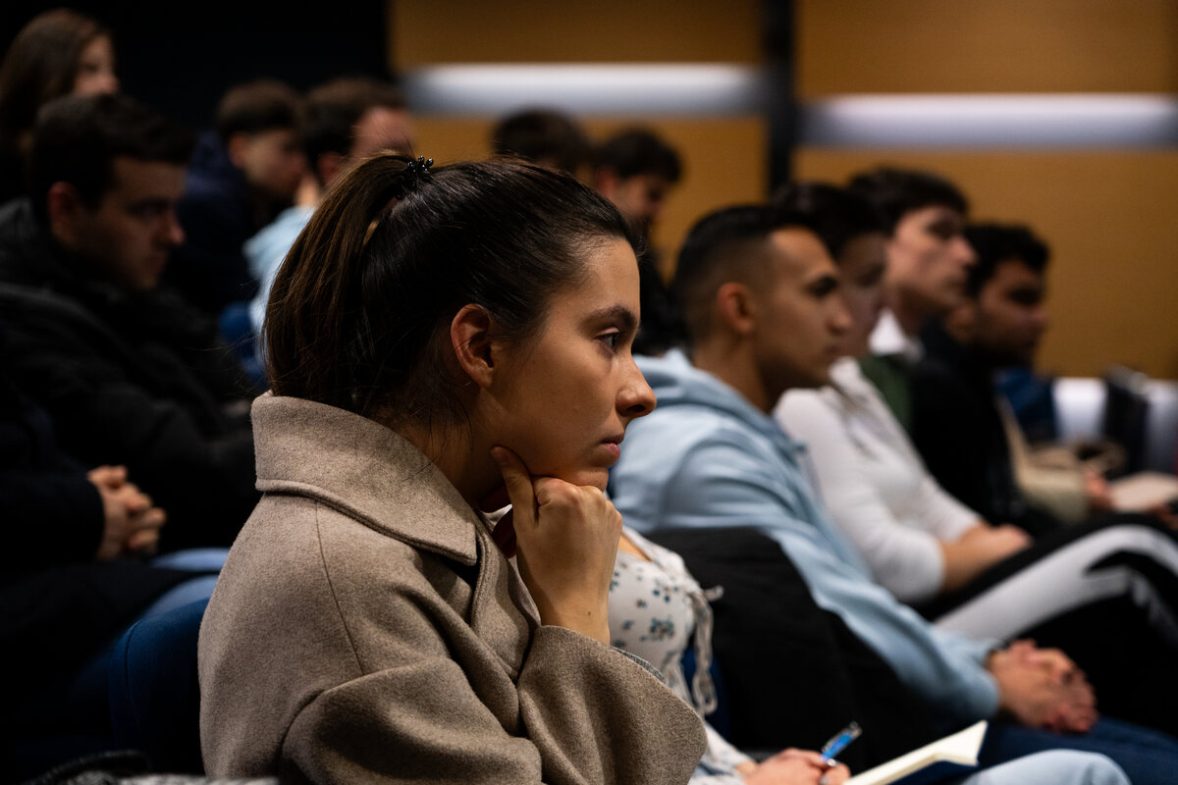
“Our mission is to make young people aware that disinformation is a threat and that there are malign actors who might attempt to influence the information space. You need to be able to decide for yourself what is accurate and what is manipulated.
“This is where the role of education comes. We have engaged with the Ministry of Education and are working to expand this type of partnership with academic institutions like AUBG and other universities in Bulgaria to raise awareness about this threat,” she said, emphasizing ongoing partnerships with universities and initiatives such as AUBG’s CIDC projects.
CIDC’s own initiatives align closely with the framework, including the CIDC-Sensika Disinformation Observatory, Be MediaWise Bulgaria, and Youth-to-Youth (Y2Y-PILLAR) – set to launch in 2025. These programs engage students and young professionals directly, fostering resilience and critical thinking across Bulgaria and neighboring countries.
You can explore CIDC’s programs aimed at increasing media literacy and stopping the spread of disinformation.
Career opportunities in diplomacy
Another way to become more actively involved in fighting disinformation and support the Ministry of Foreign Affairs’ strategic goals is by exploring the available career opportunities.
Dr. Tsvetanova highlighted several open positions at the Ministry of Foreign Affairs in Bulgaria, including a Trainee Attaché role that grants the first diplomatic rank, along with other diplomatic positions and civic security ones without diplomatic rank.
For students interested in gaining experience at the Ministry of Foreign Affairs but are not pursuing a Political Science degree, one-month internship positions are also available.
“Hopefully, I can inspire you to consider a possible career in Bulgaria’s diplomatic service if you are eager and interested to learn more,” concluded Dr. Tsvetanova.