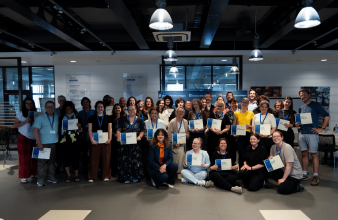
The AI Aware Universities project has officially come to an end. Representatives from the six participating institutions came together in Blagoevgrad to share, reflect, and exchange ideas on the impact of AI in academia. The project, organized by the Center for Information, Democracy, and Citizenship (CIDC) at AUBG and funded by People Powered, served as a catalyst for discussions and shaping the first-ever institutional AI policies at each university.
On May 9, 2025, student leads and faculty from AUBG, LCC International University, Bard College Berlin, European Humanities University, BISLA, and Central European University met at the AUBG campus for a day of sharing and insights. Each team presented the work they had done and what they now recommended for their universities moving forward. What followed were discussions about the philosophical aspect of authorship and intellectual ownership, as well as practical steps for regulating AI use on campus.
“I got to talk to a lot of students, and I like that there’s an initiative to listen to the students’ perspectives,” said Alejandro Gilardi Ramirez, student at Bard College Berlin.
Workshops, brainstorming, and discussions
The process looked similar across all six institutions. The project kicked off with a series of workshops that brought together students, faculty, and staff for open conversations about AI in an academic setting. What followed was the drafting of a proposed AI policy tailored to their university community.
“It was a really interesting experience – the first time I’ve had the opportunity to contribute to a policy,” said Milena Honku from Bard College Berlin. “I think students should be more involved in the process of what happens at the university. It shouldn’t be a top-down approach but an open discussion,” she added.
And while the specifics varied, one thing became clear: we need to find a balanced approach to AI in higher education. Some students and faculty see AI as a powerful tool that enhances learning and increases efficiency. Others remain deeply sceptical, raising concerns about academic dishonesty, loss of critical thinking, and digital dependency. The key is to be aware of it.
One thing is for certain: AI is here to stay. Universities now face the responsibility of adapting, not by rushing into bans or straightforward approvals, but by shaping thoughtful policies that align with their values, support their students, and evolve with the technology.
What would different policies look like?
“I liked how the project and final gathering were structured and well-organized. It was interesting to hear how each team completed their policies and to compare them with ours,” said Anhelina Allakhverdova from LCC International University.
While no two institutions are the same, several common principles emerged in the proposed policy frameworks.
At AUBG, the team focused on co-creation, involving students, faculty, and staff into open-ended discussions, as well as lectures from experts in the field. Rather than imposing rigid rules, the AUBG team suggests a “living document” that evolves alongside the technology and the needs of the community. This will consist of regular review processes, transparency in AI use, and education about both the benefits and limitations of generative tools.
Bard College Berlin’s policy leaned into ethical reflection and student autonomy, recognizing that there is no ethical way to enforce an AI ban, given the current state of AI detection. Instead, their policy focuses on disincentives, alternative resources, and education. These include AI disclosure statements, expansion of learning commons and tutoring, in-class essays and examinations, revision history, and the ban of AI use in any part of the academic research process.
BISLA grounded its policy in student-led research. Based on more than 40 student interviews and extensive peer discussions, their recommendations encourage transparency, human-centered use, and awareness of AI’s limitations. They’ve already begun working on a policy and handbook for students and staff navigating AI use, which is awaiting approval.
European Humanities University’s policy process prioritized deliberation. Their team hosted structured conversations where community members could engage in open debate and contribute to shared decision-making. The policy they’re developing centers on informed consent, academic integrity, and the importance of teaching AI literacy across all disciplines.
Although LCC International University already had a plagiarism policy in place that addresses AI, students and faculty felt it didn’t adequately address the current complexities of AI use in academia. Student leaders facilitated group debates on AI policy content, resulting in group policy proposals that were refined through a final group discussion and online voting. Their policy recommendations include clear ethical standards and AI literacy training for staff and students.
The Central European University team focused on three ethical themes: responsibility, academic standards, and intellectual ownership. They emphasized AI as a supportive tool rather than a replacement for academic work. CEU recommended university-wide authorization for AI use with mandatory disclosure, discipline-specific policies, and seeking expert guidance on AI detection software.
The students’ work on the project demonstrated that they should play a central role in university decision-making, particularly regarding academic conduct and the use of technology. Through fruitful discussions, first policy drafts, and cross-institutional dialogues, the AI Aware Universities project marks the start of a broader and deeper conversation about the philosophical and ethical implications of AI in academia and beyond.