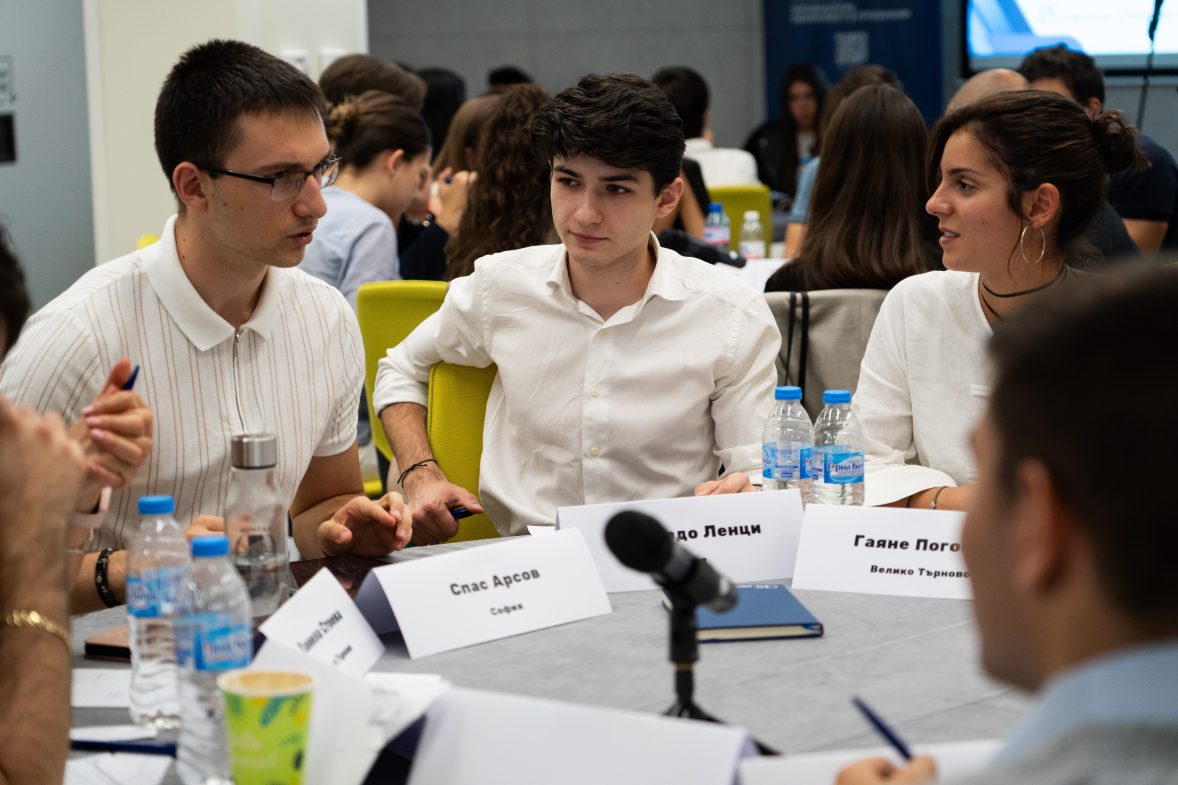
You(TH) Participate: Innovating Civic Engagement in Bulgaria Through Deliberative Democracy is more than a program—it’s a shift in mindset. Led by the Center for Information, Democracy, and Citizenship (CIDC) at the American University in Bulgaria, in partnership with the U.S. Ambassador’s Youth Council, this initiative brings a fresh, participatory approach to civic participation. At its core, the project invests in one of democracy’s most undervalued resources: young citizens. Through hands-on training, public deliberation, and leadership development, You(TH) Participate empowers university students to not only understand how democracy works but to shape how it works in Bulgaria.
Among those driving the project forward are the Democracy Youth Ambassadors (DYAs)—ten motivated university students selected to lead, organize, and inspire. These ambassadors weren’t just participants; they were co-creators of Bulgaria’s first Youth Citizens’ Assembly. Before the Assembly took place, we spoke with two of them about their experience selecting the policy question, their reflections on working with peers from across the country, and their hopes for what the deliberation day could achieve. Their insights reveal just how powerful it can be when youth are trusted with real responsibility and given the tools to lead.
Can you tell us about the process of selecting the topic?
Alexander Stoyanov: The process of selecting our topic was actually one of the most interesting parts of the project.
We had a lot of ideas — from animals and global warming to addictions and youth in general. So, we decided to vote in the most democratic way we could think of.
Each person got three pieces of paper and wrote down their top three ideas. Then we mixed them all together and pulled them out one by one to discuss as a group. After some great conversations, we ended up with our final topic: “How can we create more and better opportunities for youth employment in Bulgaria, and what role does entrepreneurship play in this process?”
Why did you choose this topic? Who suggested it? How did entrepreneurship make its way into the wording of the topic?
Elena Zaharieva: We chose this topic because youth unemployment is a challenge that affects all of us. It’s not just a statistic – it’s something many young people experience directly or see happening around them. Whether it’s a lack of job opportunities, access to training, or support for entering the workforce, it’s a problem that demands urgent attention. That’s why this topic felt so relevant and necessary.
The idea was suggested multiple times in different forms, which showed us that it resonates with a lot of people. As we refined the topic, entrepreneurship naturally became part of the conversation. That’s because an entrepreneurial mindset is one of the most powerful tools young people can use to overcome these challenges. We are a generation of changemakers, full of ideas and energy, and entrepreneurship offers a way to turn those ideas into real opportunities, not just for ourselves, but for our communities. Many young people are already thinking creatively from an early age and just need the right support to bring their visions to life.
What were the other topic ideas and why you decided not to go with them? What was the runner up topic, was there a heated debate, with what arguments?
Elena Zaharieva: We explored many different topic ideas during the brainstorming process, including important issues like addictions, sports, and opportunities for youth. Each one had strong points and could have made for a meaningful discussion. However, the runner-up topic was mental health.
There was a long and thoughtful discussion around both topics. Some felt that mental health should take the spotlight because it’s a growing concern among young people and often doesn’t get the attention it deserves. Others argued that entrepreneurship and youth unemployment, while also tied to mental health in many ways, offered a more action-oriented and empowering perspective. It focused not just on the problems we face but also on the potential we have to create solutions.
In the end, we weighed the pros and cons of both sides. The conversation was passionate but respectful – everyone had a chance to share their views. To make the final decision, we held a vote, and the topic was chosen democratically. While it was a close call, we felt that this topic allowed us to highlight the importance of mindset, creativity, and taking initiative – all things that matter deeply to our generation.
Why do you think young people in Bulgaria should care about this topic?
Alexander Stoyanov: I believe young people in Bulgaria should care about this topic because it directly affects our future. Many of us are unsure about what comes after school or university — whether we’ll find a good job, whether we’ll have to move abroad, or whether we’ll be able to build a life we’re proud of here. These are real concerns for our generation, which is why youth employment matters so much to us — it’s about our everyday lives.
Entrepreneurship gives us the chance to create our own opportunities instead of waiting for them. It encourages creativity, problem-solving, and taking initiative — all of which can make a big difference not just for individuals, but for communities and the country as a whole.
If we want Bulgaria to grow, we need to make sure there are real chances for young people to develop themselves and build a future here.
What do you expect to happen on July 15 – based on your discussions so far, do you think there will be a heated debate on the topic of youth unemployment? Along what fault lines?
Alexander Stoyanov: I do think there’s potential for a heated debate — but in a good way.
Youth unemployment is something that affects everyone, but people experience it very differently depending on where they live, their background, and their level of access to opportunities.
I expect that one of the main fault lines will be between people who believe the system should provide more jobs, and those who think young people need to take more personal initiative, for example through entrepreneurship.
I hope that even if the debate gets intense, it stays respectful and leads to real, creative ideas. After all, we all care about the same thing: making sure young people in Bulgaria have a future here.
Elena Zaharieva: On July 15, I expect a meaningful and impactful discussion – one that doesn’t just stay at the level of talk, but contributes to real change for young people in the country. The topic of youth unemployment is deeply personal for many of the participants, and because the age group involved is exactly the one experiencing these challenges firsthand, their insights will be both authentic and invaluable.
While I don’t necessarily expect a heated debate, I do think there will be strong opinions and passionate contributions. The discussion might divide along certain fault lines—such as urban vs. rural opportunities, access to education and training, or the balance between traditional employment paths and entrepreneurial alternatives. Some might emphasize the role of government policy, while others could focus on personal responsibility or innovation. These different viewpoints are a strength – they reflect the complexity of the issue and help push the conversation forward in a real, solution-focused way.
The Democracy Youth Ambassadors didn’t just step into leadership roles—they redefined what youth leadership can look like in a democratic society. Through dialogue, deliberation, and collective action, they helped create space for young people across Bulgaria to engage with real issues and propose real solutions.
Projects like You(TH) Participate remind us that civic education isn’t something that happens in textbooks—it happens in communities, in conversations, and around shared problems that demand fresh thinking.
The impact of this initiative doesn’t end with one assembly or one cohort. It lives on in every young person who now sees themselves not just as a future leader—but as a democratic actor today.