Borbala (Bori) Cox’s (’99) career changed when she decided after a decade of doing to closely examine what she could really excel at. Many people go through life without such formal inventories, as if their lives are like a flat stone skipping across a pond, making hardly a ripple.
That was not Bori’s life. After some difficult years in Romania in the mid-1990s, she rebelled against the common practice then which was to decide early on a career path, typically medicine, engineering or some other profession requiring higher education. “I had lots of interests,” she recalled at the time. “Maybe I’ll study math. Maybe I’ll go into economics. I didn’t know.”
Around that time, her parents moved the family to a small village where not much happened. Sensing the need to take charge of her own destiny, at 14 years of age she began studying English on her own.
A major turning point occurred when her high school chemistry teacher told her about her son who was studying at a place called the American University in Bulgaria which she had not heard of but was intrigued by her teacher’s enthusiastic description.
“I was told I needed to take the SAT and the TOEFL. I had no idea what they were. I had two little pamphlets on how to prepare for the five-hour long tests.”
Her interest in things American was piqued in part because of her relatively new exposure to Hollywood films. “I also liked the idea that you could be a generalist and study almost anything.”
Waiting to hear from AUBG was excruciating. It was also tough for her mother, who like many parents are invested in their children’s success. “I was so invested in going there. Like many teenagers, I was convinced my life would be over if I didn’t get in.”
“Another stressor was that in our tiny village, we didn’t have a telephone. In the end, AUBG notified us by telegram. My mom may still have it.”
All aboard for AUBG
Her life of course wasn’t over. In some ways it had shifted into a new gear. She was accepted with a full scholarship thanks to the Open Society Institute funded by philanthropist George Soros. While those scholarships no longer exist, others have taken their place, including most recently the successful Two Million Chances to Change a Life campaign which is on course to raise $1 million from donors with another $1 million to match from the America for Bulgaria Foundation. That’s a lot of change in the works.
Bori said getting into AUBG was life changing for her.
“I met my best friend there with whom I’m still in touch. We met at the Bucharest train station on the way to AUBG.”
One of the first things she noted was the international composition of the student body. She met people from Moldova, Macedonia, Serbia and Kazakhstan. There were also some American exchange students as well as several American faculty.
The professors were great, she said.
“The first semester was tough because everything was in English, but I studied hard and made great progress. I enjoyed the clubs and learned so much, especially about taking initiative but also cinema, including foreign films.”
“I was constantly asked—what are your passions? There were so many opportunities and possibilities. Romanian formal education on the other hand consisted of rote memorization, lectures and tests. Not much creativity and there were no electives.”
She took courses in math and computer science, majoring in applied economics with a minor in political science. In her last year, she applied to some PhD programs, but she questioned her own dedication to pursuing long-term research. A master’s degree was more practical.
She applied to Georgetown University for its international relations program and also the London School of Economics. In the end, she went with London because they offered a last-minute scholarship.
Off to the city that never sleeps
Another turning point came when the consulting company McKinsey came to the London campus looking for graduates interested in management consulting. “They asked if I’d interview in New York,” she said.
“I flew there and during the interview they gave the candidates case studies to analyze. One of them was about the Chicago White Sox. Trouble was I knew nothing about baseball and had never watched a game. The case study presented was how to price their season ticket packages. So, luckily, it didn’t require knowledge of the game or players or predicting who’s hit the most homeruns. The test was about how to breakdown a problem into its discreet parts; it’s never about coming up with the ‘correct answer.’”
They offered her a job and training as an analyst. “There was a group of 45 of us, and it was the best training ground out of school,” she said. “I did that for two years and realized that it was either up or out in that organizational structure.
“I moved over to Citigroup where I did strategy and business development, and then later retail banking and wealth management. We didn’t see the train wreck of the great financial crisis of 2008 coming. By 2011, Smith Barney was sold to Morgan Stanley and we went through a hard merger integration. Coming out of the crisis, I knew I loved working in the financial industry despite its ups and downs.”
Around this time after a decade in the states, she sat down with a colleague to take stock of where she was in her career.
“I felt I wasn’t on the career track I thought I’d be,” she said.
“I was successful, but there was no clarity as to the next chapter. How to rethink things? I had a mentor. The jobs I liked were closer to strategy. I was close to senior decision makers from whom I was learning valuable skills. I noticed and admired people who could quickly get to the heart of a matter and avoided paralysis by analysis, which I had also witnessed.”
Understanding what she wanted, she developed a new set of goals, joined JPMorgan and – over the next decade – eventually became chief financial officer of Consumer & Community Banking, a business that serves more than 84 million consumers and 7 million small businesses in the United States. Glass ceilings had gotten higher, and she was among those who elevated them.
“I’ve noticed that women in higher positions are more common now than when I started. Of 45 women students in my class at LSE, only three of us were women. There was one economics professor. I learned then that as a woman you have to claim your seat at the table.”

Worldwide obligations
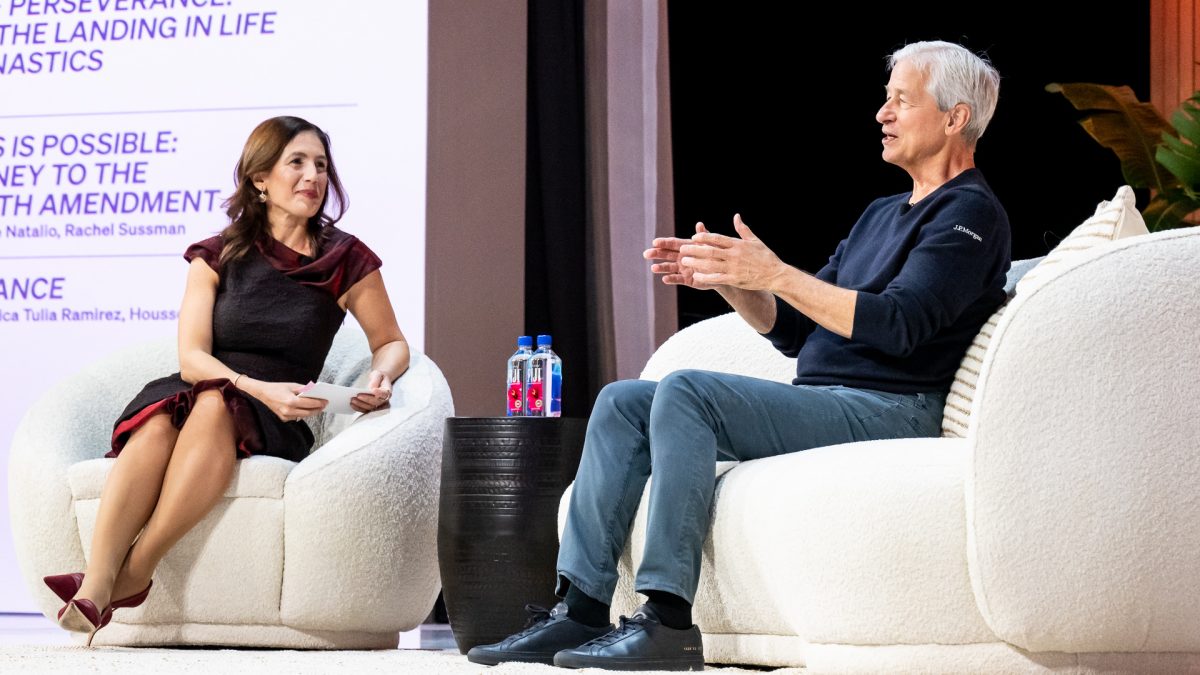
Her responsibilities are global with employees working in five core locations in the U.S., as well as India, which she includes in her busy travel schedule. Communicating company goals and market changes are important and she regularly conducts employee town halls and shares a monthly newsletter. “The more far flung your operations, the more you need to communicate.”
When not at work, Bori lives in Manhattan with her husband and their 10-year-old daughter. She swims and takes walks in nature for fun and exercise. Despite her busy life, she visits Romania every year.
“It’s amazing how the region has developed since I was a child there. The current political situation in the region in concerning but I think the pendulum is swinging in the right direction. In the long term, I’m very optimistic and who wouldn’t be with institutions like AUBG serving young people in the area.”
Now it seems like a long time ago when the AUBG part of her life began at that train station in Bucharest. She has never forgotten this turning point and continues to contribute through personal donations and that most precious of all gifts—her time and expertise as a new member of the University Council.
Although no date is set, it’s likely there will be another 10-year reckoning ahead because she does not lead a flat stone-skipping across the pond kind of life.