AUBG gets a new reading through the documentary The Birth of Change, written and produced by Georgi “Starcheto” Iliev (‘96) and directed by Kiril Tsenov. Starcheto was tasked with translating the vast history surrounding the origins of AUBG and presenting it on screen for both the insider community and outsiders looking through the peephole at a transformative moment that paved the way to freedom.
“One of the things that came from my journalistic education at AUBG is that I didn’t want to make a puff piece,” says Starcheto.
“I never wanted to make a celebration of AUBG as a PR document. I wanted to tell the story with all its struggles, tragedies, and mistakes alongside its triumphs. And this doesn’t diminish the university at all. On the contrary, in the discussion, the real truth is revealed, and it is multicolored.”
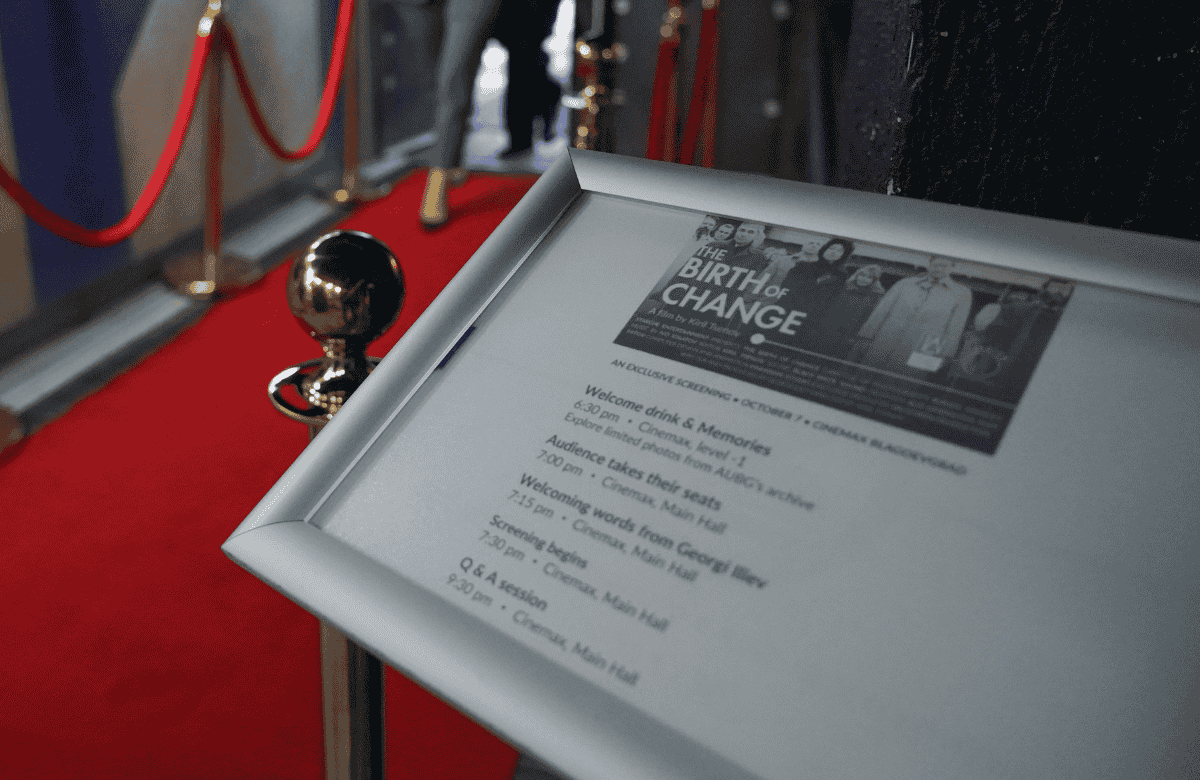
The AUBG community got a first look at the film on October 7 at Cinemax Blagoevgrad during an exclusive screening. What we saw was a story many of us hadn’t heard before in its entirety, with new layers adding nuances to the bigger picture. It’s a story we all need to hear.

Big idea for a new era
Several people sat down and started discussing an idea. An idea for an educational institution that would offer something completely different in a region with a newfound freedom. An institution that would serve as a bridge between two worlds and, hopefully, spark a ripple effect in the mentality and opportunities of the people around it.
A few big visionaries imagined an American university in Bulgaria. They had the idea but lacked everything else: the funding, the buildings, the desks, the professors. Eventually, they secured the funding, but the bigger challenge proved to be navigating the post-communist environment of early 1990s Bulgaria.
The Birth of Change tells not only the story of AUBG’s founding but also of the concoction of an entirely new mentality, new connections, and a new symbiosis between Bulgaria and America.
“The intention of the movie is to provide the bigger picture and explore loftier, more universal themes beyond this particular story,” says Starcheto. “As riveting as it is, it draws from much larger ideas that are still relevant to this day, sadly or not.”
The movie unfolds across several intertwined storylines: that of AUBG itself, of the power of wilful individuals, and of both Bulgarians and Americans stepping outside their own bubbles to make this vision a reality.
Between two worlds
For those in the movie theatre, many with personal ties to AUBG, the film struck a deeply sentimental chord. They saw the campus in its earliest days, the first dorm Hilltop that no longer operates, and familiar faces like AUBG’s first presidents, the longest-serving professor Dr. Robert Phillips, and alumni from the first and second graduating classes.
For these viewers, AUBG means something different now. They are part of an institution that has evolved, reshaped itself, and transformed once again. We’ve seen presidencies change and students come and go, yet what was written in those very first founding documents, the inscription of what AUBG stands for, remains.
The letters that the first Operations Director personally cut out and placed atop the Main Building still stand as a testament: they blended two cultures into one – the Soviet past and the American dream. And both continue to coexist inextricably.
Catching the vortex of change
It was an interesting time. People were building an institution in the dark, regimed by the unknown bureaucracy of a newly post-communist country, power struggles between local authorities, institutions, and political parties, and the blindfolded vision of several Americans for a country they knew very little about. It was a time of adjustment, and, as the movie suggests, there couldn’t have been a better moment to establish AUBG. A day later would have been too late. They caught the vortex of uncertainty, dove in, and somehow managed to rise to the surface waving the flag of victory.
“What they attempted to do in their dreams totally paid off. It completely triumphed over every adversity,” says Starcheto.
Thirty-four years later, AUBG still stands; its letters now slowly rusted by time, hinting of the past.
“We didn’t know if there would be AUBG tomorrow,” says Deyan Vasilev (‘95), alumnus and founder of MoitePari.bg. Students lived in uncertainty but also in hope, driven by a thirst for knowledge. They were eager for the new, and that’s what kept them at an institution that was being built alongside them. Together with them.
Dr. Julia Watkins, who served as AUBG’s president for a decade, recalls someone once telling her: “AUBG is building an airplane while you’re flying it.”
The voices of the past
Interviewing those who were there from the very beginning brought emotional and unexpected discoveries for Starcheto. “These people were literally putting their lives on the line. For them, this is a delicate and well-guarded personal past, so you try not to come across as a detective wanting to extract information,” he explains.
The movie segues into AUBG’s earliest days through the eyes of its first students and professors. We learn about the creation of Bulgaria’s first commercial radio station, Radio Aura, interwoven with the story of the notable Christo Grozev (‘95). The movie also revisits the humble beginnings of Panitza Library, which started with just 30 books but opened a new world for students encountering American literature for the first time. They devoured those books.
We also hear about the professors whose teaching introduced new formats unknown to the high-schoolers bred in rigid educational systems.
A university of firsts
It was a university of many firsts. It still is. And we continue to live in anticipation of how it will flourish. What new inventions will emerge? What visionaries will rise to change the world, as so many have done before them?
It’s a strange institution to be residing in Bulgaria. It almost feels like a mirage, a story from a beautiful documentary told on the screen.