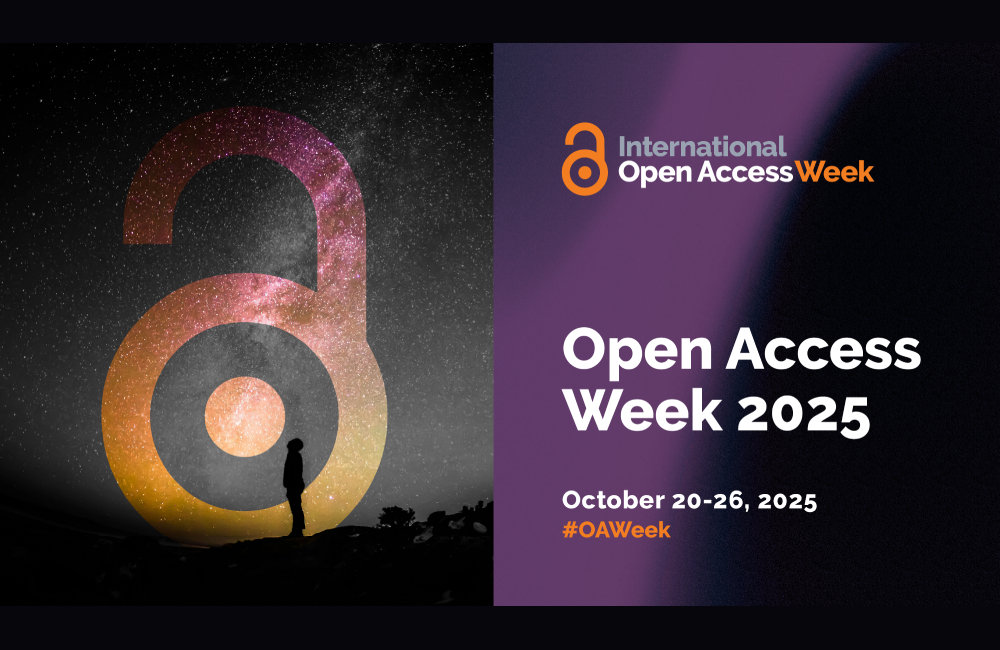
This week many academic organizations, scholars, libraries, and research institutions across the world celebrate the Open Access Week. This global event provides an important opportunity to spark new conversations and foster collaboration across research communities, helping to build more equitable foundations for open knowledge.
The Open Access (OA) movement advocates for free and open online access to academic information, including publications and research data. A publication is considered open access when there are no financial, legal or technical barriers to its use – meaning anyone can read, download, copy, distribute, print, search, or use the content for educational or other lawful purposes.
Open Access is a rapidly evolving model for scholarly communication that offers significant benefits for researchers – such as increased visibility, citation impact, collaboration, and the reuse of research results. At the same time, it calls for continued attention to maintaining the quality and integrity of scholarly work.
This year’s theme asks a pointed question about the present moment and how, in a time of disruption, communities can reassert control over the knowledge they produce. It also challenges us to reflect on not only who has access to education and research but on how knowledge is created and shared, where it has come from, and whose voices are recognized and valued.
To learn more about OA and the different publishing opportunities available, you are more than welcome to visit us at Panitza Library or schedule an individual consultation. You can also explore our Open Access LibGuide for more information and resources.
Print books:
- Baldwin, P. (2014). The copyright wars: three centuries of trans-Atlantic battle.Princeton, New Jersey. K1420.5 .B359 2014
- Christensen, G., Freese, J., & Miguel, E. (2019). Transparent and reproducible social science research: how to do open science.Oakland, California. Q180.55.S7 C47 2019
- Grindrod, P. (2020). Leading within digital worlds.Bingley: Emerald Group Publishing Limited. HD30.2 .G75 2020
- Kelty, C. (2008). Two bits: the cultural significance of free software. Durham: Duke University Press. HM851 .K45 2008
- Kimball, D. (2022). Net neutrality and the battle for the open internet. Ann Arbor: University of Michigan Press. HE7645 .K453 2022
- Langer, A. (2024). Information technology and organizational learning: managing behavioral change in the digital age. Boca Raton: CRC Press. HD58.82 .L33 2024
- Leitch, T. (2014). Wikipedia U: knowledge, authority, and liberal education in the digital age. Baltimore: Johns Hopkins University Press. LC1011 .L44 2014
- Pearce, J. (2014). Open-source lab: how to build your own hardware and reduce research costs. Amsterdam; Boston: Elsevier. Q185 .P43 2014
- Slauter, W. (2019). Who owns the news? : a history of copyright. Stanford, California: Stanford University Press. Z652.N4 S57 2019
- Williams, K. (2022). Doing research to improve teaching and learning: a guide for college and university faculty. New York, NY: Routledge. LB2326.3 .W55 2022
When off campus, please enter your credentials to access e-books and articles.
E-books:
- Baldwin, P. (2014). The Copyright Wars: Three Centuries of Trans-Atlantic Battle. Princeton University Press. Jstore
- Guibault, L., Angelopoulos, C., Tsipouri, L., & Stenius, V. (Eds.). (2011). Open content licensing: From theory to practice. ProQuest Ebook Central
- Jhangiani, R. S., & Biswas-Diener, R. (Eds.). (2017). Open: The Philosophy and Practices that are Revolutionizing Education and Science. Ubiquity Press. Jstore
- Simpson, O. (2012). Supporting students for success in online and distance education: Third edition. ProQuest Ebook Central
- Shank, J. D. (2014). Interactive open educational resources: A guide to finding, choosing, and using what’s out there to transform college teaching. ProQuest Ebook Central
- Chandler, D., & Fuchs, C. (Eds.). (2019). Digital Objects, Digital Subjects: Interdisciplinary Perspectives on Capitalism, Labour and Politics in the Age of Big Data. University of Westminster Press. JSTOR
- Sætra, H. S. (Ed.). (2023). Technology and sustainable development : The promise and pitfalls of techno-solutionism. CRC Press LLC.
- Greifeneder, R., Jaffe, M., Newman, E., & Schwarz, N. (Eds.). (2020). The psychology of fake news : Accepting, sharing, and correcting misinformation. Taylor & Francis Group.