Simona Atanasova didn’t plan to work in public health.
She once thought she’d become a dentist. But that idea quickly gave way to a broader purpose—one rooted in community, equity, and impact.
Now a technical officer at the World Health Organization (WHO) in North Macedonia, Simona, a 2012 graduate of the American University in Bulgaria (AUBG), works on key priorities like the World Health Organization HO European Programme of Work, bringing best health practices into schools and preventing gender-based violence.
Her path took her from a small town in North Macedonia to classrooms in Bulgaria and the United States—and into a career focused on systemic change.
When a devastating nightclub fire in Kocani claimed dozens of lives last March, it reinforced the urgency of her work. “It was a failure of systems, not just of individuals,” she says. “And failures like that are preventable.”
The fire has now claimed its 61st victim—a young man who died this week in a Lithuanian hospital. Many others remain in critical condition. Thirty-four people are in custody, including senior police officers, and could face long prison terms if convicted for contributing to the tragedy.
For Simona, the incident felt close to home. She didn’t know the victims personally but knew many people who did. One of the victims was a student at AUBG, where a memorial was held in her honor, attended by her parents and hundreds of others from the AUBG community.
Given Simona’s work in public health, which includes unintentional injuries and accident prevention, the tragedy served as a reminder of the importance of strong systems to keep people safe.
A journey begins
“I first heard about AUBG from a high school friend,” she recalls. “I was originally thinking of becoming a dentist, but I also had a growing interest in political science, which had been sparked by volunteer work I was doing at an NGO.” The university’s regional diversity and reputation for academic rigor helped tip the balance.
Her early exposure to English, starting in the fifth grade, was enriched by meaningful interactions with American Peace Corps volunteers in her small town. “They gave me books and spoke to me in English,” she says. “More importantly, they made me feel like I had the potential to do something greater.” Their encouragement, coupled with her own drive, helped solidify a sense of purpose that AUBG would later amplify.
Coming from a modest background where higher education wasn’t the norm, Simona—encouraged and supported by her family—sought financial assistance to pursue her studies. She received an Open Society Foundation scholarship covering most of her costs and worked during the summers to bridge the rest—balancing loans, job responsibilities, and academic ambition.
Over several consecutive summers, she found herself on Nantucket Island in Massachusetts.
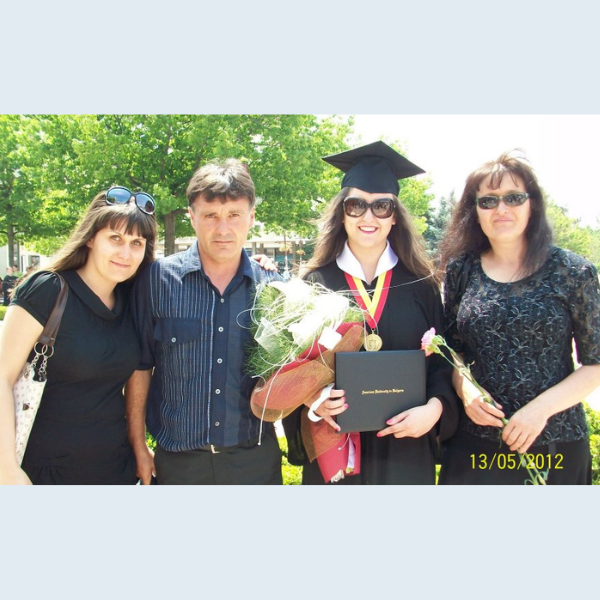
“It was a completely new environment,” she says. “I arrived with other Macedonian students and was struck by the cultural contrasts, especially around attitudes toward money and discipline.”
Her summer job experiences—ranging from retail to hospitality—weren’t just about financial independence; they were part of a broader education in navigating different worlds and learning to adapt.
Expanding horizons
After graduating from the AUBG and spending a few years working to support people living with HIV in North Macedonia, Simona was awarded a Fulbright Scholarship to pursue a Master of Public Health at the Johns Hopkins Bloomberg School of Public Health in Baltimore, Maryland.
“AUBG gave me such strong preparation. The writing, the debating, the way we were encouraged to think critically—it pushed me outside my comfort zone and gave me the tools to succeed in new environments.”
While at Hopkins, she worked on research focused on health access for Roma women in rural parts of North Macedonia. “We looked at ways to improve outreach and service delivery. Many of these communities face serious barriers to health care, from geography to discrimination,” she explains.
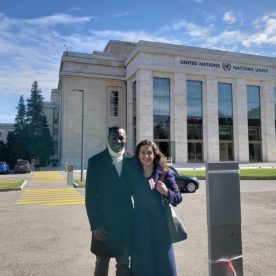
AUBG Simona Atanasova and a colleague from JHSPH in Geneva
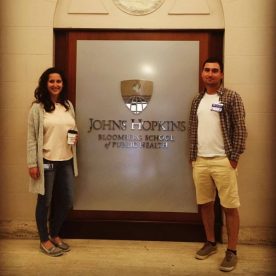
AUBG Simona Atanasova at John Hopkins
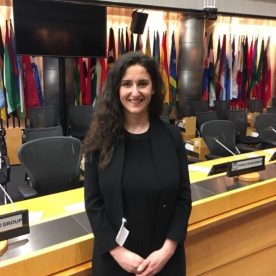
AUBG Simona Atanasova at the World Bank
Her commitment to equity in public health has continued into her work with the WHO, where she now works with a small team focused on a wide spectrum of issues—from elderly care and nutrition to systemic policy reform.
Systems, not just symptoms
“There are so many factors that shape health outcomes,” she explains. “From climate change to weak institutional coordination, the challenges are vast—and the solutions require systemic change.” Much of her work involves aligning government policies with global best practices, building bridges between ministries, and promoting integrated approaches to health.
She speaks proudly of work she led during her time at the Ministry of Health to improve services for older adults living independently. “We noticed that many had bags of medication but didn’t understand what the medicines were for—so they simply wouldn’t take them,” she recalls.
“We introduced home visits by health and social workers to help people manage their treatment with follow-up support.”
At WHO, her work continues to focus on strengthening systems and bringing services closer to people. “In one case, I supported the North Macedonia Ministry of Health to improve access to care by introducing clinical protocols and care pathways, alongside training for general practitioners to manage more conditions at the primary care level—reducing the need for referrals to specialists. “It was about making sure people could receive quality care closer to where they live,” she says. “This approach reduced barriers for patients and made services more responsive to everyday needs.”
A preventable tragedy—and a call to action
Returning to the nightclub fire, Simona doesn’t mince words. “When I put on my public health hat, it’s clear how many failures there were. One exit for patrons, falsified licenses, dangerous overcrowding, underage guests—it was a tragedy waiting to happen,” she says. “Emergency services did their best, but there were serious gaps .”
For her, these issues are not isolated. “We see preventable accidents all the time—from children biking without helmets to construction workers without safety gear,” she says.
“The standards often exist on paper. What we need is enforcement.”
Today, Simona balances her career with life as a mother and partner. She and her husband, a veterinarian, have a young son and run a pet store in her hometown, managed by her retired father. “It’s a way of staying connected to our roots,” she says.

Simona Atanasova in Nantucket

Simona Atanasova's son and the AUBG Mascot Skappy
She recalls how, as a child, her mother would call her home from the balcony: “Simona!” echoing across the playground where she and her friends played make-believe shopkeeper.
“We’d collect bits and pieces of junk and pretend we were selling them—it was imaginative, resourceful. We didn’t have much, but we made the most of it.”
That early spark of creativity and independence wasn’t a footnote to her story—it was a starting point. One that shaped a woman who, through vision and effort, built a meaningful life at the intersection of policy, community, and care.