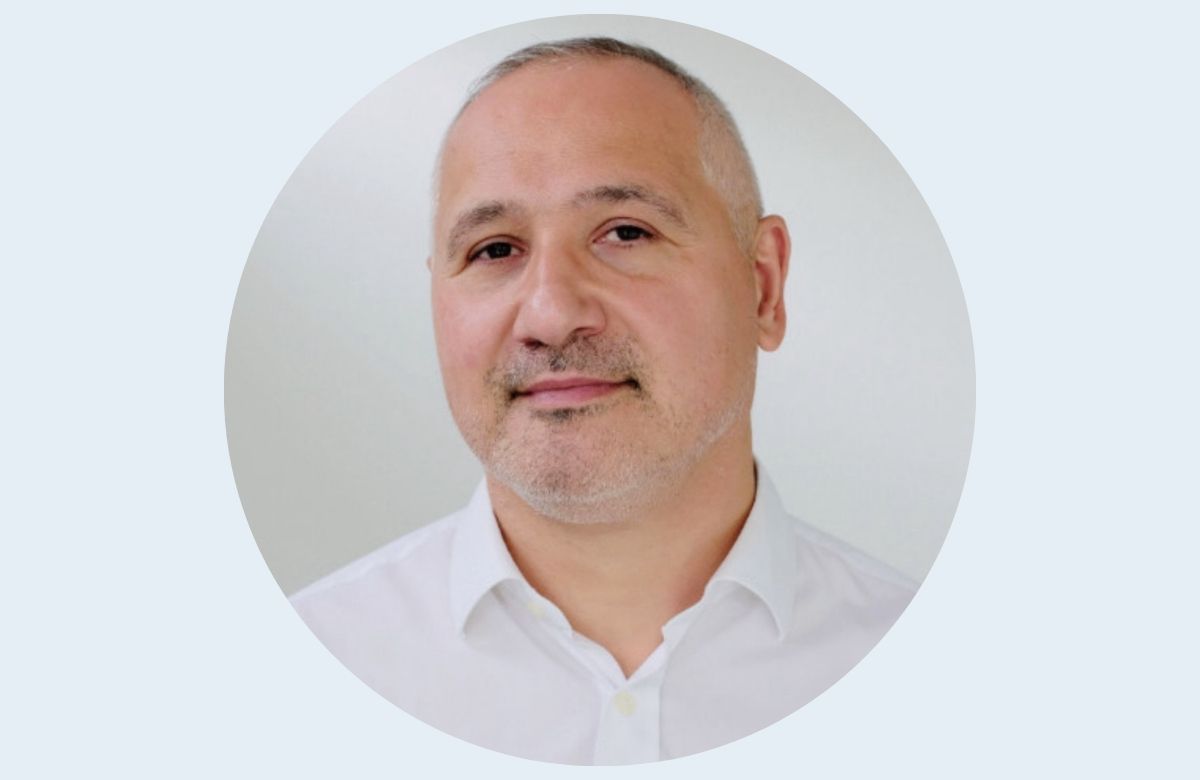
Plamen Monovski was a member of the first class to graduate from the American University in Bulgaria in 1995. He’s now one of more than 6000 graduates who, despite the small size of the university, have left an impressively large legacy for Bulgaria and the world.
Thinning hair with a touch of gray suggests that he and his class of graduates are soon to be the first members to reach retirement age, though as an asset manager with his own London-based firm he has no plans to rest anytime soon. He relishes the life-changing events, including his decision to attend AUBG that made him the person he is today.
“I was part of the first wave of college age students when the Berlin Wall fell. I had just finished two years of obligatory military service under the Communist system. Everything around me was changing. What would I do?”
An answer came when he won a government scholarship to Sofia University by winning the National Olympics in Literature, a competition for “gifted kids” that provided a free pass to a national university.
“I got there and after some time felt like I wasn’t learning anything. I got interested in an American education, especially the liberal arts, because I believed that Bulgarian and, more broadly, European pedagogy would not meet my needs.”
Plamen went to the U.S. embassy to research American colleges and universities. There was no Internet then, so he began to read a massive catalog of all the American institutions. “I settled on Thomas Aquinas College in Santa Paula, California because of its emphasis on Great Books and the liberal arts. I submitted my application. To my surprise and relief, they accepted me and offered me a scholarship.”
There was one problem: he couldn’t afford the airplane ticket. “My parents had saved for years to buy my brother and I a flat. By that time in Bulgaria, hyperinflation had hit and the value of their money vanished, wiping out their life savings in a few months.”
Somehow the money for the ticket appeared. “The university said that a person would meet me at a certain bus stop. You are fearless when you’re young and I believed everything would turn out okay, which it eventually did.”
He spent two years there and loved it. Returning to Bulgaria for personal reasons, he was delighted to discover that an American-style university was opening in a town 90 minutes by car from Sofia. He was accepted as a transfer student and became a member of the first class.
Socrates to the rescue
“It was my first exposure to economics. I had to learn by doing, a kind of ‘fake it until you make it.’ Because my previous college in California featured the Socratic dialogue teaching method, I had a good base for doing well at AUBG. I was swimming in the same aquarium because of the emphasis on analysis and dissecting information.”
Plamen felt that he lucked out because not only were the academics topflight, but many visiting professors from the States came to AUBG because they wanted to experience Eastern Europe after the fall of Communism. But the best part was the students.
“I liked that students worked in groups. At that time, Bulgarians aren’t natural networkers and community builders, so this approach was new to me.”
“I loved the diversity of the students. There were many Albanians who were very studious. This came as a shock to me because we Bulgarians had many prejudices against our neighbors, thinking Albanians were backward and drove donkey carts. But they were the best students, and we became friends.”
London calling
After graduation, he got a job with Coopers and Lybrand. He felt limited in Bulgaria, so he applied to the London School of Economics where he received a Chevening Scholarship from the British government, one of only two given each year.
After receiving a Master’s degree, he went to work for Mercury, the premier asset manager in the UK and Europe and one of the top worldwide. “I got thrown into the deep end. Fresh out of school. And I ended up on the emerging markets desk where I received baptism by fire.”
The fire was the Russian financial crisis in 1998 where the country defaulted on its domestic and foreign debt and its financial markets collapsed. Then President Boris Yeltsin had tanks shoot at the Russian parliament. And this is how he got his first taste of Emerging Markets.
But nature favors the bold and Plamen realized that the path to success required convincing investors that assets were selling at impossibly low prices and the upside of such investment is immense. A hard sell at the time but a brilliant one with hindsight as a more than a 10-year bull market in emerging market assets ensued.
That insight and a distinct investment process led Plamen’s team to a worldwide success becoming the largest and best performing investment manager of their type, with $10 billion of assets in Eastern Europe alone. The Mercury business was acquired by Merrill Lynch and then by Blackrock. That acquisition laid the foundation for transforming Blackrock into the largest money manager on the planet. Due to his investment and business success, Plamen was made the youngest managing director at Blackrock.
“I learned important lessons and they turned into our technology of investment. Buying assets in emerging markets is like a sale in a shop. You need to know you’re not buying a lemon. To know that you need to dig deep and know decision makers at the highest levels of local politics and economics. And then realize that you have to have the psychology to stand by your convictions: investment cycles are long; you need the stamina not only to stay the course but the skill to be on top of the wave at all times.”
For the last 10 years, Plamen has been an angel investor with a portfolio of companies in biotech, fintech, artificial intelligence, climate tech, fusion and aerospace.
Plamen’s role model is the billionaire philanthropist Andrew Carnegie. “Required reading for CEO’s should be his book “The Gospel of Wealth”, where he declares he will give away all of his wealth. He remains one of the few who actually did what he said he would.”
Were there any surprises during this period? “In the late 1990’s, those of us working in emerging markets were evangelical in our belief that we were playing a helpful role during the transition from Communism with its losing focus on uncompetitive, bloated state-owned enterprises. The simple principles of transparency and accountability, long at the heart of the capitalist market, gave investors chasing shiny objects the confidence to invest. The emerging markets desperately needed the investment to stave off complete disaster and to begin their recovery.”
“What surprised and disappointed us was the belief that democracy would naturally accompany changes in the economic system. That proved a naïve assumption, and it remains so.”
Twilight of the authoritarians?
Nowhere else in the world was that assumption more apparent than in Vladimir Putin’s Russia where transparency and accountability went against his interests. “He went rogue. And so did many other leaders of the emerging world who were initially reformers and passionate advocates of democracy. During the course of my long career, I have met most of the top brass in more than 20 countries and have concluded without any doubt that democracy and prosperity are married at the hip.”
“If you look around, many dictatorships are doing badly economically. Turkey is in trouble with runaway inflation. Hungary is at the bottom of the European rankings. China’s Xi does not seem to understand the relationship between the free flow of information, a strong independent business sector and freedom. What people do not understand about authoritarianism is that there are no property rights. You, as an entrepreneur, own nothing. Even if you have a successful business, it can be taken from you at any time.”
He pointed to one such case in recent weeks where Chechen leader and friend of Putin Ramzan Kadyrov and friend of Putin, along with some Chechens in the employ of Putin turned up at a business near the Kremlin, killed two security guards and grabbed a chunk of the business from the owner, Tatiana Kim, Russia’s richest woman. She is the founder of Wildberries, the Amazon of Russia, and victim of what appears to be a forced merger. According to the Moscow Times newspaper, “The merger may also be part of Russia’s wartime redistribution of business assets that has benefited business figures linked to the Kremlin.”
Among Plamen’s many worries is the future of Bulgaria. “Putin’s Russia casts a long shadow and is interfering in its neighbors’ business. To avoid moving backwards, AUBG alumni need to help build democratic networks. Fight the mafia. Get more involved in politics and business. Get elected to public office.”
He credits the Bulgarian diaspora, including many graduates of AUBG, for providing indispensable technical assistance and investment capital. But more needs to be done. “We haven’t united in a way that fully leverages our capabilities. If we don’t unite more, we’ll be rearranging deck chairs on the Titanic.”
“We need to unite around initiatives like investigative journalism, critical thinking, and opposition to disinformation. We can’t be anonymous in our support for Bulgaria’s democratic institutions and civil society.”
Never mind the talk of retiring. Who best to help with the uniting than members of AUBG’s first graduating class for whom the fire in the belly has burned brightly for many decades?