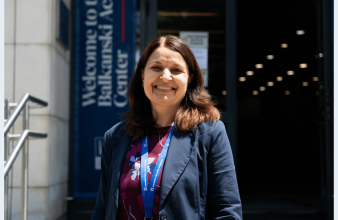
Petia Goolamallee (’04) is a Program Officer Employment and Entrepreneurship in the Trust for Social Achievement. For her, advocacy is of paramount importance to the work of the organization. It is through advocacy that their programs make a difference, extend their impact and achieve a long-term effect on public policies and institutional practices.
Petia’s program “Employment and Entrepreneurship” has defined advocacy goals to be addressed in both the short and long run for the communities TSA serves, the team is working with individuals and organizations on the way there and uses every opportunity to further its advocacy knowledge and skills.
Petia Goolamallee, an AUBG graduate in Business Administration and the 2004 Commencement Speaker, participated in the AUBG Advocacy Academy, in partnership with the Bulgarian Entrepreneurial Association (BESCO), during the spring of 2024.
Read more about her takeaways in her story below:
Personal impressions
At the Trust for Social Achievement we are no strangers to the concept of advocacy, having advocated successfully for more than 10 years and having achieved some considerable legislative changes such as the removal of kindergarten fees in Bulgaria. Yet, the AUBG and BESCO Advocacy Academy was a truly all-encompassing experience, an amazing deep dive into the world of advocacy and public policy.
The structured approach taught there reminded me again that sustainable change is achieved through a cycle of multifaceted and persistent effort – strategic meetings with policymakers, data-driven presentations, collaboration with stakeholders from literally all sectors. The Academy corroborated the notion that advocacy isn’t just about being vocal in public spaces; it’s also about understanding legislation complexities, building relationships with key decision-makers, and presenting compelling, evidence-based arguments.
This powerful perspective will surely lead to a more nuanced approach in my future advocacy efforts. I already had the chance to present a comparison between the approach to advocacy in the EU and the way it is done in Bulgaria to my colleagues at the Trust where I shared many of the learnings of the Academy – we had a very fruitful discussion in the team, which is sure to further boost our work in the area and, I hope, will substantially increase its impact.
Takeaways
Incorporating the skills and knowledge gained from the Advocacy Academy into my role at TSA involves a blend of strategic planning, coalition building, effective communication, and continuous evaluation. By applying these principles, I believe I will be able to help create sustainable change in the area of economic resilience for underserved communities, ensuring that our advocacy efforts are both impactful and aligned with their needs.
The Academy emphasized the importance of strategic partnerships and coalition building and this was demonstrated through the many examples and roleplays we had.
In my current role, I will leverage these skills to create stronger coalitions with other NGOs, businesses, and community organizations to amplify our advocacy efforts in the areas of employment and entrepreneurship of disadvantaged groups.
Another crucial aspect of advocacy is clear and compelling communication – the skills gained in the Advocacy Academy will help me craft our messages in ways that resonate with different stakeholders. Understanding how to navigate the complex policy landscape is another key component that was emphasized. I had a number of fundamental takeaways from our lectures on how to best approach this and I am already using this knowledge with regard to choosing our approach with government bodies, officials and administration.
Last, but not least – media – such an important advocacy tool! We will work to enhance our presence in social and traditional media in order to draw attention to the barriers facing marginalized groups in accessing employment opportunities, shift public perception and build broader support for our causes.
Impact
Well-trained advocates are essential for a functioning democracy. They can articulate the needs and concerns of various communities and push for reforms that benefit society as a whole. Over time, this contributes to a more participatory democracy, where citizens are active stakeholders in the decision-making process, leading to more inclusive and representative governance.
The Advocacy Academy equipped us, the participants in the first cohort, with the knowledge, skills, and tools needed to effectively engage in advocacy.
I would even say it represents a training of a new generation of leaders who understand the intricacies of policy-making and public engagement, and this empowerment will ideally foster a culture where individuals feel capable of influencing change, rather than feeling detached or powerless in the face of systemic issues. In a nutshell, the Advocacy Academy has the potential to be a transformative force in Bulgaria. Over time, I trust this will lead to a more inclusive, transparent, and participatory society, where active citizens play a central role in shaping the future of their country.
Highlights
The first cohort of the Academy was comprised of absolutely brilliant, truly unique professionals each of whom brought and shared generously their valuable experience, knowledge and perspective. I was amazed to meet and exchange ideas with all of them, used all opportunities to do so, and learnt a lot from everyone. From history and culture through politics and economics, we were able to put our heads together and generate a multitude of interesting, challenging and promising ideas.
I have already put this knowledge and network into the practical aspects of my work and have engaged in a number of brainstorming sessions with some of my Academy colleagues – and felt truly inspired by their outcome! Networking and collaborating opportunities were many – both formal and informal, and I warmly welcome the idea of having a strong Alumni Community where we will further expand our advocacy efforts, build on the support and friendships created, and work to create meaningful social impact.
Piece of advice
My aspirations for the future include further learning, growing as a leader and inspiring others to create a positive social change. After the Academy, it has become a belief of mine that the art of advocacy should be taught in schools. In that aspect, learning how to advocate is something all of us should be familiar with.
In a more specific context, I would recommend the Academy to anyone passionate about social change, human rights, environmental issues, or any cause they believe in.
Activists of any age, students of political science, business leaders, media experts, government and public sector officials – all these professionals will find the knowledge and skills they will gain in the Academy incredibly useful. I would advise them to enter the Academy with an open mind, ask questions and be ready to learn and absorb.
The networking and relationship building opportunities with unique, experienced and knowledgeable individuals abound, so I would recommend taking advantage of this opportunity as well. Focus on effective communication is fundamental, hence, practicing this skill in the Academy is invaluable.
Last, but not least – an important takeaway for me that I would like to share with future Advocacy Academy participants and with anyone interested in the topic in general, is that advocacy takes time. So stay resilient and persist.