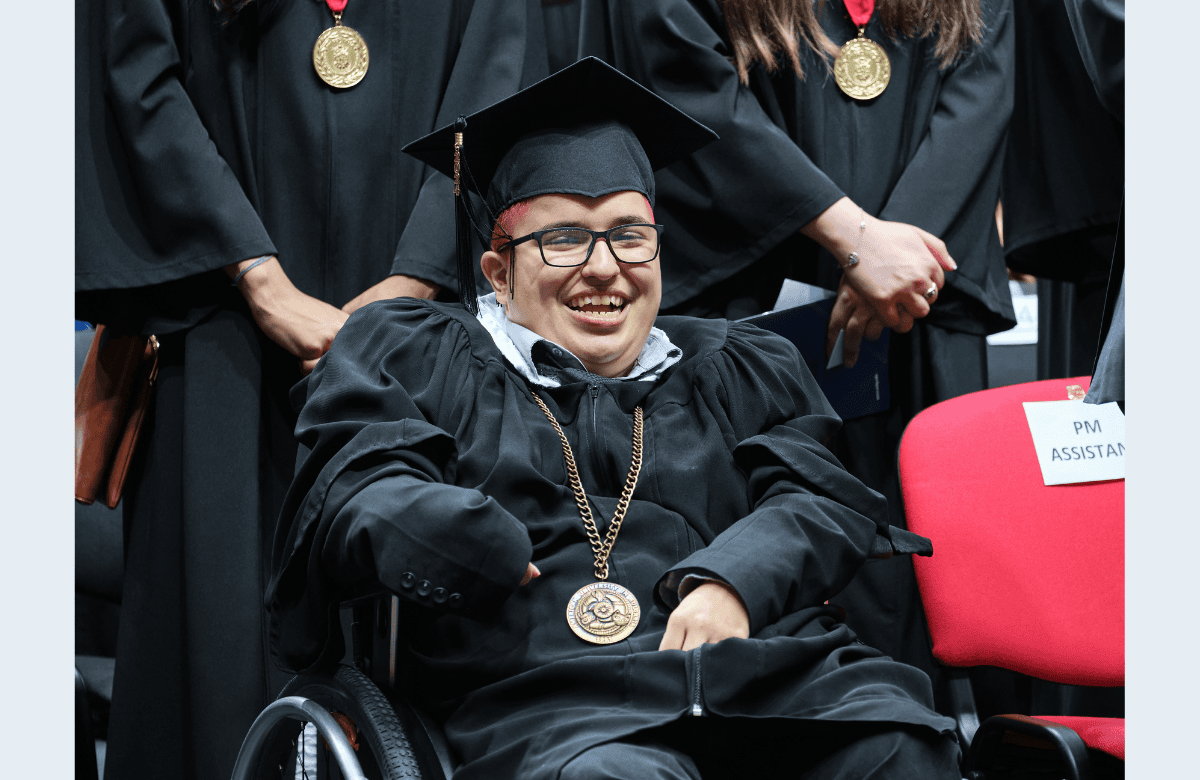
Maria Alexandrova is a young person with an undeniable creative spirit, filled with hopes and dreams of making the world a better place.
Immersing herself in comics and role-playing games that fuel her imagination, Maria has discovered her most powerful outlet – storytelling. This passion led her to pursue a degree in Journalism and Mass Communication, alongside Political Science and International Relations.
Her personal story is one of inspiration and empowerment. As the first person with Cerebral Palsy to sit for and pass the Cambridge Advanced English exam, an AUBG Presidential Medalist and esteemed alumna, a UNICEF Inclusive Education Advocate, and now AUBG’s Presidential Fellow for Accessibility and Belonging, Maria is one of the brightest young people I’ve met. Here is her story.
A foundation built on strength and love
Maria grew up in a loving household. Her mother Zornitsa’s unwavering support empowered her to become an advocate for good.
While Maria had no choice but to be open about her disability, it did not deter her from dedicating herself to community work and paving the way to a more inclusive society.
“Unfortunately, I didn’t have the luxury to keep my disability private. As you can see, I’m a wheelchair user. So, I was essentially a walking manifestation of your typical disability presentation,” Maria shared.
“Would I have wanted to become open regarding this? Yes, but I didn’t have a choice in the matter to begin with,” she added.
Passing the Cambridge English Exam and entering AUBG
One of Maria’s earliest academic victories was challenging the University of Cambridge to adapt its Advanced English examination to her specific needs and successfully passing it in 2018. You can read more about her experience in a blog post she wrote for U-Report.
Unfortunately, according to UNICEF, 49% of children with disabilities are more likely to have never attended school compared to their peers without disabilities. This drastically reduces their chances of pursuing secondary or higher education.
“Data like this only highlights the need for belonging of all marginalized groups in every aspect of society. Young people deserve to inherit a more diverse and just world. We are the key to that better future. In that vein, belonging is more than a buzzword. It means ensuring our participation in decision-making at every level,” she explained.
Maria’s success in the Cambridge exam not only opened new avenues of accessibility for people with disabilities but also enabled her to pursue higher education at AUBG, her dream university, on a full scholarship.
“Higher education is still a pipe dream in many contexts. I’m fortunate to have had the chance, but even getting here was a struggle,” she explained.
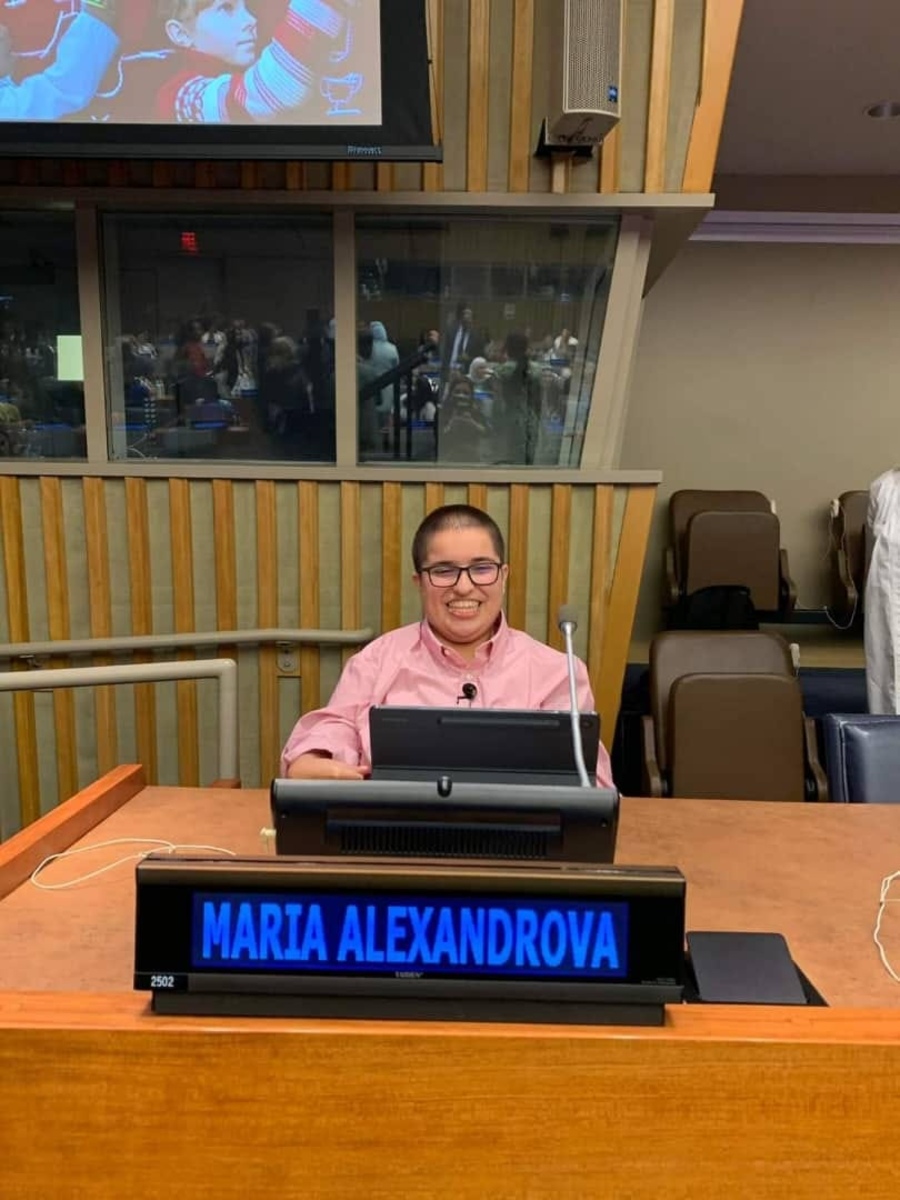
Maria at the Transforming Education Summit UNGA 2022, Personal archive
A love for storytelling
At AUBG, Maria honed her skills in written, visual, and audio media, deepening her love for storytelling.
“I think I was mainly drawn to JMC over advocacy because, for me, storytelling is the most powerful tool for changing societal behavioral patterns,” she explained.
As AUBG’s Presidential Fellow for Accessibility and Belonging, Maria is dedicated to fostering an open and tolerant campus environment. She is working on organizing events that are “fun, cooperative, and educational”, such as movie nights showcasing films that highlight the struggles and achievements of the global disability community.
“The idea is to educate people on basic terminology related to the field of disability studies. You don’t have to be a psychologist or expert to understand the origins of the term ‘disability’ or where it came from,” Maria shared.
She believes that film and discussion are the perfect mediums for engaging students, but she welcomes all forms of self-expression. “If any readers have ideas, I’d be more than happy to collaborate,” she said.
Maria emphasizes that these events aim to raise awareness without spotlighting individuals unnecessarily. “People with disabilities deserve the right to maintain their privacy,” she said.
From storytelling to policy
Another key focus of Maria’s work is developing policies – a more structured form of storytelling.
“By the end of my one-year mandate, I hope to achieve a functioning policy. Most of the groundwork has been laid,” she said.
Creating policies at AUBG is not without challenges. The university must balance compliance with Bulgarian/EU legislation and American regulations to maintain accreditation.
“In a perfect world, I’d have a detailed policy like those at Oxford, Stanford, and other Ivy League schools. But given our context, we’re striving for the best possible middle ground,” Maria explained.
Part of her work also involves building a research library of academic papers and policy tools, fostering collaborations with NGOs and other stakeholders, and making campus more accessible.
Maria’s role extends beyond supporting people with disabilities. “Although my main focus is disability belonging, my position encompasses accessibility and belonging for other marginalized groups, including the LGBTQ+ community.”
Maria is deeply aware of the responsibility she carries to represent AUBG’s colorful and diverse community. “Even if the results aren’t what people have hoped for, I want everyone to know they have at least one advocate in me within the staff,” she encouraged.
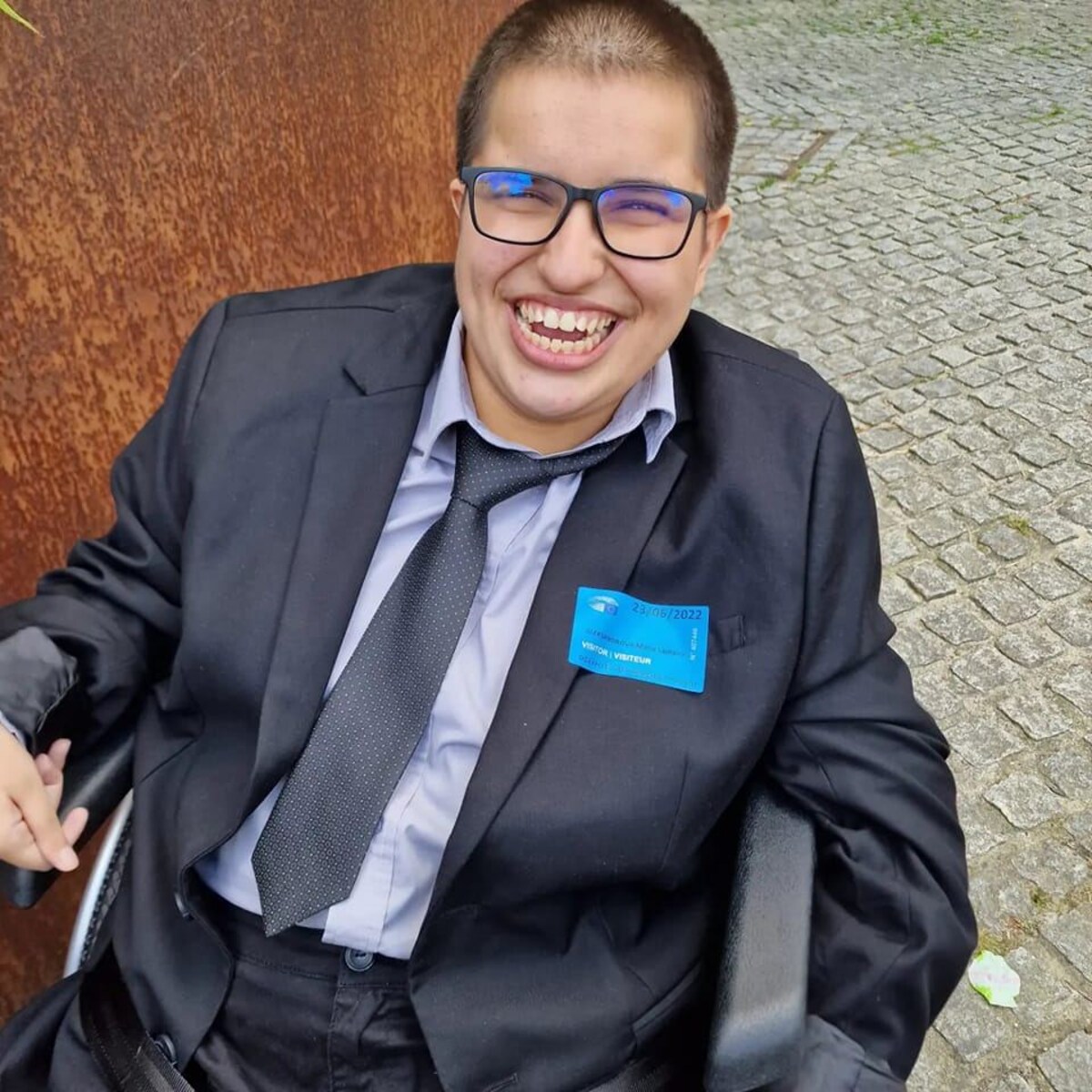
Maria in front of the European Parliament, Personal archive
Receiving support from the administration
“For anyone advocating for accessibility in higher education, two key factors are crucial: an open-minded administration and the self-determination to know and advocate for your specific needs,” Maria said.
She acknowledged the support she has received from AUBG faculty and administration.
“President Ensign has made accessibility and belonging a priority across departments. She is very hands-on with the correspondence,” Maria explained.
Maria also works closely with the Provost and Dean Sabina Wien, the current acting coordinator for accessibility and support services.
“Those first two years when Sabina Wien came into position as Dean of Students, she made it her own personal mission to support students with disabilities” Maria shared.
“I would say that the administration is making active progress to be more open,” she added.
Personal mission and ambitions
Maria is on a mission to flip the narrative for the wider community. While her advocacy has required sacrifices, she remains unwavering in her commitment.
“In order to be an effective advocate, you sometimes need to hyper-focus on what makes you different to the point where some people who are sympathetic, can become very easily annoyed by it,” explained Maria.
Looking to the future, Maria hopes to build a career that allows her to continue advocating for marginalized groups – not just as a community member but as an expert.
“We need representatives from the community speaking directly about our experiences. We are not weak or disadvantaged. We are the prime example of resilience and fighting spirit, and no one can take that away from us,” Maria said.
That’s what makes Maria a true storyteller, a passionate advocate, and a proud AUBG alumna.