AUBG alumnus Lyuboslav Gigov (’25) presented a student-faculty collaborative research paper from the Computer Science Department at the IEEE Global AI Summit 2025, the 2nd International Conference on Artificial Intelligence and Emerging Technologies 2.0 (AISUMMIT 2025) hosted by Bennett University, India, in association with the University of Florida.
The IEEE Global AI Summit 2025 is a prestigious international forum for researchers from around the world in areas such as Optimization, Artificial Intelligence, Machine Learning, Cybersecurity, Blockchain, IoT, Cloud Computing, and Computational Intelligence. Accepted papers will be published in the IEEE Xplore Digital Library and indexed in Scopus, ensuring broad visibility in the global research community.
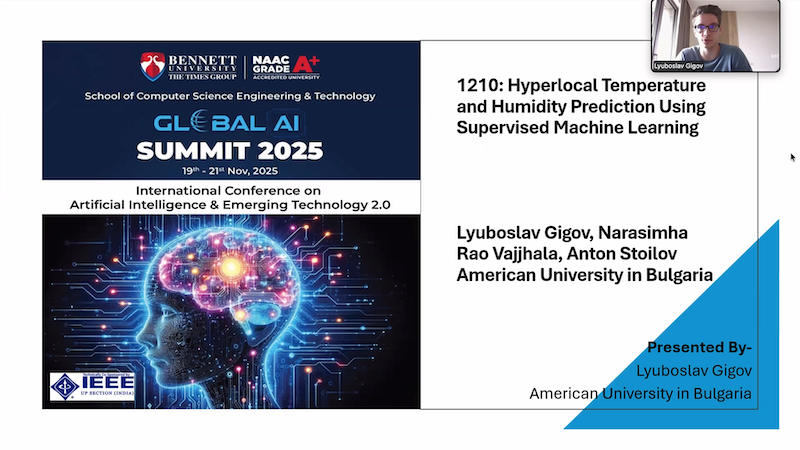
The paper, titled “Hyperlocal Temperature and Humidity Prediction Using Supervised Machine Learning,” is co-authored by Lyuboslav, Prof. Narasimha Rao Vajjhala, and Prof. Anton Stoilov from the Computer Science Department. The research originated as an extension of Lyuboslav’s senior project, which was recognized as one of the best projects from the Department. The paper reflects the strong spirit of student-faculty collaboration and applied research that promoted within the department.

“Presenting at the Global AI Summit was a truly remarkable experience,” said Lyuboslav. “What began as just another senior project became an internationally recognized research effort thanks to the strong foundation provided by AUBG’s Computer Science program and the invaluable mentorship of Prof. Vajjhala and Prof. Stoilov. Their unconditional support and constant encouragement pushed me to go further than I ever thought possible.”
Abstract— Machine learning offers computationally efficient alternatives to traditional numerical weather prediction (NWP) models and global forecasting systems (GFS), which struggle with high computational costs and coarse spatial resolution. This study focuses on hyperlocal weather prediction, comparing linear regression (LR), polynomial regression (PR), decision tree regression (DTR), and random forest regression (RFR) for forecasting average temperature and relative humidity.
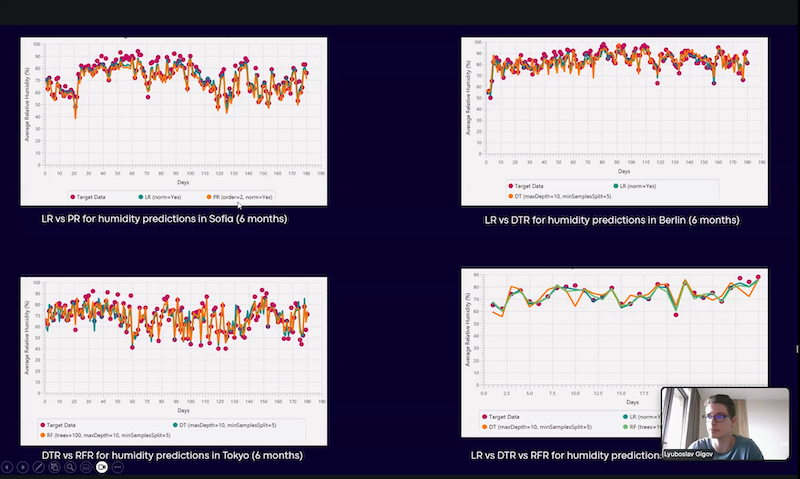
Using ten years of historical data (2015-2025) from Sofia, Berlin, and Tokyo, we achieved substantial predictive accuracy across climatically diverse regions. For temperature prediction, linear regression and random forest demonstrated statistically equivalent performance (R² > 0.994), with linear regression achieving faster execution times (0.001s vs 0.022-0.040s). For humidity prediction, linear regression demonstrated clear superiority (R² > 0.940) over random forest (R² 0.913-0.933), while decision trees showed the poorest performance (R² 0.741-0.814). Decision trees performed competitively for temperature (R² 0.992-0.993) but struggled significantly with humidity’s non-linear dynamics.
These results demonstrate that model selection should prioritize the relationship structure in data rather than algorithmic complexity, with linear regression offering a balance of accuracy and computational efficiency. The findings of this study challenge the assumption that complex ensemble methods are necessary for accurate weather prediction, offering practical applications in precision agriculture, smart city infrastructure, event planning, and resource-constrained IoT deployments where real-time predictions are essential.