They were both eager to get to Main Building. Like typical historians, they set off to excavate the remains of their rich memories.
Raul Carstocea (’01) and Emil Kerenji (’97) are sitting in front of me on the red couches of ABF. The surroundings are completely new to them. Back in the ‘90s, when they studied History & Civilizations at AUBG, the two alumni only knew a small part of what the university is today.
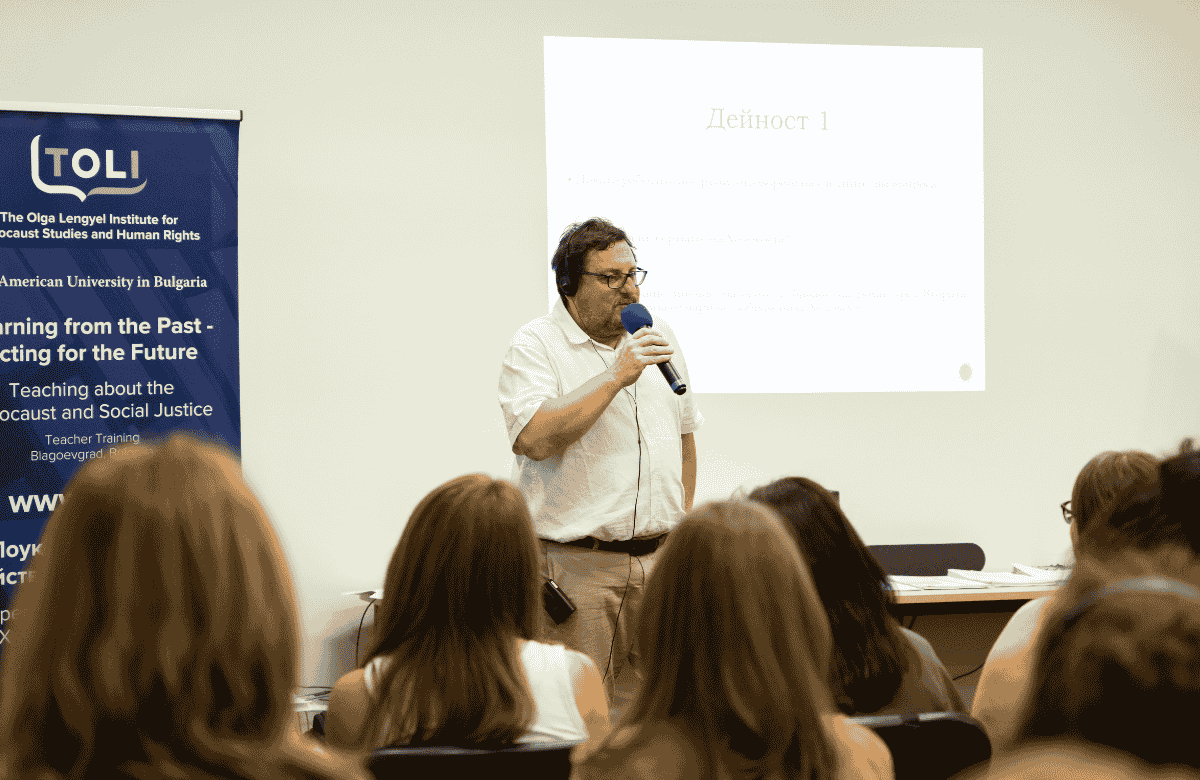
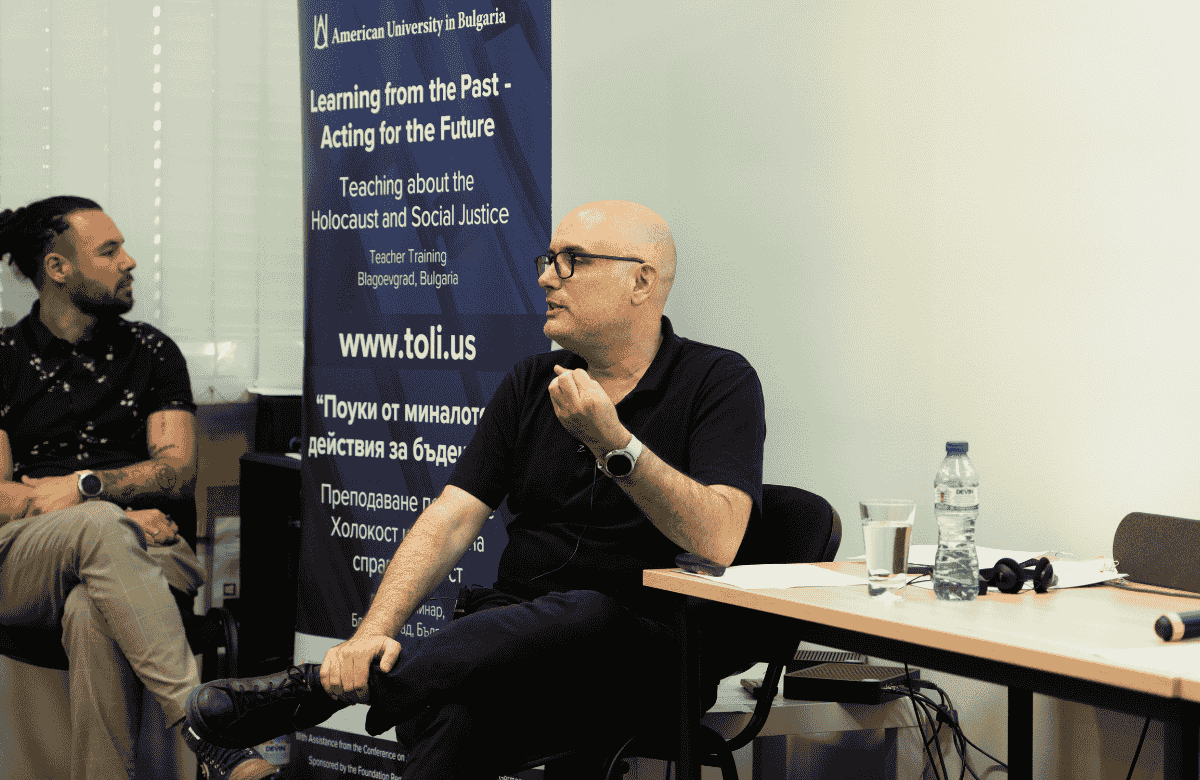
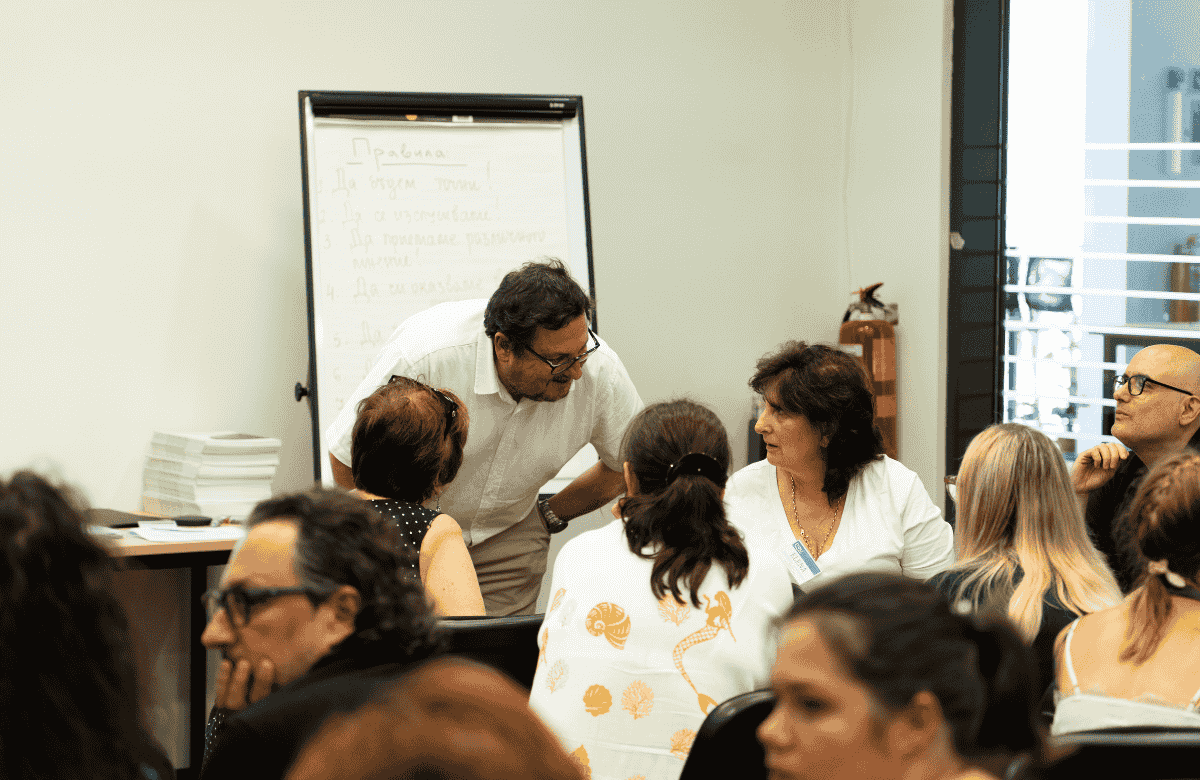
“It has grown so much,” both of them said, looking around and reminiscing about their days here. Raul and Emil are back on campus to give lectures on Holocaust and human rights as part of the Summer Educators Program by The Olga Lengyel Institute (TOLI) at AUBG.
For both, it’s an emotional return to the institution that sparked their interest in history. Now, they share their own accounts of the past, helping us see AUBG through the lens of the ‘90s.
Tracing the origins
Raul and Emil arrived at AUBG at the dawn of the university. “It was a different era back then,” said Emil. “The possibilities seemed much wider than today. But also, there were much bigger things to worry about.”
Before coming to AUBG, Emil was living in Vienna.
“Observing the war in Yugoslavia from a distance in Vienna, and later here, made me want to understand it better,” he said. “And in order to do that, you need to understand history better.”
Raul also had a personal story that led him to dive deeper into the past. “I’ve been fascinated by World War II since I was a kid, mostly because my grandfather fought in it,” he shared. These stories intrigued young Raul because “they didn’t fit the official narrative taught in school.”
He also wanted to honor his personal background: “I’m part Roma, and the Roma minority was persecuted not just in the Holocaust, but in general. I felt it was my duty to explore that part of history.”

Professors with an impact
At AUBG, several professors played a role in helping the two international students reimagine historical narratives.
Professor Dr. Jonathan York was Raul’s “mentor in history”. “He was teaching intellectual history, which I didn’t know existed until coming to AUBG,” Raul said. “It focuses on the ideas that shape the world.” Professor York’s classes had such an impact on Raul that he decided to specialize in intellectual history himself.
Emil took Professor Dr. Fred Ascombe’s classes in Balkan and Ottoman history, which offered a completely new angle of history. “He showed me how you can study these subjects in their full spectrum and appreciate all parts of history. I don’t think it’s an exaggeration to say I decided to major in history after maybe one or two of his classes,” said Emil.
There were of course, other professors in history, politics, and philosophy who shaped their worldview, and they remember them vividly to this day.
History in practice
“One of the first big differences at AUBG was that the classroom was far less hierarchical than I was used to in Eastern Europe, in Romania,” said Raul.
“The American system is much more based on dialogue and discussion,” he added. It’s a method Raul has incorporated into his own teaching at universities in the UK, Ireland, and Germany.
Now a professor at Maynooth University in Ireland, Raul teaches 20th-century history. “I try to bring history closer to the students. One thing I do is ask them to look for the history in their own lives,” he shared. He encourages students to find objects or artefacts at home that show what their families was doing during World War II or the Cold War.
“Some objects might be sitting there on a mantelpiece, but they never asked ‘Why is this here? Why is this important for us?’ And they get a feel for history that’s much more real than learning about elites,” Raul explained.
His other approach is to get students to talk and to explore different perspectives. “My goal is to get them to see that their opinion is valuable; that I don’t hold the absolute truth which I’m sharing with them. Instead, we arrive at an understanding of history that’s constructed by our multiple perspectives.”
Emil also believes in the power of different perspectives. He currently works as an Applied Research Scholar at the United States Holocaust Memorial Museum. For him, the Holocaust is just one example used to convey a larger message – one of empathy, humanity, and an understanding of how power works.
Multiculturalism at AUBG
One of AUBG’s greatest strengths has always been its international community, and in the ‘90s, that was especially profound, particularly in the context of the Balkans.
“It was like a whole new world opened here. At that time there was a war in Yugoslavia, and it was a very depressing time,” said Emil. In Vienna, the conflict felt isolating and othering to him. “But when I came here and met so many Bulgarians, Macedonians, Albanians, Romanians, it brought things into a much wider perspective.”
Raul also experienced the benefits of AUBG’s multi-cultural environment. “When you’re at this institution, you have the opportunity to engage with people from different cultures,” he said. Rail explained it’s something we often take for granted. Later, while taking a course on teaching in intercultural contexts, he realized he already knew all that from his lived experience at AUBG.
Both of them traveled all over Bulgaria, and whichever place I mentioned, they’d been there. Raul even mastered Bulgarian through an anecdotal living situation. He rented a room in town because dogs weren’t allowed on campus, and he really wanted to have one.
“My landlord didn’t speak a word of any language other than Bulgarian. He was an old man who liked to share his wine with me and escape his wife for a while,” Raul laughed.
“He would come over at least once a week with a bottle of wine and wouldn’t leave until it was finished. We had long conversations in Bulgarian, and my fluency exploded in the first three months,” he added.
Years later, while visiting Macedonia, someone told him: “You don’t speak Bulgarian; you speak Macedonian.” He’d picked up the accent of the region, too.
Where it all began
Raul and Emil immersed themselves in AUBG during a time of uncertainty and transformation. They’re both grateful for their time here, and both followed meaningful journeys in history.
“AUBG gave me the competencies and knowledge to shape my own path, which is much different from what I would have gotten in Serbia,” shared Emil.
Raul was recently awarded a major European grant for a €2 million project on global fascism, running over five years. He credits AUBG for starting him on his journey.
“It’s an achievement not just for me, but also for AUBG – to have people reaching the pinnacle of European science,” said Raul.
To future AUBG students, he shared this advice: “Keep an open mind. Look for opportunities. You’re in an excellent institution, so make the most of it. These are probably the best four years of your life, so try to live them fully.”