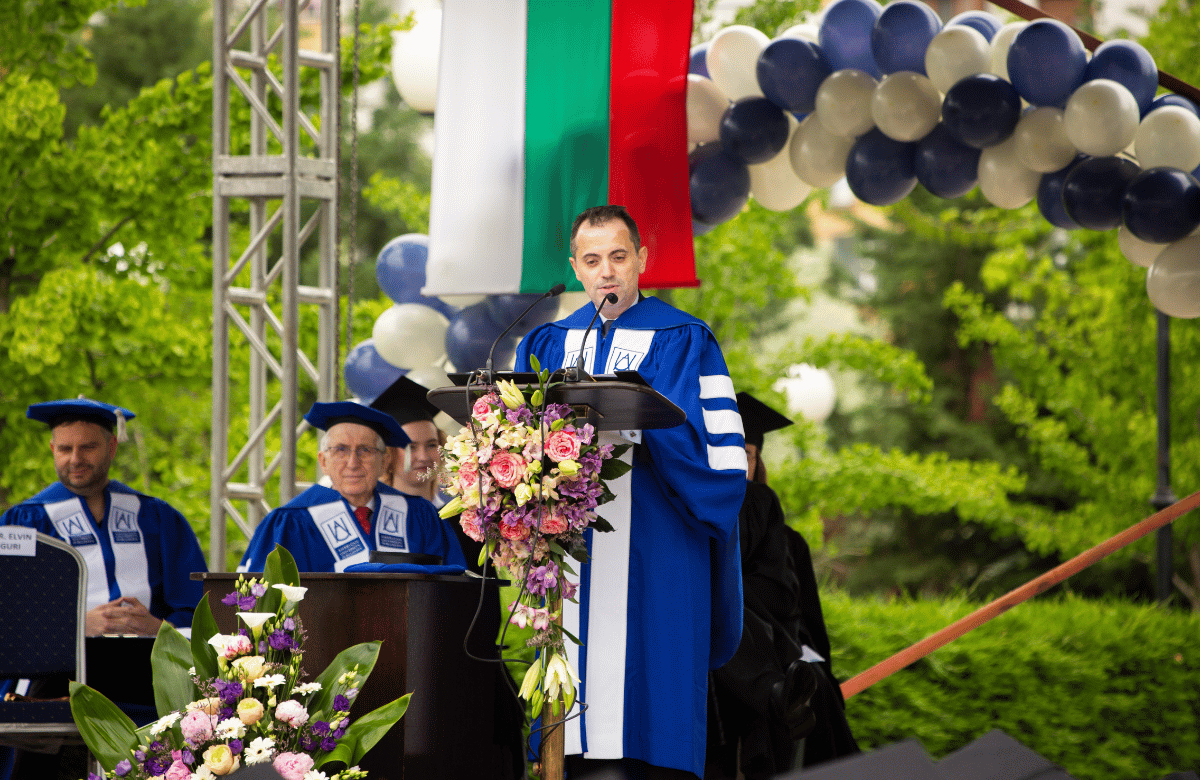
During the 32nd Commencement Ceremony, Elvin Guri (’96) delivered a heartfelt and deeply inspiring keynote speech.
Elvin Guri arrived from Albania in 1992 and, four years later, graduated in Business Administration and History & Civilizations. Even after graduation, he continued being an invaluable part of the AUBG community, contributing in numerous ways.
As AUBG’s most generous alumnus, he has personally donated $650,000 and secured another $850,000 – a transformative total of $1.5 million. These numbers represent scholarships that have enabled hundreds of Albanian and Bulgarian students to attend AUBG. Elvin is a co-founder of the AUBG Alumni Association, creating a network that now spans continents and industries. He has taught in our EMBA program, sharing wisdom earned from building and selling companies across the region. For 18 years, the maximum term possible, he served on the Board of Trustees, chairing both the Audit and the Finance & Property Committees, guiding AUBG through critical decisions with integrity and vision.
Beyond AUBG, Elvin is a proven visionary. He co-founded JetFinance International, which became the largest consumer finance lender in Southeast Europe before being sold to BNP Paribas. He invested in One Telekom Albania, the country’s second-largest mobile operator. Today, as CEO of Invenio Partners, he invests in industrial companies across the region, creating jobs and economic opportunity.
But his most impactful investment has been AUBG. The return on that investment is visible today in lives changed, leaders developed, and a community strengthened. AUBG has recognized Elvin with the HRH Princess Maria Luisa Distinguished Alumni Award, the Dimi and Yvonne Panitza Visionary Award, and the Distinguished Service Award.
“When J.D. called to invite me for this speech, I seriously questioned his judgement. For three reasons:
First, one has to be old enough and wise enough to be a commencement speaker. It was 30 years ago, almost to the day, that I was sitting where you are sitting now. I am your parents’ generation, therefore probably old enough. It will take me some time to recover from this realization.
Now, wise enough, I don’t know…wisdom requires the ability to learn from other people’s mistakes, not simply from one’s own. There, I’m afraid, I might not pass the test. And humanity as a whole doesn’t do much better, I think: these days, to paraphrase AJP Taylor, one of the best-known British historians in the 20th century, not only do we risk repeating mistakes of the past, but we’ve also learned how to make new ones.
I also felt apprehensive about accepting the honor of making this speech: what do I say? How do I make it relatable to an audience that includes students AND their parents and families, while avoiding cliches (you won’t hear none of that “follow your passion” or “do what you love” stuff from me). Gen Z’s best friend, Instagram, tells me that while you belong to the “Stop crying and I’ll buy you something generation,” your parents and I belong to the “Stop crying or I’ll give you something to cry about” generation…I guess this is our way of telling you that you’ve grown up sheltered, entitled, not having faced our challenges and sacrifices.
But you are no snowflakes, I don’t think. The overwhelming majority of you come from developing countries. You have fought hard to get here: your families have borrowed money to support your education; you have worked summer jobs; you have tasted what it means to be economic migrants, so that you could afford to attend this school. You know what it means to work hard: ¾ of you have double majors, 28% of you are graduating with honors (the disease of grade inflation hasn’t reached AUBG, it appears). Most of you have a pretty good sense that life is not a walk in the park; that the world is not black and white, but a whole lot of shades of grey; it is not a Hollywood movie where a perfect, and perfectly good, hero struggles and ultimately wins over the bad guy.
At the same time, all of you are wondering about what kind of world you are about to enter into: a world in which the 20th century promises of human progress, stability, and prosperity ring hollow; where the spectre of war, democratic regress, and the return of the ghosts of the past (fascism and socialism) are not simply a matter of academic discussion – talking about repeating the mistakes of the past, it boggles the mind that Fascism and Socialism,
even though under different guises and sometimes different names, have reared their ugly heads again:
To quote two iconic American presidents: “The liberty of a democracy is not safe if the people tolerated the growth of private power to a point where it becomes stronger than the democratic state itself. That in its essence is fascism: ownership of government by an individual, by a group, or any controlling private power.” – President Franklin Delano Roosevelt.
As for socialism, I feel we need to be reminded of that phrase of President Reagan, who said that “socialism only works in two places: in heaven, where they don’t need it; and in hell, where they already have it.”
Add to all of this the societal tsunami that is the Artificial Intelligence and, lest we forget, a not-to-distant future of environmental collapse, and anyone would struggle to be optimistic about the future: we, your parents, are having a hard time making sense of this world (just like our parents had a hard time making sense of the world after the fall of socialism).
It is true that my generation was forged differently: we (1) helped to bring down socialism; (2) we survived the long winter of discontent that was the 1990s; (3) faced the 2008 crisis; (4) Covid; and now today…there is a major difference between the world in 1991 and the world today, though: hope was abundant then. It is in rather short supply nowadays.
Which brings me to the third reason why I feared making this speech. This year marks the 35th anniversary of the establishment of AUBG; 250 years of the foundation of the American republic; 150 years of the April Rebellion, that most glorious of Bulgaria’s struggles for freedom and independence. I was, and am, absolutely mortified that I shall come up short. It feels like someone else, better read, more knowledgeable, and more eloquent, should be here instead of me. But here we are.
You are graduating from an institution that has taught you: American. Liberal Arts. Values. Concepts that today are under attack, not only from their usual adversaries and opponents, but from our own side. The former Hungarian PM called for an EU as a “trade federation” as opposed to a community of values. While a British political scientist, Dr. Sumantra Maitra, wrote in an article in the American Conservative “A consolidated EU, even as a trade superpower, is a civilizational danger to American prosperity and predominance. A divided Europe isn’t…The key is to be focused, partially retrench, allowing the natural European divisions to fester; only aligning with those few who are geographically and materially important.
Alliances based on values, kinship, religion or ideology are a recipe for disaster” (2025).
The result of these attacks has been to cheapen them, to devalue them, and void them of positive meaning, of optimism, of their symbolism as the best that the West could offer to the world:
American. Liberal Arts. Values. Especially Values. Chief among them Freedom. Freedom, as we currently understand it, is an Enlightenment idea: it was born in Europe, but it was really given life in the United States, and it returned to Europe to inspire everything: from 19th century reforms in Western Europe, to liberation movements in Central and Eastern Europe, to the founding of the European Union itself. Yet today Freedom is under threat, both in the more physical sense and in the sense that President Roosevelt warned. The Bulgarian political scientist Ivan Krastev has said: “the border between democracy and authoritarianism is the least defended border in the world.” That border feels so porous now, so weak, so fragile.
“Give me liberty or give me death,” Patrick Henry said; “all we have is our blood, and this land to take it in,” said Stefan Karadja. I wonder how many of us would be inspired by such words today…even though the Ukrainians are showing us by example…
“Freedom Works” the Secretary of State James Baker told hundreds of thousands of Albanians in June 1991. But it only works for those who wish to make it work. We’ve stopped believing in a better future, and have forgotten, or lost faith, on what they call “Cathedral Thinking” – the idea of starting something new in the knowledge that only future generations will enjoy the fruits of your labor: Sagrada Família in Barcelona took 130 years to build, the Duomo in Milano close to 600 years. Now we think in election cycles only.
For hope and inspiration, we can do no better than turn to the Founding Fathers of the American Republic. George Washington, when writing to the Hebrew Congregation of Newport, R.I. Assuring them of their liberty in this new nation, quoted his favorite Bible verses, “May the Children of … Abraham, who dwell in this land, continue to merit and enjoy the good will of the other Inhabitants; while every one shall sit in safety under his own vine and fig tree, and there shall be none to make him afraid.”
This is the America that we have learned about and learned to love, the America of pluralism, religious tolerance, and respect for others’ beliefs. Notice Washington’s expression “the Children of Abraham…” – I can’t help but feel that, were he alive today, George Washington might have written a similar letter to
American Muslims. Incidentally, the first Iftar (traditional dinner given during the holy month of Ramadan) in the White House was given in 1805 by President Thomas Jefferson, in honor of a Muslim ambassador.
American. Liberal Arts, Values. The US Declaration of Independence embodies them fully. The Founding Fathers were not naive or unworldly, very far from it. Firmly rooted in unpleasant and oftentimes horrible realities, they realized that the essence of good government and, essentially, good life is that while our reality is imperfect, our values should not be! They realized that the world is a whole lot of shades of grey, and life is a continuous attempt to define what price should one accept for our values and principles. It is a struggle that President Eisenhower warned about when he said “A people that values its privileges above its principles soon loses both.”
The reality of America often has come up short of the ideals of the Founding Fathers. But the US is a great nation not just because of its perfect ideals or of its achievements, but because it does not give up striving to do better, because it embodies an unshakeable belief that we can and ought to do better, as individuals and as a nation. It is “the pursuit of happiness” while being faithful to our values, not its attainment at any cost, that makes us better people and the world a better place. If there’s only one thing that you, young graduates, take away as you start your hopefully long and successful lives, is exactly this urge to continuously do better, continuously be better.
Rabindranath Tagore, the Bengali Indian polymath, wrote, “I slept and dreamt that life was joy. I awoke and saw that life was service. I acted, and behold, service was joy.” As you pursue your life of happiness, I hope that you shall find such in serving others – your loved ones, your communities, or your countries; just like Viktor Frankl wrote in “Man’s Search for Meaning.”
Your lives shall be very interesting. The world you are inheriting is a difficult one. We, the older generations, have made sure of that. The challenges you shall face are monumental. But you’ll be fine, as long as you keep striving to be better and to do better.
Keep faith in your values and in a better future for you and the generations that shall come after you. Nurture hope, like Vaclav Havel wrote: “Hope is definitely not the same thing as optimism. It is not the conviction that something will turn out well, but the certainty that something makes sense, regardless of how it turns out.
Build those cathedrals for future generations to see and enjoy. And remember: “Freedom Works” – So fight for it. Protect it. Advance it.
Good luck, and God bless you all!”