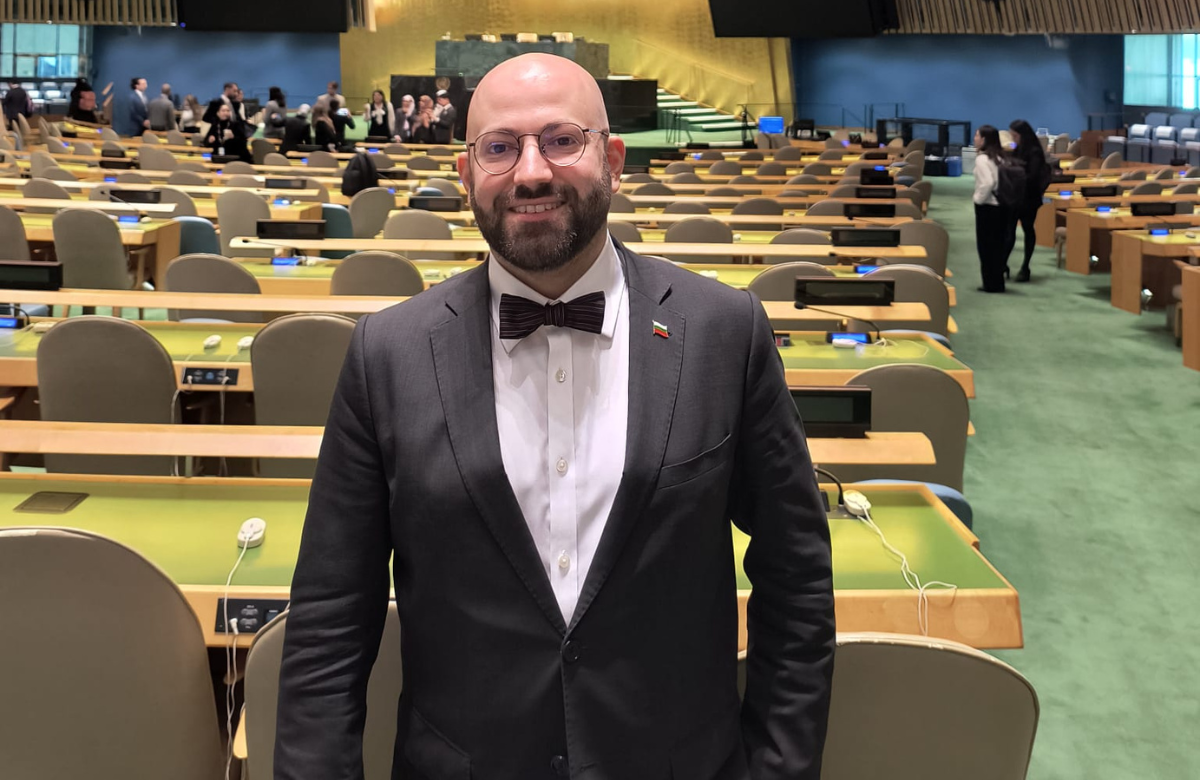
“Diplomats talk a lot while saying little,” according to an old adage. That’s not the case with Svetozar Dimitrov (’08), one of Bulgaria’s representatives at the United Nations in New York.
He had a lot to say about his education at AUBG and his current work in international diplomacy. Bulgaria became a UN state in 1955, and not long after, its foreign ministry had the good sense to purchase a 1903 Gilded Age mansion on the Upper East Side as its mission in New York. It’s a good place to share thoughts on 30-plus years of life and on the human condition.
The only child of a diplomat father and academic mother, he spent his early years living in other Balkan countries, a couple of hours or so drive from the Bulgarian border. He attended American schools and for high school, the American College in Sofia.
“AUBG was the self-evident choice,” he recalls. “I was accepted at two U.S. universities and one in Switzerland. I very much wanted to go to the U.S., but back in those days, anything short of a full scholarship made studying abroad off limits. AUBG provided a generous scholarship, though it wasn’t enough to cover tuition and living expenses. I also considered Sofia University, where my parents graduated.”
He visited the campus in Blagovegard and was immediately sold.
“There was what I felt was an American vibe, which is easier to say than to define. I think it’s some combination of people, the atmosphere, the way people carry themselves—a friendliness and openness.”
“My parents drove me to campus from Sofia on the first day. It took a few hours in those days before the motorway was built. I moved into the dorm and had two roommates—an American exchange student from Arizona and another freshman from Romania.”
He was very impressed with his classes and professors. They seemed interested in what students had to say, and they had good discussions. He focused on academics, worked hard, and before long ended up on the Dean’s list with a nearly 4.0 GPA. He double majored in political science and international relations, and history.
“I made lots of friends and enjoyed the Blagovegrad nightlife. I’m not a clubbing person, but I liked the “Underground,” which had a divey atmosphere and references to the London underground and seemed ahead of its time. More importantly, come nighttime, it felt like an extension of AUBG. Some good, inexpensive bars and restaurants in town. There were students from Americ,a but not many, and from the Balkans and Central Asia.”
Questioning and criticizing
“I was on campus during the Iraq war and was impressed by notices in the halls where the faculty had their offices that were critical of U.S. policy towards the war. Lots of voices that were critical. This was a bit of a revelation to me—not merely tolerating, but encouraging the questioning of things, the airing of multiple perspectives—and it carried over into the classes with very lively political discussions.”
He said one of the best experiences was the year he spent on an exchange program at the University of Vermont. The time there helped challenge my stereotypes and grounded me as a person. It was my first time living outside the Balkan region other than a long trip to Paris and Brussels as a teenager.”
He also spent his first college summer working in Maryland—at a Starbucks and a Popeyes chicken restaurant—conveniently positioning himself near Philadelphia, where an exchange student he had grown particularly close to during his freshman year at AUBG lived.
“It was such a pleasure making my own money for the first time and even paying some of the next semester’s tuition myself. The work was very tiring, and I now have a great respect for people who do these jobs. However, it also confirmed my gut feeling that I didn’t want to make a living this way. Taking care of people’s coffee needs wasn’t sufficiently fulfilling.”
He remembers American customers were mostly nice and took an interest in the unusual name on his name badge. “They ranged from Hippy academics to truck drivers. Some complained about the price of a cup of coffee, as if we, the employees, set it at a high level, and this is when you could get a cup for less than $2, not the $6 cost today. I noticed two types of Americans—those with high school and college educations and the lower socio-economic class, some of whom seemed crushed by life.”
Indelible memories
He remembers one co-worker in particular who married at 15 and immediately had kids. Her husband was an abusive alcoholic and later died. “She was homeless for a time in New York City. She worked hard and earned enough money to buy a trailer home, where she raised the kids who graduated high school and are now adults with kids of their own. She was very proud of them. I was greatly impressed by her resilience and positive outlook. She overcame so much adversity.”
Do such social differences not exist in Bulgaria? “Of course, we have them. I was probably a little sheltered and have never forgotten how fortunate I am. Here at the UN, I’m especially proud of Bulgaria’s support for children and their human rights.” Bulgaria is currently in its third year as a member of the UNICEF Executive Board, and in 2024, Dimitrov supported his ambassador’s work as Vice-President of the Board.
Dimitrov also participated in the Student Government at the University of Vermont. “One issue was the Red Cross’s discriminatory approach to blood drives that rejected gay men from donating by default. We voted to ban them from campus, but after a tie, the Student Government president added his vote against, so the resolution was rejected. I’m glad to see that the FDA and Red Cross later changed their policy and now have a more inclusive screening process.”
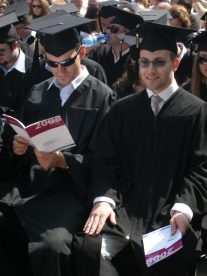
After graduation he weighed several choices. At a job fair on campus featuring recruiters from big businesses such as Coca-Cola, he received offers. He knew that to be considered by the Bulgarian foreign service, he needed a master’s degree. In the end he was accepted by the Central European University, now in Vienna, before it was kicked out of Hungary because of its ties to George Soros, who also was instrumental in funding AUBG in its early days.
“I received a full scholarship, and AUBG prepared me to be successful there. My master’s thesis contrasted Croatia and North Macedonia’s paths to EU membership. This was in 2009 and so far, what was written holds true.”
He then worked for the AUBG admissions office for two years, one of them in Sofia and one in Blagoevgrad.
“Returning to AUBG as a staff member was an enjoyable experience and the hard proof of that was that I painted a lot – a hobby I’ve had forever – and even had my works exhibited on campus.”
During this time, he thought more about a career in the foreign service or as university professor. Life progressed at a fast clip.
The career choice
He was accepted to do a practicum at the office of a leading CDU politician in the German parliament. He passed the foreign service exam and was accepted to a Ph.D. program at Freie Universität Berlin researching the legacy of Herbert Marcuse’s philosophy on German politics.
He spent a year in Germany, mostly researching at archives, and did the rest of the work remotely while working fulltime as a diplomat including his first posting in London during Brexit.
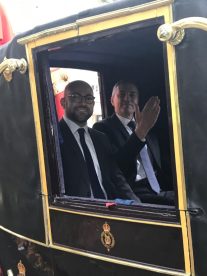
“Perhaps the most treasured professional memory from London is the time when I had the opportunity to meet H.M. Queen Elizabeth II while accompanying the ambassador who was presenting his credentials. We spoke briefly and I will never forget her talent for making everyone feel welcome and appreciated.”
He received the doctorate in 2023, a year after starting his next posting in New York.
Asked about the current turbulence in the EU with the U.S., Russia and Ukraine, he said he was optimistic. “Rather than a situation where Europe becomes more divided and weaker, I see it as an opportunity to become more integrated and stronger. I hope and expect that Bulgaria will rise to the challenge and play a positive role.”
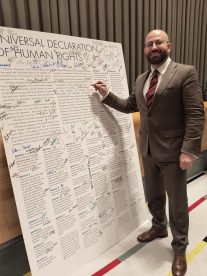
Progress and stability grounded in democracy and respect for human rights is his hope for all countries, and these goals are part of the UN’s mission, although its role and performance are often misunderstood and underappreciated.
“There are unrealistic expectations that the UN can resolve everything. Its structure, particularly the way the Security Council operates with the veto power of its five permanent members, can limit its ability to take decisive action on global crises. Overall, it’s an important and worthwhile institution. A place where countries can talk to each other.”
“UNICEF, UNDP, WHO—they all go about their business protecting and saving lives and providing access to education, basic health care, clean water. These things are not in the news because they happen every day. Bulgaria works closely with UNICEF because children’s rights are a priority for the country.”
“One of the fun elements of the job is working together with Bulgaria’s UN youth delegates who come to New York twice a year. There are new delegates every year and so far, five of them have been AUBG students or alumni. Sadly, that’s more than the number of AUBG alumni in Bulgaria’s diplomatic service.” Dimitrov says he hopes more will follow.
Recently, he joined AUBG guests, board members, and alumni for a reception honoring annual board meeting at Bulgaria’s Consulate General. He moves around the room, a kind word for everyone. A guest there is reminded of the Will Durant quip: “To say nothing, especially while speaking, is half the art of diplomacy.”
It’s the other half, or maybe more, that Dimitrov is particularly good at, and that likely will see him promoted to ambassador while still a relatively young person. When asked, he admits it’s the ultimate career goal of most in the field but adds that his number one goal so far has been to make sure he’s doing meaningful work.
“I was always interested in politics and foreign cultures, so the idea of a career that involved these elements, while also allowing me to see the broader social relevance of what I do, felt like the right fit.”
AUGB is proud of him, and grateful for his service to Bulgaria and the world.