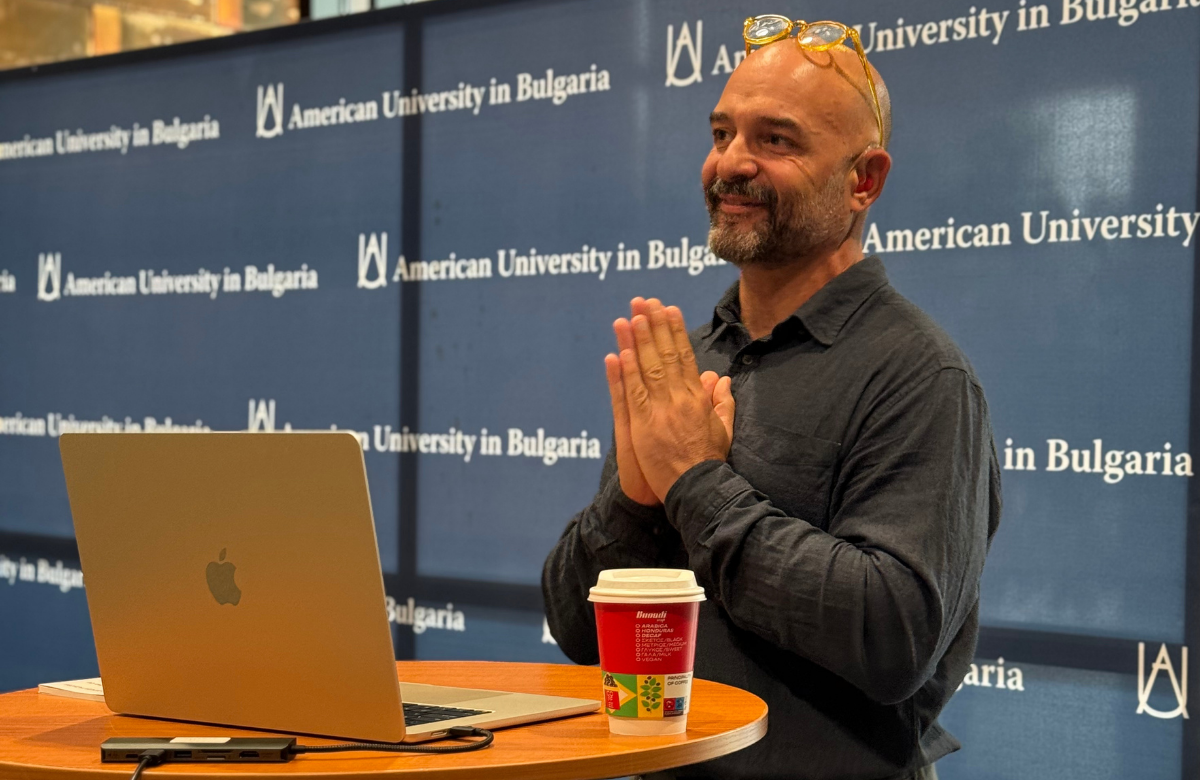
Ashod Derandonyan (‘01) joined AUBG at a time when deaf and accessibility support was still a topic that wasn’t addressed much in Bulgaria. Yet his university and community provided a welcoming environment that set the tone for what would become a lifelong mission, advocating for accessibility, equality, and sign language rights for thousands of people in Bulgaria and beyond.
After graduating from AUBG in 2001 with a Business Administration major, Ashod earned a Fulbright Graduate Scholarship at Gallaudet University, the world’s first university for deaf and hard of hearing (DHH) students, based in Washington, D.C. Since then, he has helped shape the Bulgarian Sign Language Act (2021), advised international organizations, and contributed to UN-level strategies on human rights and accessibility.
Today, he serves as Chief Strategic Officer of Deaf.BG and is recognized globally as a strong voice for sign language rights and accessibility. His contributions are immense, and his connection to AUBG remains strong. This year, he returned to his alma mater as a presenter at the Civil Society Forum 2025.
Ashod is an invaluable figure to the AUBG community, setting an example of what genuine belonging in universities and other institutions can look like. AUBG has made steady progress since the early 2000s in expanding its accessibility efforts, implementing new practices, and raising awareness in a way which strengthens Ashod’s sense of pride about his alma mater. The Equal Opportunity and Accessibility Support Office ensures that students with documented disabilities receive reasonable academic, housing, and daily life accommodations, following ADA, Bulgarian and EU legislation.
The AUBG community is deeply involved in spreading accessibility awareness and actively supporting causes related to equal opportunity for all. Last year, Student Government organized a Christmas Charity fundraiser to support education for kids with disabilities. This semester, the student-run club The Hub raised funds to support adaptive sports. This year’s Christmas Bazaar and Gift Donation campaign of Better Community Club, carried out in partnership with the Blagoevgrad Regional Social Assistance Directorate, will benefit some local social care centers for children and adults with disabilities. Film screenings, guest lectures, and workshops organized by faculty, student support staff or students, aiming to instill a culture of empathy and belonging for everyone.
Substantial progress has been made but AUBG knows that there is still room for growth. Ashod continues to serve as a guiding light in our efforts, exemplifying what meaningful advocacy looks like.
In this conversation, he opens up about the realities of accessibility in Bulgaria, his efforts to support the DHH community, and the practical steps allies can take to make a difference.
You often say that “sign language is freedom.” What kind of freedom has it given you personally, and what opportunities has it opened up in your journey?
For many years, “freedom” was something I didn’t fully understand. I grew up oral, which in practice means growing up expected to fit into a world built entirely for hearing people. I used only spoken language, lipreading, speaking, constantly adapting, constantly proving, constantly guessing. I survived, yes. I succeeded academically, yes. But I was never free.
The true transformation came later when I discovered sign language and, even more importantly, when I allowed myself to become a full part of the Deaf community.
That is when my world expanded, when my identity finally made sense, and when I felt, for the first time, that I didn’t need to “perform hearing.” I could be myself.
Establishing Deaf.BG was another turning point: a home, a movement, and a vision shaped by Deaf people themselves. Through it, I became not only bilingual, but whole. Spoken language connects me with the hearing world; sign language connects me with my community, culture, and inner truth. And bilingualism – the ability to move fully and freely across both worlds – is the greatest freedom I have ever had.
Sign language gave me space to exist without limitations, to lead confidently, to advocate internationally, to build policy, and to step into global roles. It opened the door to Gallaudet University, Fulbright, and the World Federation of the Deaf.
So when I say “sign language is freedom,” I mean: It is the freedom to stop surviving and start living.
What have been the biggest challenges of both your undergraduate and graduate education as a deaf person? What changes or innovations could improve the educational experience for deaf students and people with disabilities?
When I look back at my undergraduate years, I see a young person trying to navigate a system without the tools he needed.
I never had access to interpretation services – not because they didn’t exist, but because I didn’t know my rights. Nobody taught me about accommodations, accessibility, or linguistic equality. I thought lipreading would be enough. For years, I convinced myself that I was “fine.”
But the truth is: lipreading gives you fragments, not the full picture. I was constantly missing information, context, and nuance. I studied twice as hard, reading every resource I could find to fill the gaps.
I was fortunate to have professors and peers who supported me – people who met with me one-on-one, who had clear articulation, who truly cared. But I also had professors, who were wonderful, yet understanding them through lipreading was often challenging.
Then everything changed at Gallaudet University. For the first time, I experienced bilingual education – deaf people learning through both sign language and spoken/written language. It felt natural. It felt human. It felt like the education I was always meant to have.
What needs to change today?
- Deaf children must have full access to both signed and spoken languages from early childhood.
- Technology must support accessibility: captioning, real-time services, visual communication.
- Sign language recognition and rights must be implemented, not just declared.
- Deaf youth must be empowered to embrace bilingualism, not hide from it or feel ashamed of needing visual access.
We have better laws now, more tech, and more awareness. But the gap between “rights on paper” and “rights in practice” is still too wide. My dream is that no Deaf student in Bulgaria goes through what I did – piecing together an education from scraps of information.
How did your AUBG experienceinspire your work with the Deaf community and the founding of Deaf.BG? What skills or lessons from your time here have proven most valuable?
AUBG was the first place that taught me to think beyond limitations. It taught me to dream bravely and to act on those dreams.
The university opened my mind to international perspectives, civic engagement, and the responsibility to build the world you want to see. It taught me creativity, critical thinking, and the power of organizing people around a shared mission.
These lessons became the DNA of Deaf.BG. AUBG gave me confidence to found an entirely Deaf-led organization – one that not only advocates but builds structures, creates programs, drafts legislation, and transforms national systems. It was at AUBG that I realized: If an idea is strong enough, and if the community believes in it, it can become an institution. Deaf.BG was born from that spirit.
Your research explores technology and human rights. What role does technology play in advancing accessibility for deaf people? How can tools like AI captioning support accessibility without replacing the human connection of sign language?
Technology is one of the greatest allies the Deaf community has today when used responsibly.
We now have tools that were unimaginable 20 years ago:
- high-quality AI captioning,
- Video Relay Service (VRS) and Video Remote Interpreting (VRI),
- sign language avatars and recognition systems,
- digital communication platforms that reduce isolation,
- modern accessibility tools for education, health, and government.
But technology must never attempt to “replace” sign language. Sign language is not a feature – it is a culture, a community, a worldview.
The future is about balance:
- Use AI to support communication, not to erase human connection.
- Use avatars to fill gaps – not to replace interpreters.
- Use captioning to expand access – not to claim universality.
- Use digital tools to complement sign languages – not to re-create them artificially.
Today, in my role as Coordinator of the Human Rights Expert Group at the World Federation of the Deaf, I work to ensure that sign language is recognized at European and global levels. Technology must be shaped with Deaf communities, not imposed on them.
Accessibility is modern.
But identity is timeless.
What message would you share with those who want to be true allies to the Deaf community? How can they support the community effectively?
Being an ally starts with respect. Not pity, not charity, but respect for Deaf people as a linguistic and cultural community.
A true ally:
- learns about sign languages,
- advocates for accessibility in their workplace and institutions,
- supports Deaf-led organizations and initiatives,
- listens to Deaf voices and amplifies them,
- and believes that equality is not optional – it is necessary.
Allyship means standing beside us, not speaking for us. It means recognizing that accessibility strengthens the entire society.
You’vedescribed education, policy, and advocacy as interconnected. How do you envision the future of Deaf.BG, and what role do you see for yourself in shaping that future?
The future of Deaf.BG is about building systems, not projects.
I envision:
- a national network of Deaf educators,
- a strong Bulgarian Sign Language Research Center,
- modern accessibility infrastructure across institutions,
- digital platforms that ensure equal access for all Deaf people,
- and strong international partnerships that connect Bulgaria to global Deaf leadership.
My role is to continue bridging communities, building policy frameworks, and ensuring that Deaf voices shape the decisions that affect their lives. I want Deaf children in Bulgaria to grow up with access, opportunity, and pride – something my generation had to fight for step by step.
The work ahead is big, but the future is bright. And it is already beginning.
Ashod’s story reminds us that accessibility is an essential part of any community’s culture, and that by opening our institutions and our hearts to everyone, we create a kinder and more equal world. It is time we start listening to the voices that are driving real change.