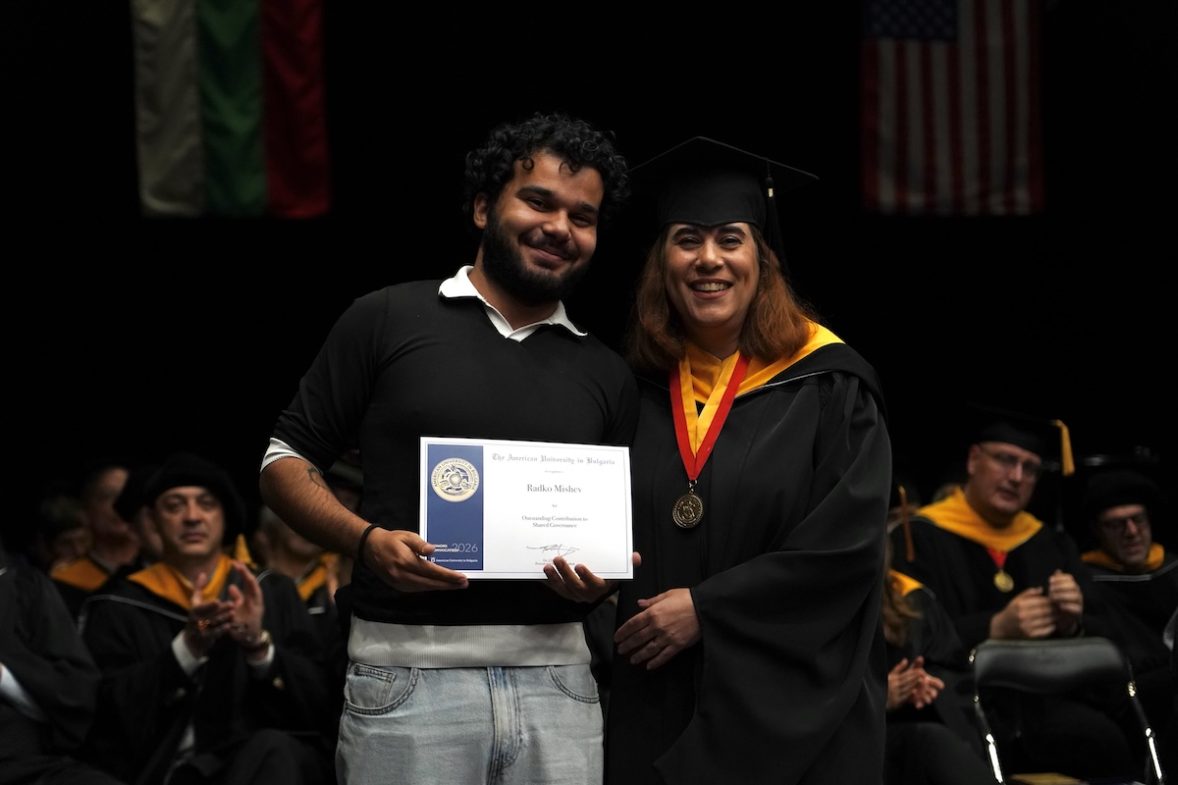
Read below the winning paper of the Stefanija Aleksova’s Best Paper Prize of the AUBG Research Conference ‘Fellowship of the Mind’ 2026.
Rethinking “Genocide” through an Analysis of the Artsakh Blockade
Introduction
This paper addresses the 2022-2023 crisis in Nagorno-Karabakh, known to Armenians as Artsakh, which ended in the forced displacement of over a hundred thousand ethnic Armenians.[1] The events, which unfolded in the span of ten months, under the observation of the entire world, serve as a case study to evaluate the efficacy of international law. The question, that arises now is: Does the failure of international law to prevent this forced displacement reveal a fundamental and structural flaw in the 1948 UN Convention of the Prevention and Punishment of the Crime of Genocide?[2]
This paper argues that the Artsakh crisis shows that the 1948 UN Convention is both inaccurate in its definition and ineffective in its preventative measures. The Convention uses a narrow and intent-centric framework, which requires a proof for “specific intent”, thereby making it not well suited for contemporary forms of genocide. Modern perpetrators, as in the case of Azerbaijan, are very well versed in “genocidal mutation,” structuring their plans and actions to exploit legal loopholes and argue “definitional denial”.[3] This paper, therefore, proposes an alternative approach, which is process oriented, as a more accurate model for understanding group destruction and thus a more effective prevention mechanism.
The Genocide Convention, the UN’s foundational legal instrument for combating genocide, was structurally unable to compel action. Its strict definition turned a preventative measure into a barrier by providing the very legal loopholes and political cover that perpetrators need. Following this introduction, the paper is divided into five sections. The legal framework of the UN Convention is explained in Chapter 2. A factual account of the Artsakh crisis in 2022-2023 will be given in Chapter 3. The specific ways in which the Convention’s definition and mechanisms failed in this case will be examined in Chapter 4. The alternative, process-oriented approach, and its superiority will be detailed in Chapter 5. Finally, the conclusion summarizes and further clarifies the findings of this analysis.
The 1948 UN Convention
The 1948 Convention on the Prevention and Punishment of the Crime of Genocide is the world’s first modern human rights treaty. It represents a significant legal and moral agreement. However, its legal system, which was created to punish a specific past crime, has been unable to prevent later genocides. Article II is its central component, and it includes the Convention’s legal definition. It defines genocide as “any of the following acts committed with intent to destroy, in whole or in part, a national, ethnical, racial, or religious group, as such”.[4] This definition makes a crucial distinction between the criminal act and intent. The criminal acts include five categories:
- Killing members of the group;
- Causing serious bodily or mental harm to members of the group;
- Deliberately inflicting on the group conditions of life calculated to bring about its physical destruction in whole or in part;
- Imposing measures intended to prevent births within the group;
- Forcibly transferring children of the group to another group.
The specific intent to dismantle the group “as such” is the criminal intent requirement. The Convention’s central threshold – and, as this paper argues, its biggest structural flaw, is this high standard of proof for intent.
The Convention’s mechanisms for enforcement favor post-facto punishment, rather than prioritizing real-time prevention. Article I provides the core obligation for the contracting parties to “prevent and to punish” genocide.[5] The following articles, however, are mainly legalistic in nature. Article VI stipulates that perpetrators must be tried by an “international penal tribunal” with jurisdiction, such as the International Court of Justice (ICJ), or by a “competent tribunal” of the state, in which the act was committed; Article V requires states to enact domestic legislation. By definition, all of these processes take place primarily after a genocide is completed and its perpetrators are tried.
Article VIII, which permits any contracting party to “call upon the competent organs of the United Nations to take such action under the Charter of the United Nations as they consider appropriate for the prevention and suppression” of genocide, is the only preventative mechanism, provided by the Convention.[6] In practice, this means appealing to the UN Security Council, which is a body infamous for its political paralysis. This design leads to a paradox. Until genocide is legally proven, the punitive provisions, Article V and Article VI, cannot be fully activated; however, because of Article II’s high “intent” standard, establishing such proof is practically impossible, unless the genocide has already ended, and archives have been reviewed. At the same time, the “appropriateness” clause, which is dependent on the political will of veto-holding members, makes the preventative article useless, due to their frequent lack of that will.
A Factual Account of the Crisis in Artsakh
The 2022-2023 Artsakh crisis provides a very clear illustration of this paradox. The destruction of the ethnic Armenian community of Artsakh was not a spontaneous event, but rather a systematic, multi-staged process. It can be considered as taking place into four stages:
- Stage 1: The Blockade (December 2022 – September 2023)
On December 12, 2022, a group of self-identifying “eco-protester” Azerbaijanis blocked the Lachin corridor, which is the only road connecting the over one hundred thousand ethnic Armenians of Artsakh to Armenia and the outside world.[7] These “protesters” were eventually identified as state-sponsored agents.[8] This blockade gave start to a severe humanitarian crisis by cutting off access to all essential goods. The population of Artsakh was subjected to severe food, medicine, fuel, gas, and electricity shortages.[9]
This stage was a genocidal act in progress, not merely a political act. The blockade itself was recognized by legal experts, including former ICC prosecutor Luis Moreno Ocampo, as a textbook case of genocide under Article II(c) of the Convention: “Deliberately inflicting on the group conditions of life calculated to bring about its physical destruction”.[10] Human rights organizations, such as the Lemkin Institute for genocide Prevention and Genocide Watch agreed, calling the starvation a “genocide by attrition” and an “invisible genocide weapon”.[11]
- Stage 2: International Law Failure (February 2023 – August 2023)
This real-time testing of the Genocide Convention’s mechanisms revealed that they were in fact ineffective. On February 22, 2023, the International Court of Justice (ICJ), acting under Article VI of the Convention, issued a legally binding provisional measure in response to a request from Armenia. Azerbaijan was mandated by the ICJ to “take all measure at its disposal to ensure unimpeded movement of persons, vehicles, and cargo along the Lachin Corridor in both directions.”[12] Azerbaijan’s response was blatantly disobedient. In violation of the ICJ’s order and proving the total ineffectiveness of the Convention’s legal mechanism, it established a military checkpoint at the corridor’s entrance on April 23, 2023, formalizing the blockade. Despite all concerns, raised by UN experts in August 2023 about the “dire humanitarian crisis”[13], no enforcement action followed.
- Stage 3: Military Offensive (September 19-20, 2023)
On September 19, 2023, Azerbaijan began a massive military offensive, following ten months of this “systematic weakening” of the target population. Already isolated, starved, and demoralized, the population was unable to fight back. The de facto Artsakh authorities were forced to surrender in 24 hours of shelling.
- Stage 4: Forced Displacement and Institutional Erasure (September 2023 – January 2024)
The ultimate, planned result of the blockade came immediately after the surrender. More than a hundred thousand ethnic Armenians, or nearly the entire remaining population, fled their ancestral homeland for Armenia in the final week of September 2023 in a mass and rapid exodus.[14] This was widely described by observers as a campaign of ethnic cleansing. In order to completely eradicate the Armenian political, social, and institutional presence in the area, the de facto government of Artsakh signed a decree on September 28, 2023, dissolving all of its institutions by January 1st, 2024. The media narrative of a “24-hour war” fundamentally misreads the event. The offensive on September 19 was the last stage of the genocidal event, not its beginning. The actual genocide was the ten-month blockade that inflicted the conditions of life (Article IIc), calculated to make the group’s existence – impossible. The military offensive was simply the last step in ensuring that the group is permanently removed, finalizing the “destruction… in part” of the Armenian group in that territory.
The Convention’s Failures
For the 1948 Convention, the Artsakh crisis is a fatal diagnosis. It provides empirical evidence of both the Convention’s failure and how its own design contributes to it. The Convention was a failure on two different levels: definitional, by being inaccurate, and mechanical, by being ineffective.
- The Inaccuracy of the Definition
The Convention’s 1948 “intent-centric frame” is inaccurate, because it is static, while genocide is adaptive. Henry Theriault coins this term as “genocidal mutation”. A modern perpetrator like Azerbaijan knew the legal framework and thus mutated its method to avoid triggering an unambiguous international response.
Azerbaijan weaponized starvation (Article IIc), which is slower, more ambiguous, and allows for plausible deniability, as opposed to mass killing (Article IIa), which is politically costly. This approach was specifically chosen, because it takes advantage of the Convention’s main weakness, which is the high standard for demonstrating “specific intent.” Azerbaijan’s strategy relied heavily on this tactic, which Theriault refers to as “definitional denial.” Azerbaijan has repeatedly denied genocidal intent, arguing that the blockade was an “anti-terrorist” security measure or that it was a legitimate action by “eco-protesters”. It denied that a “humanitarian crisis” existed at all, even though UN experts were sounding alarms.5
This strategy was successful. It paralyzed the international community by leaving it stuck in a “definitional debate” over whether to use the word “genocide,” “ethnic cleansing,” or “forced displacement” rather than taking any kind of action to stop the act. The 1948 definition, intended to shield victims, became a barrier to their protection.
- The Ineffectiveness of the Mechanisms
The Artsakh case provides empirical proof that the Convention’s mechanisms are ineffective.
Firstly, the failure of Article VI, or the legal accountability. This mechanism wasn’t simply disregarded; it was put to the test, and it didn’t work. Even though Armenia’s appeal to the highest court in the world, the ICJ, was successful and Azerbaijan was given a legally binding order by the ICJ to open the Lachin corridor, it was ineffective. Azerbaijan responded by doubling down and establishing a military checkpoint, openly disobeying the directive. Since there is no way for the Convention to enforce such an order, the entire article and the Court’s jurisdiction were moot against a state that refused to comply.
Secondly, the failure of Article VIII, or the political prevention. This mechanism, which is the only preventative tool of the Convention, also failed completely. The “competent organs,” namely the UN Security Council, were “called upon” by Armenia, by UN experts, and by scholars. The Security Council was briefed on the crisis. It did nothing. It failed to take “appropriate action,” proving that this mechanism is, and always has been, entirely under the geopolitical interests of its veto-holding members, not to the mandates of humanitarian law.
There is a causal relationship between the ineffectiveness and inaccuracy of the Convention. The legal ambiguity of the definition (Article II) allowed for the Security Council’s political failure (Article VIII). Azerbaijan’s “definitional denial” gave states the political and legal justification they needed to do nothing. By framing the intent as “unproven” or “debatable,” these states were able to overlook the obvious criminal act, the starvation, that was being broadcast in real time. The flawed definition (inaccuracy) causes the mechanisms’ failure (ineffectiveness).
An Alternative Framework
The static “is it/isn’t it” binary of the 1948 Convention is a failed model. The alternative, drawn from the work of contemporary genocide scholars, is to reframe genocide not as a fixed legal label, but rather as a dynamic and observable process. This chapter provides three process-oriented theories to build a superior framework.
First, according to Daniel Feierstein’s concept of “Genocide as Social Practice” theory, genocide is a “technology of power” that reorganizes social relations, rather than juts mass murder. Importantly, Feierstein argues that “stigmatization,” “harassment,” “isolation,” “systematic weakening,” and ultimately “mass annihilation” are observable stages of this social reorganization.[15] This model is a perfect fit for the Artsakh crisis. The “isolation” and “systematic weakening” phases were executed in a textbook fashion during the ten-month blockade. This framework is better, because it does not require the world to wait for the ultimate stage of “annihilation,” but rather allows for the legal and political identification of genocide during these early stages.
Second, according to Ernesto Verdeja’s work on “Emergent Intent” theory directly solves the Convention’s “intent problem”. Verdeja argues that researchers should “disaggregate genocidal ‘intent’ over time and space” as opposed to looking for a single “pre-given” plan. Intent is not a prerequisite; it emerges from a “process of increasing radicalization”. The pattern of the perpetrator’s actions can and must be used to deduce their intent. There was no denying the pattern in Artsakh: (a) the engineered blockade; (b) the intentional cutting of gas and electricity; (c) the open, public defiance of a binding ICJ order, and (d) the final military attack. This pattern of escalating actions constitutes overwhelming proof of an “emergent intent” to destroy the group.
Third, the importance of this process model is explained by Henry Theriault’s concept of “Genocidal Mutation.” According to Theriault, perpetrators mutate their methods in reaction to legal frameworks, in order to “avoid political and legal consequences.” A process-based model is “future-proof” because it is not tied to a specific historical form of genocide. Instead, it tracks the function of the acts, such as isolation, weakening, destruction, etc. over time.
This proposed process-oriented framework is better than the 1948 Convention. It is much more accurate, because it provides observable, empirical indicators (Feierstein’s stages)[16] that described the events in Artsakh as they were happening. It is more effective, because it identifies these stages as triggers for prevention, bypassing paralysis of “definitional denial” by focusing on the observable process of destruction, not on the perpetrator’s deniable “intent.” The contrast between these two frameworks is obvious. The 1948 UN Convention presents genocide as a static, fixed legal issue, a reactive model that relies on proving “specific intent” as a prerequisite. This approach proved ineffective in the Artsakh case, as the blockade was obscured by a “debatable” intent, providing political cover for inaction. Conversely, the process-oriented approach is dynamic and proactive. It understands genocide as an evolving thing and treats intent not as a prerequisite, but as a property that can be inferred. This model is more effective as it identifies observable, preventative indicators, such as “isolation” and “systematic weakening”, which accurately described the Artsakh blockade as a genocidal act in progress.
Conclusion
This paper used the 2022-2023 Artsakh crisis as a case study to show the failures of the 1948 UN Convention on the Prevention and Punishment of the Crime of Genocide. The systematic account of the crisis showed how a ten-month blockade, designed to result in unbearable conditions of life, was a genocidal act, which culminated in a final military assault and the forced displacement of over a hundred thousand ethnic Armenians.
Following this, the analysis demonstrated that the Convention’s framework failed due to its design. Its definitional inaccuracy, a static, intent-centric model, was exploited by the perpetrator, who mutated their methods to allow for “definitional denial.” The result of this was the mechanical ineffectiveness of the Convention. Both its legal (Article VI) and political (Article VIII) mechanisms were rendered useless by a open defiance and geopolitical paralysis. The flawed definition provided the political cover for international inaction.
The international community’s dependence on an outdated legal system is an exposed by the tragedy in Artsakh. A static, 75-year-old label cannot be the subject of endless debate if genocide prevention and accountability rely on this. There is a better option, as this essay has argued. The adoption of an adaptable, dynamic, and process-oriented framework, which combines the work of academics, such as Feierstein[17], Verdeja[18], and Theriault[19], is essential. Such a model offers the conceptual tools to recognize and stop genocidal processes, such as isolation and systematic weakening, long before mass annihilation occurs. The greatest failure in Artsakh was not just a lack of political will. It was a crisis of legal and conceptual understanding, which the process-oriented model can and must address.
Bibliography
Amnesty International. “Azerbaijan: Blockade of Lachin Corridor Putting Thousands of Lives in Peril Must Be Immediately Lifted.” February 9, 2023. https://www.amnesty.org/en/latest/news/2023/02/azerbaijan-blockade-of-lachin-corridor-putting-thousands-of-lives-in-peril-must-be-immediately-lifted/.
“Azerbaijan’s Offensive in Nagorno-Karabakh and the Evolution of Its Dispute with Armenia.” Strategic Comments29, no. 38 (December 2023). https://www.iiss.org/publications/strategic-comments/2023/azerbaijans-offensive-in-nagorno-karabakh-and-the-evolution-of-its-dispute-with-armenia/.
Feierstein, Daniel. “Defining the Concept of Genocide.” In Genocide as Social Practice: Reorganizing Society under the Nazis and Argentina’s Military Juntas. New Brunswick, NJ: Rutgers University Press, 2014. https://www.jstor.org/stable/j.ctt6wq9vn.6.
International Court of Justice. Application of the International Convention on the Elimination of All Forms of Racial Discrimination (Armenia v. Azerbaijan). Summary of the Order of 22 February 2023. February 22, 2023. https://www.icj-cij.org/node/202558.
Moreno Ocampo, Luis. Expert Opinion: Genocide against Armenians in 2023. Center for Truth and Justice, August 7, 2023. https://www.cftjustice.org/wp-content/uploads/2023/08/Moreno-Ocampo-Expert-Opinion.pdf.
Theriault, Henry C. “Genocidal Mutation and the Challenge of Definition.” Metaphilosophy 41, no. 4 (July 2010): 481–524. https://doi.org/10.1111/j.1467-9973.2010.01658.x.
United Nations. General Assembly. Convention on the Prevention and Punishment of the Crime of Genocide. Resolution 260 A (III), December 9, 1948. https://www.un.org/en/genocideprevention/documents/atrocity-crimes/Doc.1_Convention%20on%20the%20Prevention%20and%20Punishment%20of%20the%20Crime%20of%20Genocide.pdf.
United Nations. Security Council. Letter dated 11 August 2023 from the Permanent Representative of Armenia to the United Nations addressed to the President of the Security Council. S/2023/594, August 14, 2023. https://docs.un.org/en/S/2023/594.
USC Dornsife Institute of Armenian Studies. “Chronology of Events.” Resources on Karabakh. Accessed December 4, 2025. https://dornsife.usc.edu/armenian/initiatives/resources-on-karabakh/chronology-of-events/.
Verdeja, Ernesto. “The Political Science of Genocide: Outlines of an Emerging Research Agenda.” Perspectives on Politics 10, no. 2 (June 2012): 307–321. https://www.jstor.org/stable/41479553.
[1] “Azerbaijan’s Offensive in Nagorno-Karabakh and the Evolution of Its Dispute with Armenia,” Strategic Comments 29, no. 38 (December 2023), https://www.iiss.org/publications/strategic-comments/2023/azerbaijans-offensive-in-nagorno-karabakh-and-the-evolution-of-its-dispute-with-armenia/.
[2] United Nations Security Council, Letter dated 11 August 2023 from the Permanent Representative of Armenia to the United Nations addressed to the President of the Security Council, S/2023/594 (August 14, 2023), https://docs.un.org/en/S/2023/594.
[3] Henry C. Theriault, “Genocidal Mutation and the Challenge of Definition.” Metaphilosophy 41, no. 4 (July 2010): 481-524. https://www.jstor.org/stable/24439632
[4] United Nations General Assembly, Convention on the Prevention and Punishment of the Crime of Genocide, Resolution 260 A (III), December 9, 1948, https://www.un.org/en/genocideprevention/documents/atrocity-crimes/Doc.1_Convention%20on%20the%20Prevention%20and%20Punishment%20of%20the%20Crime%20of%20Genocide.pdf
[5] United Nations General Assembly, Convention on the Prevention and Punishment of the Crime of Genocide.
[6] United Nations General Assembly, Convention on the Prevention and Punishment of the Crime of Genocide.
[7] USC Dornsife Institute of Armenian Studies, “Chronology of Events,” Resources on Karabakh, https://dornsife.usc.edu/armenian/initiatives/resources-on-karabakh/chronology-of-events/.
[8] “Azerbaijan: Blockade of Lachin Corridor Putting Thousands of Lives in Peril Must Be Immediately Lifted,” Amnesty International, February 9, 2023, https://www.amnesty.org/en/latest/news/2023/02/azerbaijan-blockade-of-lachin-corridor-putting-thousands-of-lives-in-peril-must-be-immediately-lifted/.
[9] UN Security Council, Letter dated 11 August 2023, S/2023/594.
[10] Luis Moreno Ocampo, Expert Opinion: Genocide against Armenians in 2023, (Center for Truth and Justice, August 7, 2023), 1, https://www.cftjustice.org/wp-content/uploads/2023/08/Moreno-Ocampo-Expert-Opinion.pdf.
[11] Moreno Ocampo, Expert Opinion, 1.
[12] Application of the International Convention on the Elimination of All Forms of Racial Discrimination (Armenia v. Azerbaijan), Summary of the Order of 22 February 2023 (International Court of Justice, February 22, 2023), https://www.icj-cij.org/node/202558.
[13] UN Security Council, Letter dated 11 August 2023, S/2023/594.
[14] “Azerbaijan’s Offensive,” Strategic Comments 29, no. 38.
[15] Daniel Feierstein, “Defining the Concept of Genocide,” in Genocide as Social Practice: Reorganizing Society under the Nazis and Argentina’s Military Juntas (New Brunswick, NJ: Rutgers University Press, 2014), https://www.jstor.org/stable/j.ctt6wq9vn.6.
[16] Feierstein, “Defining the Concept of Genocide.”
[17] Feierstein, “Defining the Concept of Genocide.”
[18] Ernesto Verdeja, “The Political Science of Genocide: Outlines of an Emerging Research Agenda,” Perspectives on Politics 10, no. 2 (June 2012): 307, https://www.jstor.org/stable/41479553.
[19] Theriault, “Genocidal Mutation.”