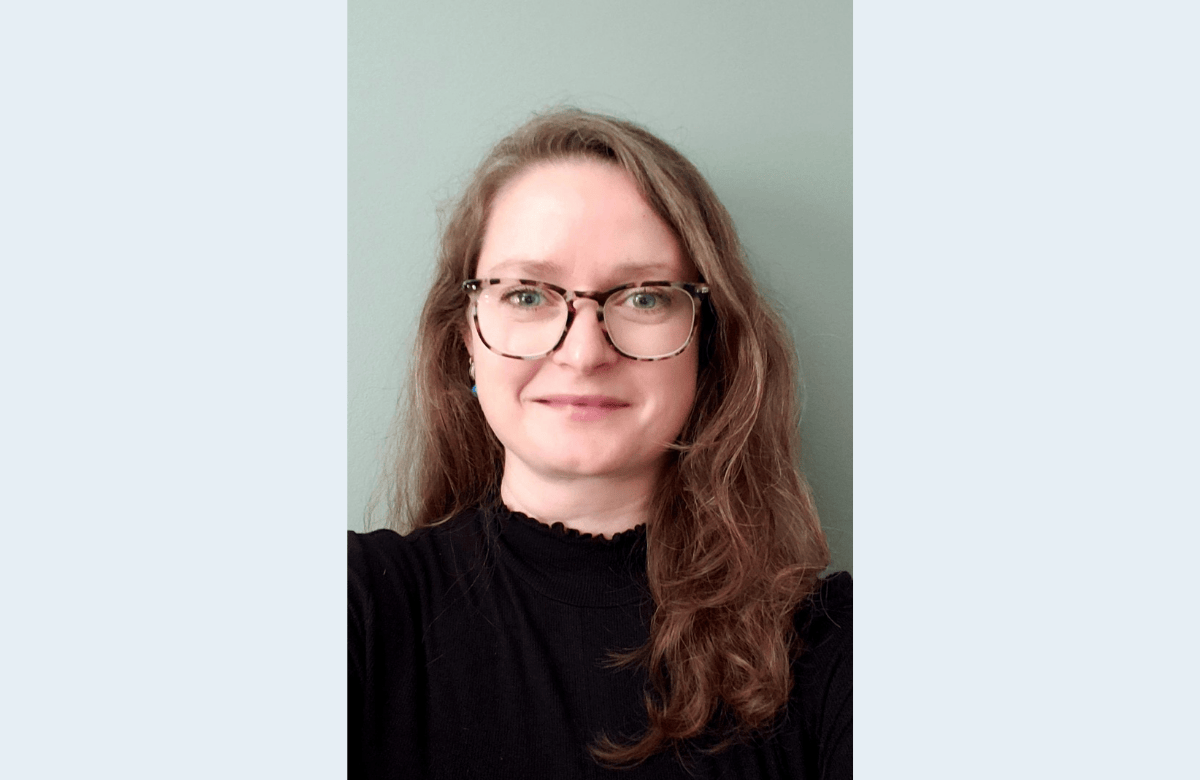
“I open the office window, and I see the town square. I’ve spent my childhood here,” says Professor Ellie Lovellette. “It feels so good.”
Professor Lovellette was born and raised in Blagoevgrad and left the city at the age of eighteen to study in Germany. She then went on to earn both her master’s degree and PhD in the United States and is now Assistant Professor and Graduate Program Director in Computer Science at College of Charleston. Recently, she applied for the Fulbright Scholar Program.
“When it came time to pick where to go for the Fulbright program, there was not even a question. AUBG was the natural choice,” she admits. “I was always curious about the university, but I never tried to apply. So, I figured, why not join AUBG on the other side, not as a student?”
Coming home to teach
During the Fall 2025 semester, Professor Lovellette joined AUBG as a Fulbright Scholar in Computer Science, teaching two courses and collecting data for a research project alongside her teaching.
Returning to Blagoevgrad after decades abroad had a sentimental value for Professor Lovellette, bringing her back to her childhood. “I love this town. It’s my favorite place in the whole world,” she says. “This town used to be very different when I was here in the ‘90s, but it’s still just lovely.”
From the side of teaching, AUBG also feels like a home to her. “It’s definitely very close to an American institution. It’s almost a seamless transition for me, like if I’m just in a different location, but the style and structure are the same.”
What stood out most to her were the students. “They’re just great kids,” she says. “It’s been a wonderful experience.” Professor Lovellette notes that they have a very high level of preparation. “Students already have a very, very solid liberal arts background,” she explains. “And their preparation in language and mathematics is very strong. That’s probably the biggest difference with the U.S.”
Combining teaching with research
“Faculty usually have about two research areas, if that,” says Professor Lovellette. Hers is centered around computer science education for novice programmers, particularly students who are in their first or second introductory programming course.
“I’m also interested in the use of virtual reality as a tool for mental health, but I haven’t gotten too far with that,” she says. “Computer science education is my first love and almost my only love.”
Another area she hopes to explore in the future is virtual reality in education, and the ground for that is particularly fertile, as the field is evolving rapidly and education is need of new and innovative teaching methods.
During her Fulbright semester at AUBG, Professor Lovellette took the opportunity to collect data for her upcoming research on the experience of students learning to program in a language that is not their first. “My research project has to do with English as the language of instruction for students learning to program, but for non-native speakers,” Professor Lovellette explains. “There’s been this question about whether English is a barrier to learning, and if it is, how much of a barrier it actually is and what we should do about it.”
Mentoring the next generation of computer scientists
Another role that Professor Lovelette holds is that of a Graduate Program Director for the master’s program and the accelerated bachelor’s-to-master’s track at College of Charleston.
She brings a thoughtful, student-centered approach to mentorship. “When I’m teaching, I see talent and I try to gently guide students toward a graduate degree,” she explains. “It doesn’t have to be at my institution. If I think somebody needs to go to grad school, I’ll tell them that.” What matters most to her is not where students continue their education, but that their abilities are recognized and cultivated. “If they come to us, great. If they decide not to, that’s also fine, as long as that talent is applied somewhere.”
This philosophy is particularly relevant in the current computer science and software engineering job market, which Lovellette describes as having “contracted a lot.” In this context, she sees graduate education as a strategic step. “Now maybe getting a little bit more education might give you a leg up,” she notes, especially for students seeking to deepen expertise or distinguish themselves in a competitive field.
A bittersweet goodbye
When it came time for her departure, Professor Lovellette described it as a bittersweet moment. She speaks very warmly of AUBG: “The university itself is really solid,” she says.
“I like everybody I work with, and the people are very friendly.” She even describes it as “the elite school in the Balkans.”
Looking ahead, Professor Lovellette hopes she will be able to return and teach again in the future. She is very interested in developing a study abroad or exchange program between AUBG and College of Charleston.
“I just really wish that this was not a single semester,” she admits.
After years of fast-paced academic life abroad, the rhythm of teaching and living in Blagoevgrad felt peaceful. “I’m sure my college is happy to have me back to teach my classes, but I got used to having a slower pace.”