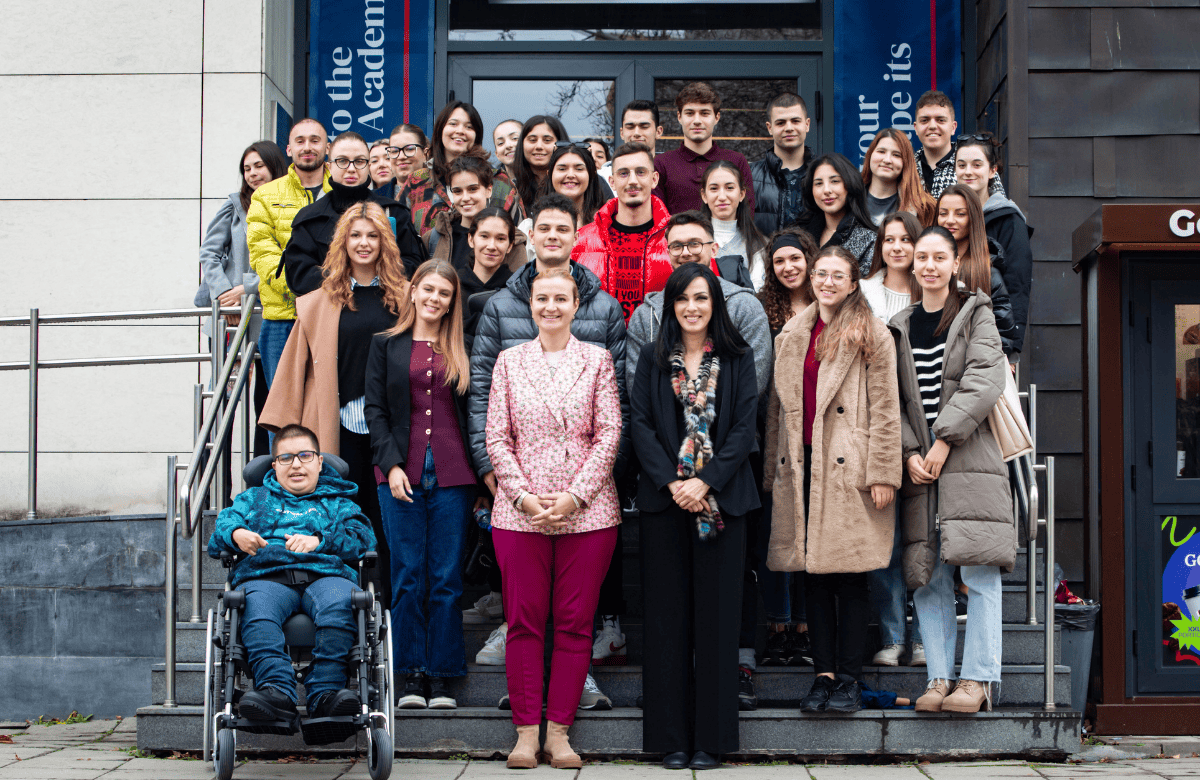
Prominent Bulgarian journalists Stanislav Ivanov and Victoria Petrova visited AUBG to discuss the challenges of navigating truth in a world overwhelmed by fake news and algorithm-driven content.
In an age of AI-generated misinformation and media saturation, identifying the truth and maintaining journalistic integrity is becoming increasingly difficult. So how can you navigate a noisy and complex information landscape while staying informed and advocating ethical journalism?
Ivanov and Petrova offered strategies to preserve truth in a rapidly evolving media environment.
Who is orchestrating the flow of information?
Stanislav Ivanov pointed out that there is a larger player who is controlling the flow of information.
“Many people think that the media outlets set the pulse of the information we consume, but it’s tech giants that truly navigate the ocean of information,” he explained.
Even major Western media outlets, combined, do not hold a fraction of the value of a single tech giant like Google. The manipulation of public opinion through fear, propaganda, and algorithms is, as Ivanov noted, “perfectly in sync with tech giants’ playbooks.”
The problem, he explained, is that people often accept as truth what already aligns with their beliefs and emotions rather than the objective. This gives rise to “alternative facts” and multiple versions of the truth.
Traditional media vs social media
Ivanov and Petrova highlighted the waning trust in traditional media, worsened by conspiracy theories, and the rising dominance of social media platforms.
“In Bulgaria, trust in traditional media is 44%, comparable to the UK, while Greece has the lowest point of trust at just 13%,” shared Ivanov.
Fake news is everywhere, and “it’s pushing the idea that history, literature, and even reality aren’t what they seem,” he added.
Victoria Petrova pointed out that many people consume news with preconceived notions. “At 7 pm, they tune in to the news already convinced they know what will be said – because they’ve read it on Facebook,” she observed.
She noted that in 2017, the Reuters Institute published a report predicting the decline of TV networks within two years. However, when the pandemic hit, “it became clear that you can’t inject bleach into your veins as Facebook suggested,” said Petrova. People began to scrutinize the news they consumed. “Even the most avid social media users turned to traditional TV for accurate updates – not out of preference, but because it became the quickest route from decision-makers to the public,” added Petrova.
Age also influences media habits. In regions like the Middle East and Africa, where the average age is around 22, TikTok, Instagram, and Facebook dominate. Conversely, in Bulgaria, where the average age is 44, people still watch traditional TV.
Yet, social media often outperforms traditional media in reach. “I use social networks to share opinions expressed on bTV, and sometimes, the reach is greater there than on live broadcasts. For instance, a bTV editorial reached one million people on social media compared to 800,000 live viewers,” Ivanov shared.
He also warned of the growing of realistic AI-generated fake videos and the addictive nature of short vertical videos, TiTok style, which he called “the king of content.” He referenced “brain rot”, Oxford Dictionary’s word of the year, describing endless, mindless scrolling on social media.
How to recognize fake news
In 2024, with a record number of elections worldwide, social media platforms struggled to filter fake news, so they suppressed all news content.
Ivanov proposed a better solution: media literacy and critical thinking. “It’s a long process, perhaps years, but essential to counter misinformation,” he said.
He noted that the format of news itself is evolving. “I discussed this with the founder of Al Jazeera English over a decade ago. When he left, he said, ‘I’m tired of creating puzzles in people’s minds,’” Ivanov shared.
Petrova highlighted the importance of verifying news sources. “This might surprise you, but I don’t use social media, so that’s not a source I rely on for information.
Ask, ‘Who said it? Where did this happen?’ I guarantee you that if you answer this simple question, in 90% of cases, your information will be accurate. Also, if you can’t answer or verify it through another source, don’t trust it. Use it cautiously, knowing it might influence others who won’t question it,” she advised.
The role of the journalist
A good journalist adheres to classical principles, serving as a guardian of truth amid the noise of misinformation. Journalists have a difficult task at hand – to restore trust in traditional media and to guide audiences toward objective truth over alternative facts.
“Some may not agree with us,” Ivanov noted, “but if we can get them to listen, that’s a big success.” He emphasized the urgency of journalism: “We’re drowning in an ocean of information and misinformation every hour. The fight is to keep our audience’s attention because that’s how we can fulfill our mission.”
Ivanov called journalism a mission to inform and defend society from bad actors who distort reality and create division. “Dividing a nation weakens its society, state, and institutions – a danger we see especially in our region,” he warned.
Petrova highlighted journalists’ responsibility as mediators. “You’re the bridge between the public and political figures. You have enormous power because what you say on TV shapes public opinion, especially in small towns where television is often the sole source of information. Do you realize in the responsibility in your hands outside of TikTok and Facebook?” she provoked future journalists.
She cautioned against manipulation: “It’s human to influence perceptions, but let people decide for themselves. Your guiding principle should be to intervene only when confusion undermines humane values. Everything else is a matter of preference.”