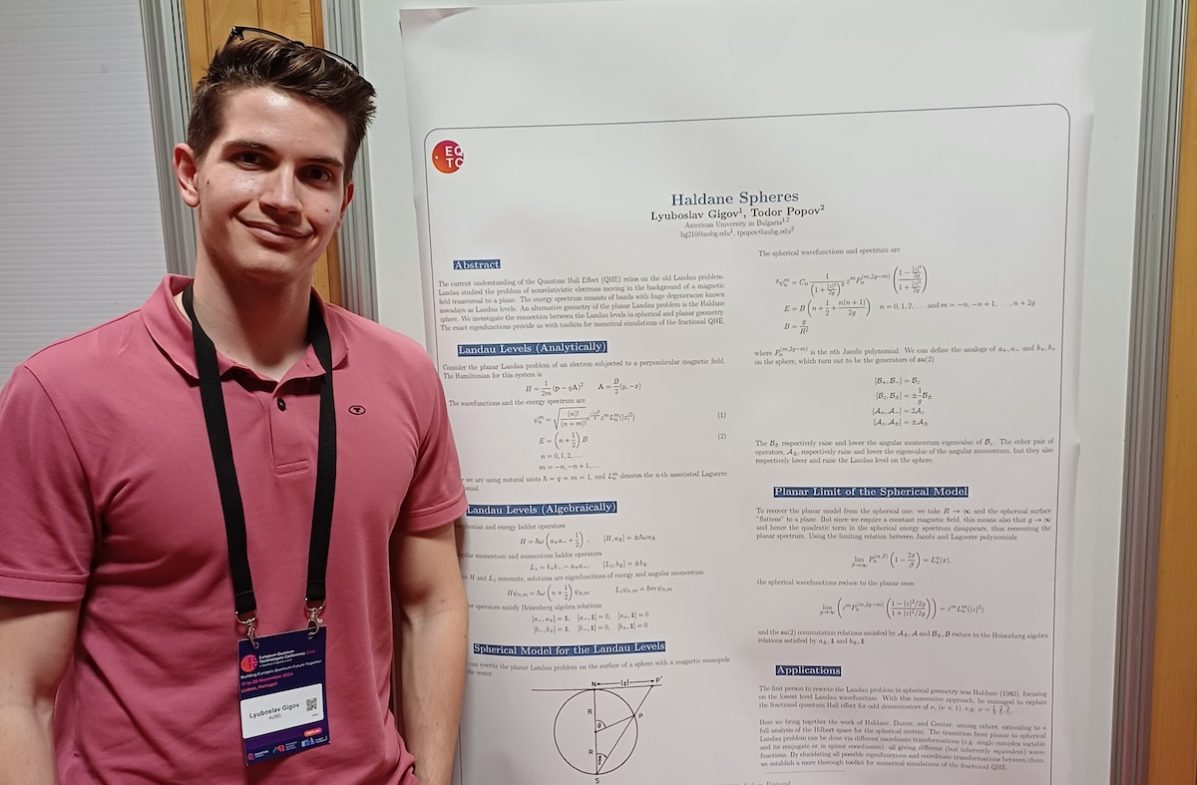
In Fall 2024, the senior student Lyuboslav Gigov participated in the European Quantum Technologies Conference (EQTC) held 18-20 November 2024 in Lisbon, Portugal, organized by the Portuguese Quantum Institute (PQI). EQTC aimed at showcasing the latest developments of research and innovation in Quantum Information Science and Technology, and discussing the corresponding scientific and technological challenges ahead.
He participated with a poster presentation on the topic of “Haldane Spheres”.
“This was an extension of my senior project in Physics under the supervision of Prof. Todor Popov,” Lyuboslav said. “He introduced me to this conference and suggested I go, so I consider him as the initiator of my research journey.”
Here is our paper’s abstract:
The current understanding of the Quantum Hall Effect (QHE) relies on the old Landau problem. Landau studied the problem of nonrelativistic electrons moving in the background of a magnetic field transversal to a plane. The energy spectrum consists of bands with huge degeneracies known nowadays as Landau levels. An alternative geometry of the planar Landau problem is the Haldane sphere. We investigate the connection between the Landau levels in spherical and planar geometry. The exact eigenfunctions provide us with toolkits for numerical simulations of the fractional QHE.
Lyuboaslav expressed gratitude for having the opportunity to attend the conference thanks to the AUBG Student Travel fund that covered the attendance fee and accommodation.
“I would like to express utmost gratitude to Sabina Wien and Yordanka Trenovska who went out of their way to support me even though they were on vacation. The process went really smoothly and I will be forever grateful to AUBG for supporting me to visit such a beautiful city to represent our university at the forefront of quantum science.”
In addition to this, as part of his physics studies, Lyuboslav also participated in the 4th National Congress on Physical Sciences in Sofia, Bulgaria, his first conference presentation ever. Motivated once again by Prof. Popov, he presented the early stages of their work on ‘Haldane spheres,’ gaining experience in communicating his ideas to a scientific audience.
“Just a month before EQTC, the Sofia presentation served as an essential preparation: it allowed him to refine the structure of his talk, anticipate the kinds of questions researchers might ask, and gain confidence in presenting his results publicly. This made the transition to the international stage in Lisbon smoother, helping him represent AUBG with clarity and professionalism at one of Europe’s major quantum science events.”