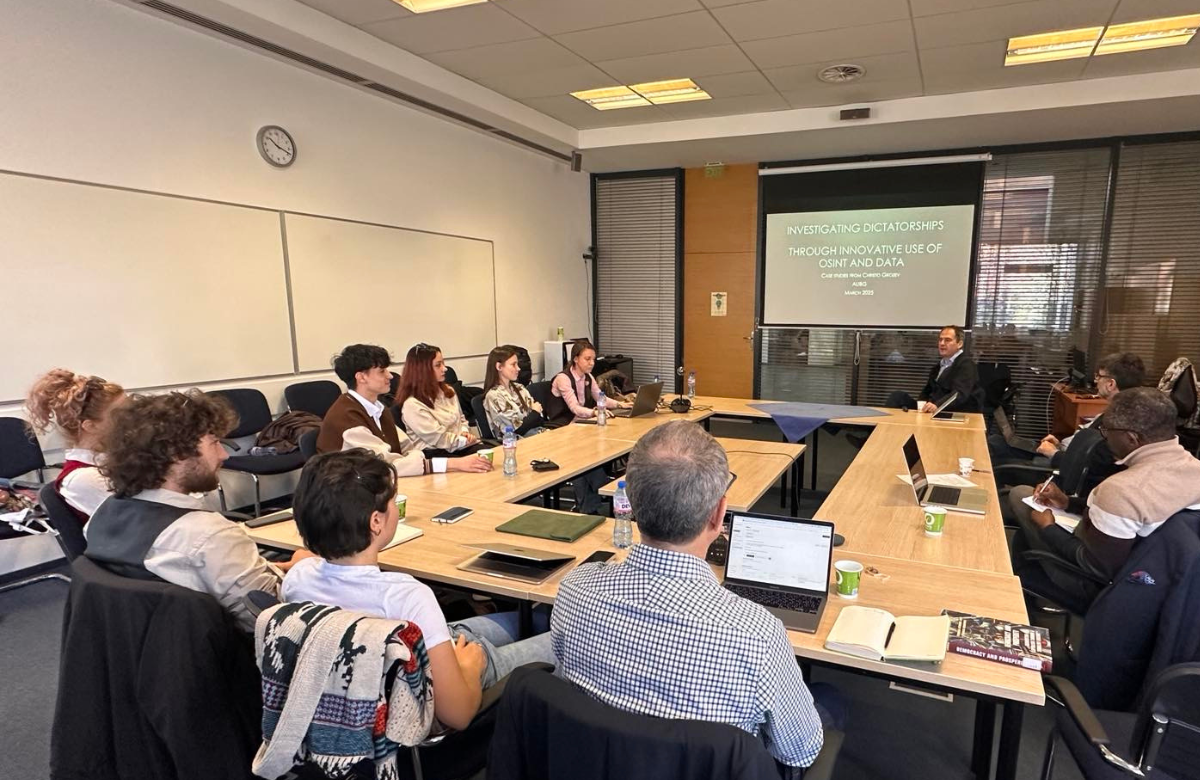
With democracy under siege and disinformation metastasizing at an alarming pace, our new cohort of journalism fellows has just completed a tailor-made intensive training at the American University in Bulgaria (AUBG). Designed by the Center for Information, Democracy, and Citizenship (CIDC), the training workshop was an intellectual and applied boot camp for reinventing journalism at a time when factual media is under increasing pressure.
The Christo Grozev Fellowship for Courageous Journalism and the Bulgaria International Journalism Fellowship (BIJF) – both anchored in CIDC’s Factual Media Advocacy program – brought together experienced and budding journalists to equip them with cutting-edge Open-Source Intelligence (OSINT) techniques, digital and personal safety techniques, human rights and ethical trauma reporting methods, and impact-driven storytelling strategies.
The training ran from March 5 to March 10 and was the jump-start to the fellows’ upcoming journalistic work.
The Imperative of Investigative Journalism in an Age of Disinformation
The weeklong program unfolded against a backdrop of deepening geopolitical tensions and increasingly sophisticated disinformation operations. Among the participants were Grozev Fellows Philip Obaji Jr. and Finn Perelstein, BIJF Senior Fellows Spas Spassov, and Joanna Elmy, as well as a cross section of AUBG students serving as Junior Fellows in the BIJF.
Philip Obaji Jr., who was recently awarded the Homo Homini Prize 2025 in Prague in recognition of his exceptional contributions to human rights and press freedom, said, “It was a really great workshop, and I enjoyed every bit of it. I did learn a lot from all the resource persons, and from other fellows who are incredible. This is one of the most important workshops I’ve ever been involved in, and it is certainly going to shape my career as a journalist.”

Philip is known for his fearless investigation into human rights violations by Russian paramilitaries in Central and West Africa.
BIJF Junior Fellow Viktoria Bozhinova, a senior in the Journalism and Mass Communication department at AUBG, described the training as an “incredible experience”.
“It was inspiring to connect with so many passionate journalists,” she said. “I gained a ton of knowledge in such a short time. I’m definitely more excited and ready to dive into journalism,” she added.
Mastering the Tools of the Trade
The training drew on the expertise of some of the world’s leading investigative journalists, security strategists, and human rights advocates.
- Christo Grozev, the legendary investigator whose OSINT work exposed the Russian intelligence operatives behind the poisoning of Alexei Navalny among other ground-breaking exposés, led intensive sessions on tracking state-sponsored crimes, uncovering corruption, and navigating current geopolitical shifts.
- Mariana Katzarova, the UN Special Rapporteur on the situation of human rights in the Russian Federation, trained fellows on how to investigate human rights violations; techniques of trauma-sensitive interviewing; ethical reporting of atrocities, and how to maintain professional detachment while remaining empathetic to victims. Her message was clear: be empathetic, even with the perpetrator – but not sympathetic; recognize your own trauma and seek professional psychological help when needed.
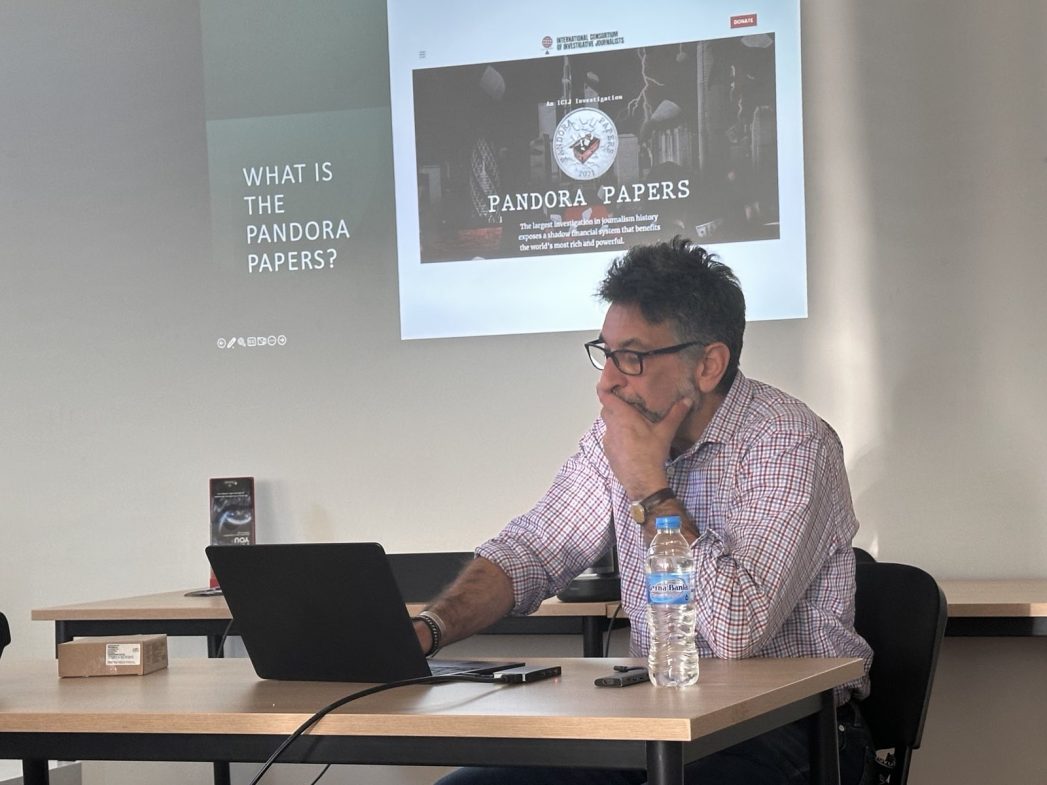
- Dean Starkman, a Pulitzer Prize-winning journalist and Editorial Director of the BIJF, walked participants through the mechanics of transnational investigative collaborations, drawing lessons from the Pandora Papers, Paradise Papers, and other groundbreaking cross-border exposés, in which he participated.
- Lionel Rawlins, security expert and former US Marine, currently serving as the National Security Adviser to the Prime Minister of the Federation of St. Kitts and Nevis, drew on his experience in Afghanistan, Iraq, and Sub-Saharan Africa to deliver a workshop on assessing risks, reporting from conflict zones, and anticipating threats in hostile environments.
- Eleonora Hristova, Senior Content Manager at AUBG’s Office of Communication and Marketing, led an advanced session on online audience management and SEO optimization to ensure that investigative reports reach not just the right people, but as many people as possible.
- Illia Hanchev, program manager at CIDC delivered training on project management, productivity, and collaboration tools for managing complex journalistic projects.
Beyond the Classroom: Confronting the Realities of Power and Risk
The fellows spent the week sharpening their journalistic tools, meeting in groups and one-to-one with Christo Grozev and Dean Starkman who mentor the Grozev fellows and the Bulgaria International Journalism fellows, respectively.
Reflecting on the training, Starkman said, “Journalism needs a stable platform and a protected space to produce great work, and we’re lucky to have one, courtesy of the CIDC. To have five full days of training is amazing these days, and for it to include learning from Christo Grozev is more amazing still. All of us in the BIJF are grateful for that opportunity. Now we’re eager to get to work.”
The intensity of the program was complemented by a screening of the Academy Award-winning documentary Navalny—which chronicled the investigation into one of the most brazen state-sponsored assassinations of recent times—setting the stage for a reflection on the perils of investigative journalism. In his introductory remark at the screening, Grozev, whose work formed the basis of the film, spoke candidly about the personal costs of exposing authoritarian regimes.
The fellows also embarked on a cultural immersion in Blagoevgrad with a visit to the Museum, where they gained historical and political context for the evolving landscape of democracy in Eastern Europe. Informal networking dinners with AUBG leadership and CIDC’s Advisory Council fostered relationships between the fellows and CIDC-AUBG leadership and seasoned veterans.
A Blueprint for Journalism’s Future
The CIDC’s Factual Media Advocacy program is an investment in the survival of independent journalism at a time when journalists are increasingly denigrated by authority figures.
“Investigative journalism remains one of the most powerful instruments for democratic accountability,” said Dr. Jacob Udo-Udo Jacob, Executive Director of CIDC. “Through our fellowship programs, we are equipping journalists with the tools to ensure that factual, fearless journalism continues to shape the global democratic order.”
The Christo Grozev Fellowship for Courageous Journalism, named after the AUBG alumnus and global investigative powerhouse, embodies this commitment. Its mission is to cultivate an elite cohort of journalists who will use OSINT, digital forensics, and in-depth reporting to expose corruption, counter disinformation, and hold power accountable.
The Bulgaria International Journalism Fellowship (BIJF)—funded by the America for Bulgaria Foundation—seeks to reinvigorate Bulgaria’s independent press by fostering global collaborations and reportage of Bulgaria’s democratic journey to the world.
A Global Network of Truth-Seekers
As the fellows dispersed to their respective assignments, they carried with them more than just knowledge—they took with them a network, a methodology, and a sense of mission.
The CIDC’s approach is deliberately global. It seeks to foster cross-border collaboration and ensure that investigative journalists are not working in silos but as part of a larger, more resilient ecosystem. For more information about CIDC’s fellowship programs, visit CIDC’s official website.