Many women aspire to take on leadership roles, but few know the winning formula. In a world where women’s rights have progressively advanced, and where more women are taking a seat at the table, gender equality in senior leadership remains a work in progress. The latest Women in Business research from Grant Thornton shows that women now hold 31% of senior leadership roles in the U.S., down from 34% in 2025. For women who want to move into leadership, learning how to navigate this path is key.
Along her path to leadership, Miglena Ouzounova-Tsekova learned that talent alone was not enough. To move forward, she needed a few other ingredients alongside her evident capabilities.
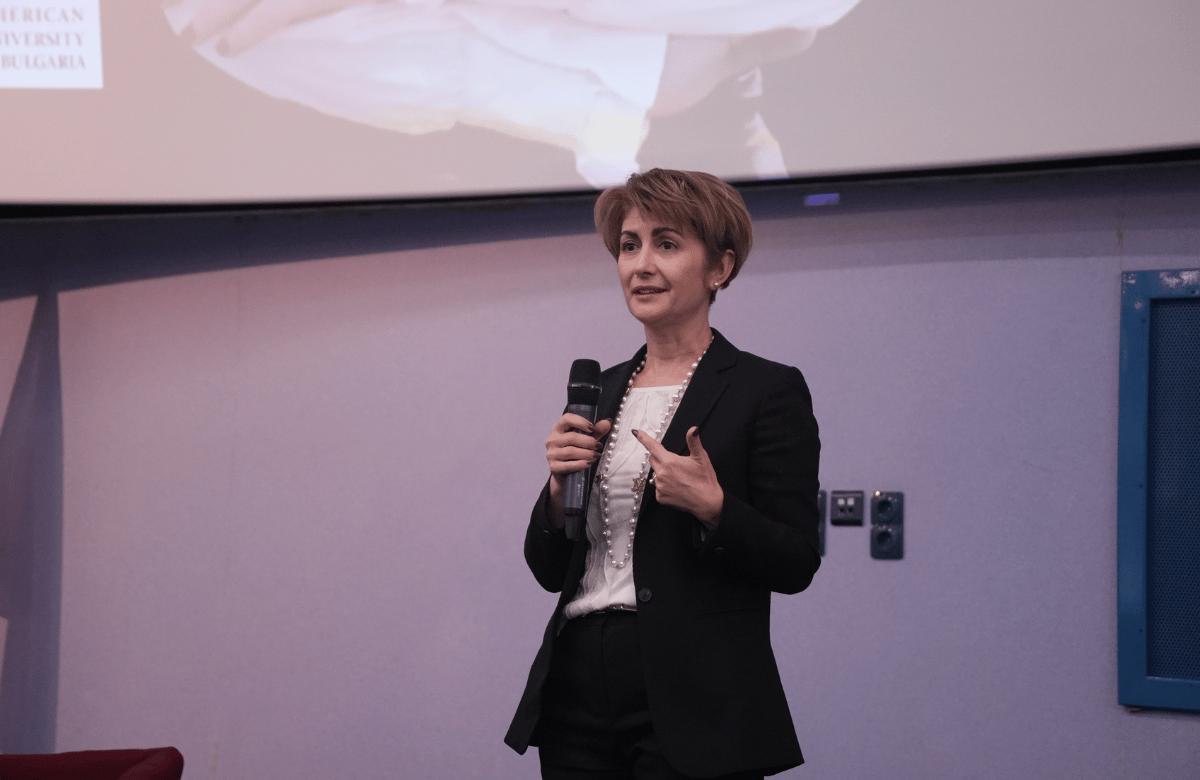
Today, Miglena is Senior HR Director and member of the Leadership Team at A1. She is also a dedicated mentor to many women, both in her corporate role and in her capacity as a member of the Management Board of the Council of Women in Business in Bulgaria. At her EMBA Leadership Talk in Sofia, Miglena shared what can help accelerate women’s careers today, offering practical steps.
Who gets noticed?
Speaking up can still carry a stigma, especially for women. While silence can often be associated with being poised, thoughtful, and reflective, in professional environments, it can be read as absence.
“When I entered the corporate world, I realized that silence is taken as lack of opinion, or lack of knowledge, lack of confidence, even lack of capability,” shared Miglena.
This made her realize that others also needed to see her readiness and talent. “It is not that women are not talented or well-spoken or educated or gifted,” she said. “It is that they are not loud enough or they are not visible enough.”
This raises the question of who gets noticed and who is considered for the next opportunity. Is it the person who is most capable, or the person whose capability is most visible?
The winning leadership formula
For Miglena, talent is the natural starting point of any leadership journey, and without it, we cannot even consider the next steps. As an HR leader, she emphasized that organizations invest significant time and resources into identifying and developing talent, but talent alone does not always determine who progresses.
In Miglena’s view, talent needs to be supported by three other equally important elements: visibility, advocacy, and opportunity. “Talent is what gets us in the leadership room,” Miglena said. “But I believe that we have to be smart enough to navigate talent.” This is why in her leadership role in A1 Miglena strongly encourages her teams to develop and implement talent development and learning opportunities for employees to pursuit their professional and career growth. The number of women in management positions in the company is a significant percentage, impressive for the High Tech industry.
Part 1: Visibility
The first key ingredient is visibility.
“I’m not talking here about showing off in the negative connotation of the word,” she said, “but rather making sure that your voice is heard, your performance is recognized, and the results are associated with the business impact that they have.”
Women often associate visibility with self-promotion or feel uncomfortable drawing attention to their achievements, “because modesty is often socially rewarded and perceived as a personal value.” In the positive sense of the word, visibility is about building trust.
“Healthy visibility means sharing ideas, speaking up with value, and allowing your work to be seen without losing authenticity,” shared Miglena.
Part 2: Advocacy
The next part of the equation is advocacy, which can happen through mentorship or sponsorship. While mentorship can guide, advise, and support someone’s development, sponsorship puts a person forward.
“If the mentor is supporting you with growth, sponsorship is really someone who is helping you not just enter the leadership room, but find your way there,” she said.
According to McKinsey and LeanIn.Org’s 2025 Women in the Workplace report, employees with sponsors have been promoted at nearly twice the rate of those without sponsors in the past two years.
Part 3: Opportunity
The final element is opportunity. While some people rely on chance, which may sound accidental, opportunity can be created. It can be created by leaders who notice talent before it becomes loud; by organizations that look beyond stereotypes; and by cultures that do not confuse modesty with lack of ambition.
Miglena shared that there are still many stigmas around women’s behavior in the workplace. For example, work flexibility, which many women may need or value, is often associated with lower engagement. Family focus can be misread as lack of ambition. Staying longer with one’s children on maternity leave can be wrongly interpreted as not being ambitious enough to get ahead.
This is why, for Miglena, the responsibility does not sit only with women who aspire to leadership, but also with those who already have influence.
“As a leader, I wanted to leave you with a question for you leaders: Are we really supporting the next generation by giving them opportunities to grow into leadership roles?”
How to lead before you have the title
For women who want to move into leadership, Miglena urges them not to wait for the title to start acting like leaders. McKinsey and LeanIn.Org found that four in ten entry-level women have not received a promotion, stretch assignment, or opportunity to participate in leadership or career training in the past two years.
“Demonstrate leadership before getting the title,” she said. “Take ownership, lead new projects, mentor others, show initiative.”
This is where visibility becomes key. “Step into new responsibilities,” Miglena advised, adding that women should “proactively build visibility by contributing to key projects and strategic discussions where you can make an impact.”
Another important step, according to Miglena, is to look beyond mentorship. Mentors can offer guidance, perspective, and advice, but women also need advocates – people who can speak for their potential when opportunities are being discussed. “Build relationships with leaders who can recommend and sponsor you,” she said, so that you have someone in the room who understands your work, trusts your abilities, and is willing to put your name forward.
Finally, Miglena emphasized the importance of communicating ambition openly. “Many opportunities start when managers know you are ready and willing to grow.”