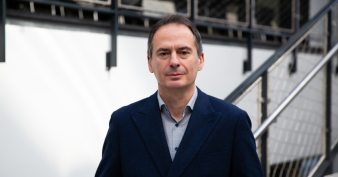
We’re delighted to introduce the members of the CIDC Advisory Council—nine distinguished experts whose experience and perspective help shape CIDC’s strategic direction. This week we bring you the insight of Dr. Velizar Shalamanov – former Bulgarian Defense Minister and security expert with an impressive career spanning the Bulgarian Armed Forces, NATO agencies, and academia. His opinions are sharp and thought-provoking. Known for his incisive analysis and unorthodox perspectives, Dr. Velizar Shalamanov is always a voice worth listening to.
Tell us one story from your career that taught you a valuable lesson.
Important things normally require prolonged effort, and results come later. So when you take on a new position, it is important to enter it with a goal and a vision of how to engage and motivate the people that will continue the effort after you move on. This is something I learnt during my mandates in the Bulgarian Ministry of Defense 1998-2001 and in NATO 2009-2017, even as Minister of Defense in the short interim government of 2014 that lasted only 100 days.
I came from Brussels with a clear goal in preparation for the Wales Summit – to have Vision 2020 agreed on as a mandate for the Delegation on defense and use it as the base for achieving a formal decision of the Bulgarian Government for the modernization of our defense strategy. It was clear to me that in 100 days I will return to NATO and it will be the new government taking further decisions on defense policy based on the agreements reached at the Wales Summit.
So I used these 100 days to bring the leadership of the Ministry of Defense together around Vision 2020, to get support from the Foreign Minister, the Minister of Finance and Industry, the Vice Prime Minister for the Security Sector, the PM himself as well as the President who was leading the delegation. We organized an industrial forum with representatives of Bulgaria’s business sector and the Assistant Secretary General of NATO, General Managers of the two NATO agencies (NCIA, NSPA), and the Deputy Executive of EDA, also inviting newly elected members of the Parliament under the leadership of the President. The goal was to secure a common understanding and real commitment for the priorities and approaches we were advocating for.
Now, 10 years later this framework still shapes the developments in our defense strategy – the same way that in the past Plan 2004, agreed upon in 1999, was shaping our defense reform up until our full fledged NATO membership. All of this because of people’s shared understanding and commitment to the effort, which was formed together in this very short time at the beginning of the mandate.
What is a key marker about where things are going right now in Eastern Europe that is overlooked and we need to pay closer attention to? What would be a signal for good development – and for things going really badly?
A clear attitude towards conventional deterrence of Russia, and resilience to Russian destabilization operations. It will be a very good signal if nations develop and deploy modern capabilities for conventional military deterrence, and achieve a much higher level of resilience to Russian information attacks. What would be really bad is to see pro-Russian parties or leaders coming to power through elections, as well as a lack of interest in developing defense capabilities in a NATO framework for successful deterrence of Russian aggression.
Through the lens of your line of work, what is one significant but under-discussed trend affecting democracy globally today?
Lack of visionary leadership. Inspiring people who are pro change and lead with integrity, embracing the value of freedom on the one side, and technology on the other. We see this deficiency in the performance of our presidents and party leaders in Bulgaria. And democracy depends on such leadership, the same way it depends on the active participation of all people, of active citizens with an ability to self organize. So with the upcoming 2026 elections, we have to be able to envision what type of leader we need for democracy to flourish in Bulgaria. And the other free nations have to do the same in their upcoming elections, so that these leaders can form a new wave of a democracy for people and for freedom.
Who is the one expert/agent/thinker you would recommend people follow closely in order to understand the world better right now and why?
The real problem is that, at least for me, it is difficult to name one such expert/agent/thinker. In the past it was possible to name Zbigniew Brzezinski, Henry Kissinger, Alvin Toffler and many others, but now – I have a difficulty. So maybe we need to use AI to follow trends. But even more we need to look inward for our own understanding of the world – and then participate in the debate. For sure we need someone to explain the world we live in, as the world we are co-creating is getting more and more complex. I am sure that someone will appear soon… as we definitely need them. I could recognize that need especially last year working closely with Prof. Georgy Fotev on the foreign policy strategy of Bulgaria, and reading about 5-6 of his books in a row. I could point to him as a person whose view of the world I very much share.
Dr. Velizar Shalamanov is the Head of Bulgaria’s delegation to the NATO Parliamentary Assembly and Bulgaria’s former Defense Minister (Aug-Nov 2014). With a career spanning the Bulgarian Armed Forces, Ministry of Defense, NATO agencies, and academia, he has contributed to defense modernization, cybersecurity, and NATO integration. He is currently a Deputy Director at the Bulgarian Academy of Sciences and Director of Defense Capabilities at the Atlantic Club of Bulgaria.