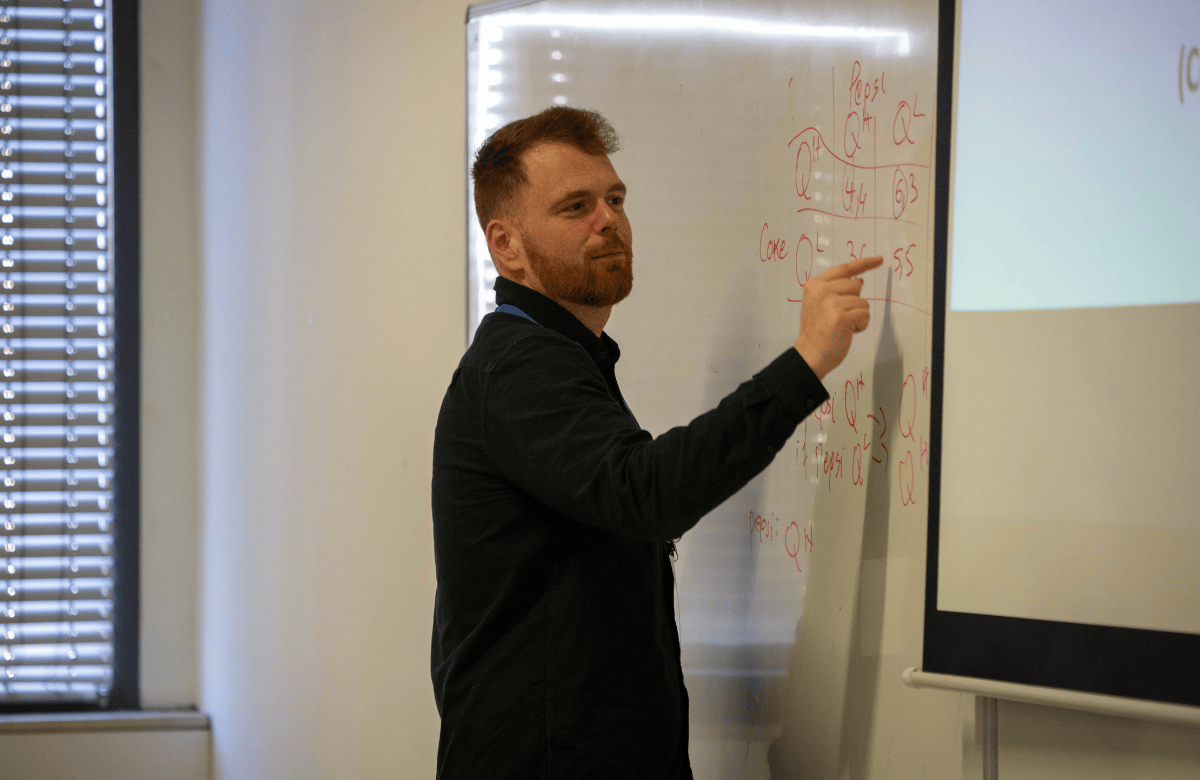
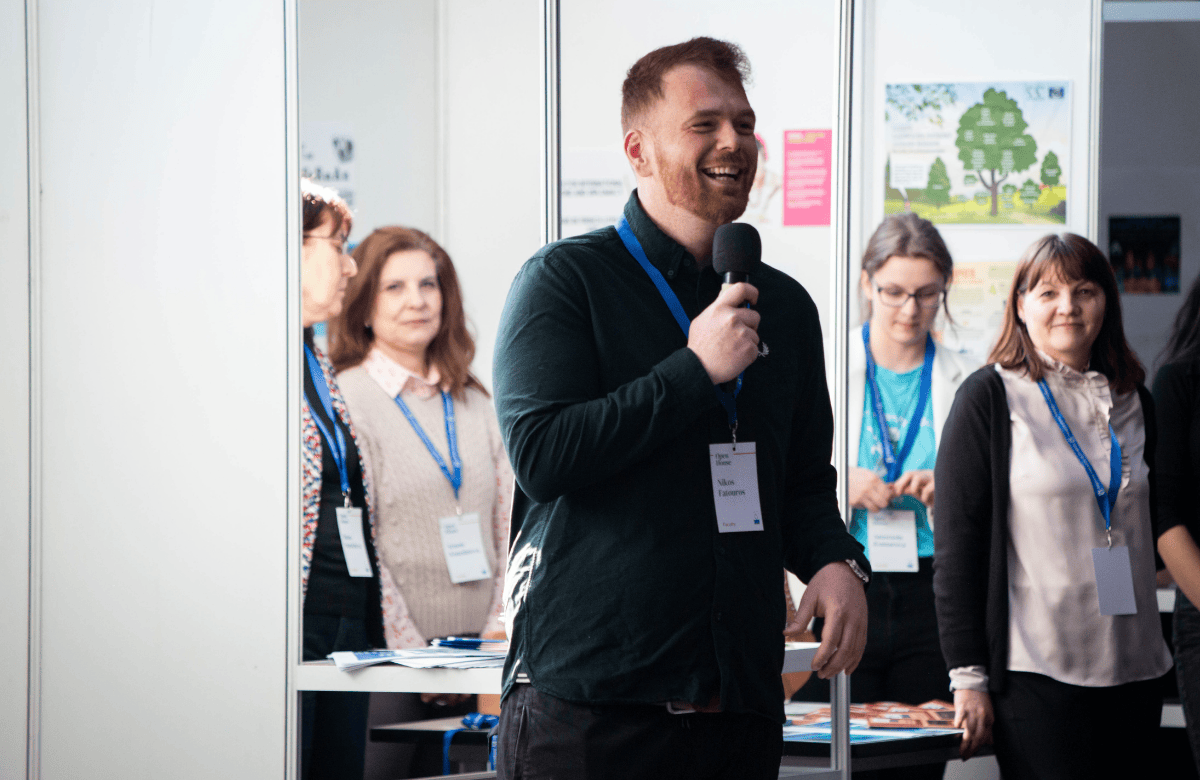
Professor Nikos Fatouros joined AUBG in the 2024/2025 academic year and is already serving as the Interim Chair of the Economics Department.
His research interests go beyond plain economics. Professor Fatouros is an avid explorer of environmental economics, natural disasters, and nuclear energy, and that innovative approach is what guides his teaching.
Professor Fatouros is open to new teaching methods, and his view on adaptability in career development is both ahead of his time and very much aligned with the new era for education.
Today, we learn about what this esteemed professor with Greek roots, Balkan perspective, international experience, and an inventive academic mindset brings to AUBG, and why he chose to teach at a small liberal arts university in Bulgaria.
Economics of the 21st century
When we asked Professor Fatouros what economics is really about, he emphasizes on the role of people and happiness. “Economics is a misunderstood science,” he says. “What economists actually do is try to explain human behavior and figure out how we can improve welfare, not just numbers.”
He says that cost-benefit analysis is central to the field of economics, and that resonates with Professor Didar Erdinc’s words on how everyday purchasing decisions are based on cost-benefit analysis, from a concert ticket to milk. Professor Fatouros explains, “the cost, especially in production, is both a monetary cost but also in terms of emissions and environmental quality.”
This human-centered, environmentally conscious understanding of the discipline is what drives Professor Fatouros’ teaching and research in environmental and energy economics.
Multidisciplinary roots and academic curiosity
Professor Fatouros’ interests are varied. He went to engineering high school to practice his love for mathematics and physics. “I’ve always had an affinity for physics and social sciences. But I also love more positive sciences, such as economics,” he says.
During his PhD at the University of Guelph, this multidisciplinary mindset fully came to life. A period of intensive reading on nuclear energy led to his first dissertation chapter, combining environmental science, energy policy, and economic analysis. That blend still informs his research and teaching approach, and is what led him to and made him fall in love with AUBG in the first place.
Finding AUBG: “It felt like home from day one”
Before arriving in Blagoevgrad, Professor Fatouros held academic positions in Canada, the UK, and the University of Birmingham’s Dubai campus. Dubai, he admits, made him realize he needed a change and that he wanted to work in a place where he could see himself long-term. A colleague suggested applying to U.S. universities, and a browse through the American Economic Association’s job board led him to AUBG – an unexpected destination for him which he hadn’t heard of before.
But the more research he did, the more AUBG started to grow on him. “I started seeing it for what it is: a small, cute campus resembling one from the U.S., but at the same time in the heart of the Balkans. I saw how professional things are here.”
When he visited the campus for his teaching demonstration, everything clicked. “The moment I came here, I fell in love with the place. For me, it combines something I think would be really hard to find anywhere else.” And that’s precisely the Western academic approach with the cultural familiarity of the region.
“For someone who’s always felt ‘too Greek’ abroad and ‘not Greek enough’ at home, this place made perfect sense,” said Professor Fatouros.
“Ever since day one, I never felt that I needed any transition period. What really helped was my colleagues who were so friendly and accommodating from the beginning,” he shared.
Now living in Blgaoevgrad, Professor Fatouros has found himself a home. “With the exception of Dubai, I’ve always lived in small towns. Blagoevgrad fits me perfectly. It’s incredibly beautiful.”
On weekdays, he enjoys the rhythm of classes, research, gym sessions, and campus life. On weekends, Greece is only an hour’s drive away.
“I never feel far from home anymore. I can go to Thessaloniki, Sofia, or even my hometown easily. The location is ideal, because you have more options than you would anywhere else.”
Innovating the classroom
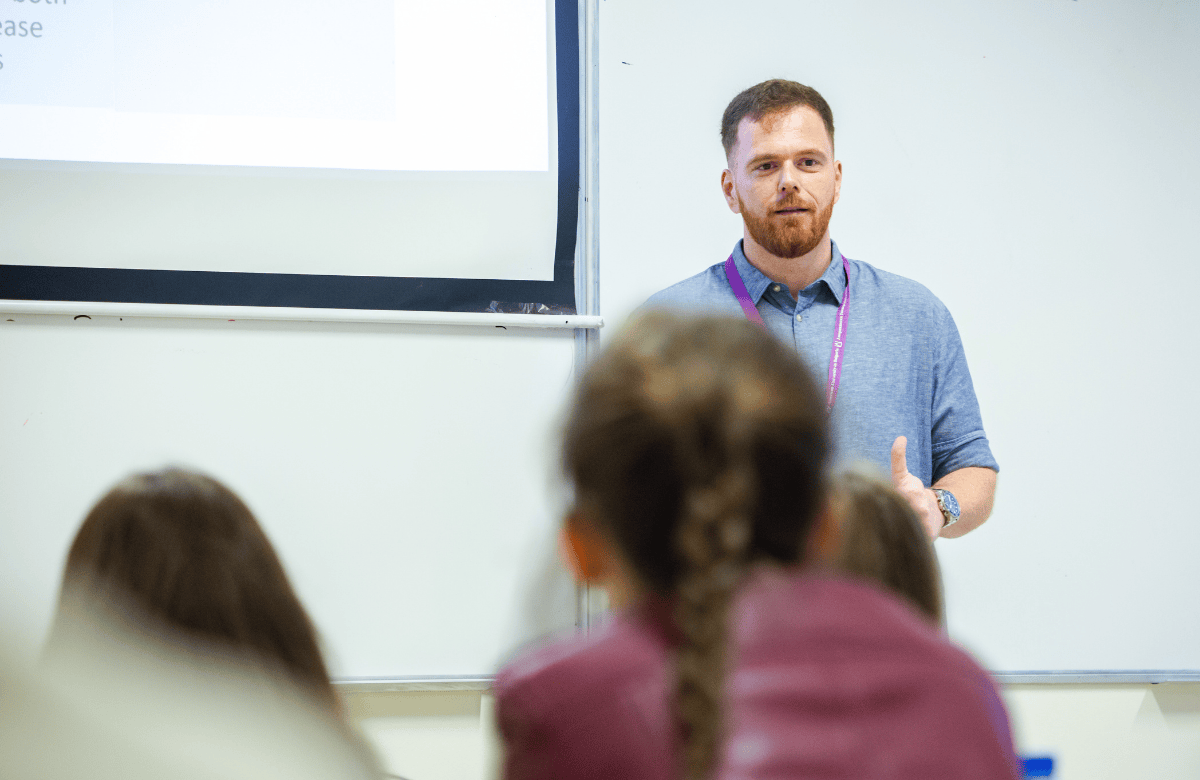
Professor Fatouros has taught in Canada, the UK, and Dubai, yet he feels the closest to the AUBG students. “They remind me of students in Greece, but within a much more dynamic, liberal arts environment,” he says.
Being relatively young and familiar with the Balkan mentality, which many AUBG students share, helps him connect with them more easily and adapt his teaching methods accordingly.
His teaching philosophy centres on making economics real. In courses such as Principles of Microeconomics, Environmental and Energy Economics, and Game Theory, he demonstrates what economics thinking can do for people outside the classroom.
“I give a lot of real-life examples, because economics is real life,” he says. “To understand the science, students must connect theories to human behavior and the world around them.”
He is also a big supporter of peer learning, and at the start of every semester he does one particular exercise that is favored among students. He divides them in groups, and they work on the hardest topic of the course. Knowing that any group and any individual within that group may be randomly selected to present the solution to the entire class, motivates students to not only understand the material but also to make sure that their peers know it well too.
“It’s not just about solving the problem. It’s about collaboration, responsibility, communication – skills students need far beyond economics,” he says.
Above all, Professor Fatouros avoids imposing personal views. “I share my opinions only as examples, never as fact. My role is to help students learn how to form their own perspective, evaluate information, and engage respectfully, even when they disagree. That’s essential for democratic citizenship and central to the AUBG mission.”
Educating for the future
Professor Fatouros is an educator of the new time. He understands that teaching is about much more than imparting knowledge.
“I have two roles. One is being a professor of economics and the second, more important, is simply being a professor.”
While one of his goals is to make students fall in love with the science of economics like he did, the other is to nurture them into becoming informed citizens that can have arguments respectfully and stand behind their truth.
When it comes to advising students on what path to take in life, he emphasizes adaptability as the highest skill. “It’s the best predictor of success,” says Professor Fatouros. “It means recalculating different situations, reassessing your views, and trying to fit into the new normals.” He notes that while “new normals” used to emerge every ten years and later every five, today they seem to appear almost every month.
To illustrate adaptability, he shares that different topics come and go in cycles, and there is no sure way to predict what will be trendy in ten years, for example.
“I don’t think that any student should be focusing on trying to predict a field that is going to be in demand, especially with the rise of AI. Instead, I think that any field that is helping you develop critical thinking and problem-solving will be the most applicable and valuable to you.”