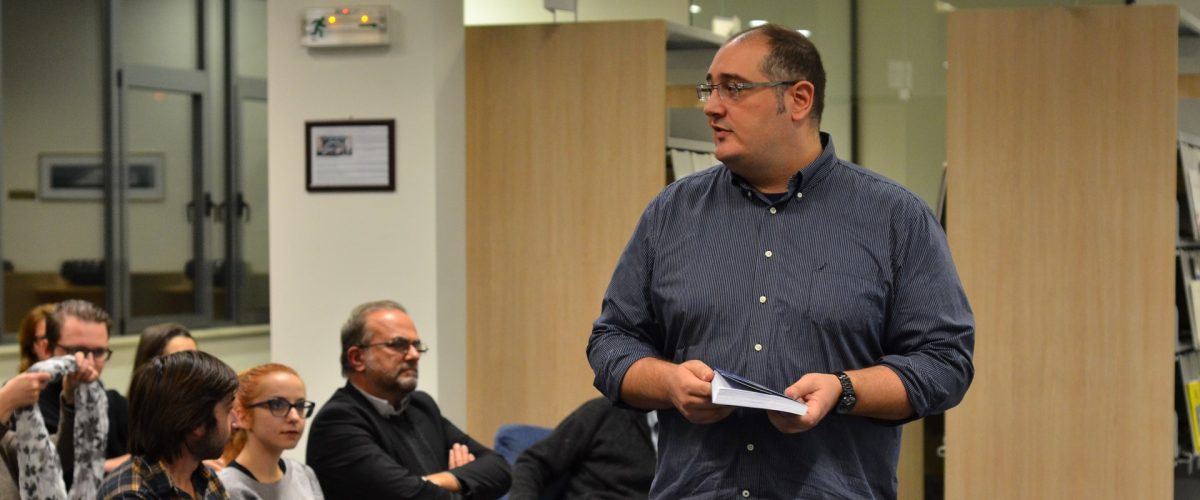
AUBG philosophy professor Dr. Diego Lucci has been appointed General Secretary of the International Society of Intellectual History (ISIH), which gathers together several hundred scholars from Europe, the Americas, Australia, Asia, and the Middle East. In this new role, he will serve on the Executive Committee of ISIH, which makes decisions about the activities of this society, particularly its annual conferences, prizes, website, and journal – the prestigious Intellectual History Review.
Lucci has been a member of the society for 13 years and organized its 2017 conference, “which saw the participation of around 130 scholars and was a very successful event here at AUBG,” he said. He also organized the recent 2022 John Locke Conference, has published several articles and book reviews in the Intellectual History Review, and often serves as a peer reviewer for the journal.
In 2021, Lucci published his book John Locke’s Christianity, which examines Locke’s version of Protestant Christianity and which has since been nominated for three prestigious awards.
“In recent years, my research was particularly focused on Locke’s religious thought,” Lucci said. “Besides John Locke’s Christianity, I have published several articles on issues such as salvation, mortalism, personal identity, the Trinity, and religious toleration in Locke’s oeuvre. Moreover, I was recently asked to contribute several papers on Locke to special issues of journals or collections of essays. For instance, two chapters of mine on Locke’s religion will soon appear in two volumes published, respectively, by Brill and Oxford University Press.”
Lucci’s book on Locke has earned him several invitations to lecture at various academic institutions, including, among others, Jagiellonian University in Poland, the universities of Verona, Venice, Naples, and Chieti-Pescara in Italy, Durham University, the Institute of Historical Research and the Fatima Elizabeth Institute in England, Sofia University, and Locke’s alma mater – Christ Church, University of Oxford.
“I was also invited to present my research on Locke at other institutions, including the University of Amsterdam, the University of Florence, and several North American universities, such as Vanderbilt University, Manhattan College and St. John’s College in the USA, the Autonomous University of San Luis Potosi in Mexico, and Dalhousie University and the University of King’s College in Canada,” he said.
“But, alas, I had to cancel my trip to North America in the spring of 2021 because of the COVID-19 pandemic.”
In recent months, the AUBG professor has also completed several papers, some of which have already been published, on topics such as deism in its international dimension, the philosophy of the Irish freethinker John Toland, the reception of anti-Trinitarian books in early seventeenth-century England, and the political ideas of the anti-Trinitarian theologian Faustus Socinus and his disciples, the Polish Brethren.
“As regards the near future, I plan to work on a long article concerning the disputes between English Catholics and Protestants about transubstantiation, the Trinity, and the rule of faith in the 1680s,” Lucci said. “No one has ever written about this topic, which, however, is essential to reach a better understanding of the controversies on Church authority and religious toleration in late seventeenth-century England. Moreover, I intend to write an article, based on a lecture I recently gave at the University of Hamburg, on the rediscovery of Isaac Newton’s religious thought by the late historian of philosophy Richard Popkin.”
Lucci said he will keep researching Locke’s thought, but, from now on, with a focus on his political theory, particularly on the impact of his religious views on his political ideas. “A few monographs already exist on this subject, but some of them are obsolete while other, most recent books are, in my opinion, severely incomplete and partly incorrect,” he said.
“I plan to write, first, some papers about the influence of Locke’s religion on his concepts of natural law, natural rights and duties, the state of nature, state authority, revolution, and toleration. Then, I would like to gather the results of my research on this subject in a new monograph, although it will take several years to finalize a new book on such an important topic, in which a number of scholars are deeply interested.”