For many first-year students, university brings a lot of exciting questions about their future. What kind of professional do I want to become? How can I apply classroom knowledge to real workplaces? What does it mean to work in a global world? And for graduate students, looking back and tracing their steps is a moment of reflection and potentially a redirection.
This spring semester, students in the Management in a Global Environment class, part of the Business Department at AUBG, had the opportunity to explore these questions through a unique mentorship program with graduate students from the University of South Florida’s Muma College of Business.
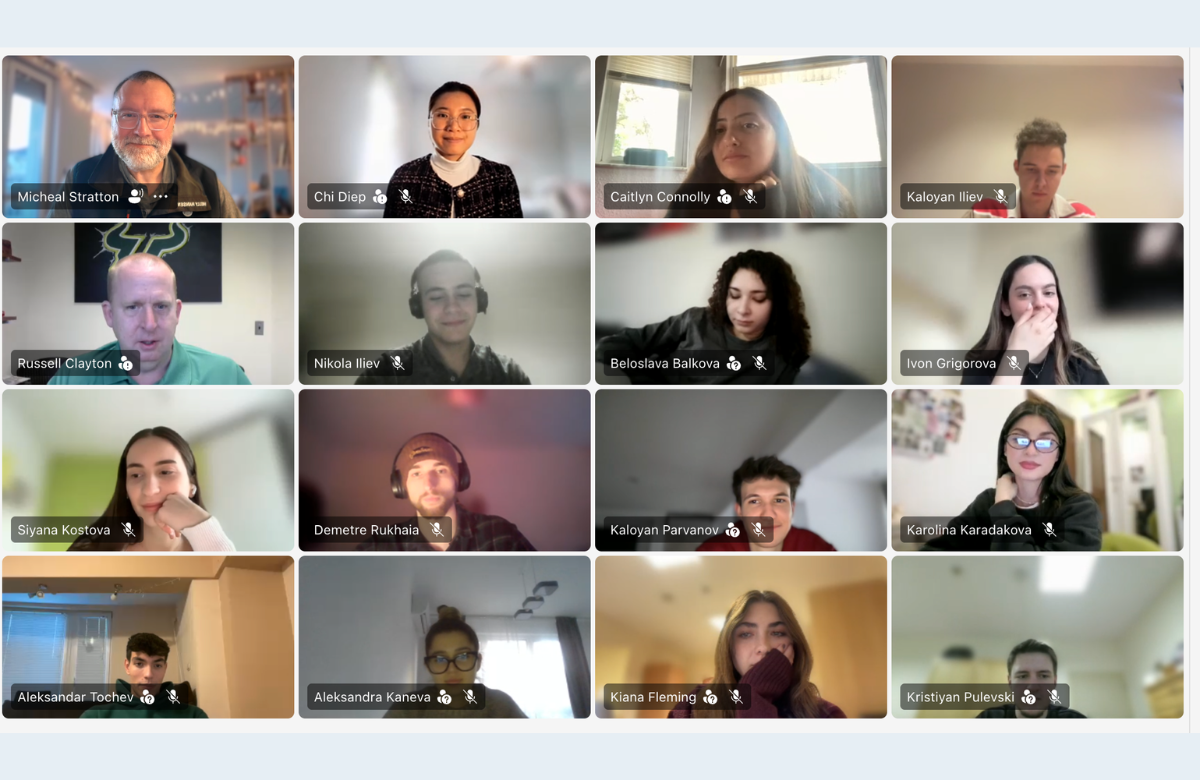
The pilot International Virtual Mentorship Experience paired AUBG first-year undergraduate students with USF MBA, MAcc, and MS in Marketing students, many of whom are already working professionals. Through several virtual meetings, students discussed career paths, professional development, and cross-cultural communication.
The initiative was developed by Dr. Micheal Stratton, Professor of Management at AUBG, and Dr. Russell Clayton, Associate Professor of Instruction in the School of Management at the University of South Florida and Associate Academic Director for the USF Center for Executive & Leadership Education.
“For me, international education has never been just about coursework,” Professor Stratton said. “It’s about the experience beyond the classroom and about exposing students to the reality that the world they’ll manage and lead in is genuinely global.”
Thinking differently about virtual collaborations
The idea for the program grew out of a long-standing professional relationship between Prof. Stratton and Prof. Clayton. During a conversation earlier this academic year, they started discussing a potential virtual collaboration between their students, done in an innovative way. Rather than asking first-year undergraduates and graduate students to collaborate on a shared project, they decided to structure the experience around mentorship.
“Pairing our AUBG freshmen with USF MBA students who are working professionals felt like a natural bridge,” Prof. Stratton said.
Students were matched based on shared interests, experiences, and professional goals, with the aim of creating meaningful connections. For AUBG students, the mentorship program culminated in an analytical reflection assignment, in which they reflected on how the experience connected to course concepts such as leadership styles, organizational culture, decision-making, and communication.
Mentorship in the age of AI
With students receiving readily available information and advice from generative AI, the value of interpersonal connections that such a mentorship provides is even more enhanced.
“Everybody’s talking about AI,” Prof. Clayton said. “AI is going to take our jobs, replace jobs, and things like that. I’m not going to say that’s not true. But right now, AI can’t be our mentor.”
He acknowledged that people can have conversations with AI tools, but emphasized that mentorship involves something different and fundamentally human that AI can’t par with: lived experience, judgment, empathy, challenge, and relationship-building.
“As of today, AI has been shown to be overly agreeable,” Prof. Clayton said. “If I am using AI as my mentor, it’s probably going to tell me what I want to hear.”
For him, this made the program even more valuable for USF students who are already part of the workforce in today’s climate. “AI may replace the spreadsheet that I create weekly,” Prof. Clayton said, “but it can’t replace the human part of my job, which is to mentor those who work with me or work for me.”
In that regard, students from both universities took this mentorship experience to heart. The USF students, for example, had to complete one of two LinkedIn Learning courses on mentorship. The goal was to establish a foundation for what a strong mentorship relationship requires.
For the AUBG students, the experience also required preparation, initiative, and openness. They had to approach their mentors, schedule meetings, and keep track of progress. For Prof. Stratton, this was one of the most important parts of the program.
“The International Virtual Mentorship Program is, at its core, is about putting first-year students in professional relationships before they might typically feel ready for them,” he said. “Watching them rise to this occasion has been so meaningful for me as a faculty member.”
Cross-cultural communication in practice
The program was also designed as a Collaborative Online International Learning, or COIL, experience. COIL is a pedagogical approach that connects students from different countries and institutions through virtual collaboration, allowing them to learn across cultures without physically traveling abroad.
“Our students get mentors who are navigating real careers in real organizations, and they do it across a time zone, across a cultural context, across an institutional divide,” said Prof. Stratton.
Prof. Clayton noted that while AUBG students speak English, for some of them, it is not their first language.
“The jargon that we use might not resonate with students in Bulgaria,” he said. “The acronyms that we use might not resonate. And then there are little things, like the different ways American and European business differ.”
These differences became part of the learning experience. Students were encouraged to ask about cultural nuances, share their own contexts, and reflect on how professional relationships are shaped by national, organizational, and generational cultures.
For Mila Kostadinova, a first-year AUBG student majoring in Journalism and Mass Communication and Business Administration with a concentration in Marketing, the experience was her first time participating in a mentorship program.
“My mentor was a perfect match for me,” Kostadinova said. “She was very prepared and did a great job. It was amazing.”
For Julia Gennocro, Kostadinova’s mentor, the value of mentorship was something she had experienced personally. “My previous mentors played a meaningful role in my educational journey, guiding me towards career opportunities, defining my idea of what success looks like, and helping me recognize my own potential,” she said.
Gennocro works in marketing and content creation for a food magazine while pursuing her graduate degree in business, and their match was perfect.
“My mentee and I shared so many similar interests, including digital marketing and storytelling, which made our relationship natural and engaging from the start,” Gennocro said.
The mentorship also had an immediate practical impact. Kostadinova shared that she had been facing challenges related to team management in one of her student leadership roles at AUBG. Through their conversations, Gennocro offered advice, resources, and examples from her own studies and professional experience. She also saw the importance of creating a supportive space “where my mentee felt comfortable sharing her ideas, questions, and uncertainties about her academic and professional journey.”
Kostadinova has already started applying these insights. “I am trying to incorporate them in my work, and I already see the benefits from that.” For Gennocro, the connection felt meaningful and helped her understand support in a new way.
“My main takeaway from this experience is that meaningful connections can form regardless of geographical location and distance,” Gennocro said.
Mentorship as learning and mutual growth
For AUBG students, the mentorship offered career exposure, global learning, and a form of identity formation. The idea is for students to start asking future-focused questions, which are usually left until later in the university journey, when internships, job searches, or graduate school applications become more immediate. Prof. Stratton believes that first-year students benefit from beginning this process much earlier.
He stressed to his students that while the mentorship experience was part of a graded assignment, it could become much more than that.
“Think about this as starting to build a relationship with a professional that you can then call in a year and say, ‘Hey, remember we met? I have a question,’” Prof. Stratton said.
Although mentorship is often imagined as a one-way relationship, with the mentor giving advice and the mentee receiving it, the International Virtual Mentorship Experience showed that both sides can benefit.
Several USF students described the experience as meaningful not only because they were able to support someone else, but because it made them reflect on their own educational and professional journeys.
For Jissel Abuawad, a USF student, the mentorship experience was part of her Communication Skills course. She said she was motivated by the opportunity to try something new and connect deeply with someone internationally.
“Not only was I able to remember my experience, but I provided insight on what I would’ve done differently now that I have experience and knowledge,” Abuawad said. “I believe it added so much value for me and for her, and I am excited to continue building our relationship.”
The experience also made her think more deeply about the value of mentorship. “I learned that it is great to take time and learn from others,” she said. “It made me realize I can value from a mentor as well, and I am looking forward to future mentoring opportunities.”
Another USF mentor, Kristajah Roth, also entered the program with a strong appreciation for mentorship. As a first-generation student, she said mentorship had played an important role in shaping her professional path.
“During my undergraduate experience, my mentor helped guide me into the industry I’m in today, and I’m incredibly grateful for their advice and support,” she said. Because of that, she wanted to offer the same kind of support to someone else. “I know how overwhelming and confusing that first year can feel,” Roth said.
For Roth, the questioning of the right path her mentee experienced reminded her of her own early uncertainty. “This experience showed me that students are starting to explore their interests earlier and with more intention,” she said.
The beginning of a larger vision
As a pilot program, the International Virtual Mentorship Experience was also an opportunity for Prof. Stratton and Prof. Clayton to learn what works, what can be improved, and to come up with a future vision for the program.
“This type of program is not just beneficial to business students,” Prof. Stratton said. “Every major on campus, every student, regardless of their major, could benefit from having a mentor that is in their discipline, outside their discipline, somebody who is in graduate school right now or not in graduate school.”
For both professors, the pilot was not only a one-semester experiment, but a starting point for thinking about how mentorship can become a more intentional part of the student experience.