5 lessons on startups, AI, and the future of education from Bret Waters
We often think innovation happens only in places like Silicon Valley or that today’s AI platforms can solve every problem equally well.
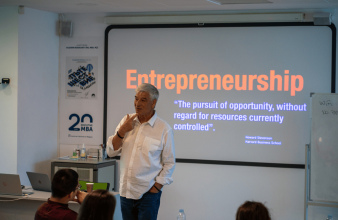
During his visit to the American University in Bulgaria, Silicon Valley entrepreneur and Stanford lecturer Bret Waters challenged these assumptions, sharing lessons drawn from decades of building startups, mentoring founders, and working at the heart of one of the world’s most innovative ecosystems.
1. Success is rarely an overnight story
Silicon Valley is often portrayed as a place where a brilliant idea quickly turns into a billion-dollar company. The reality, Waters says, is very different.
Even companies that appear to have exploded onto the scene are usually the result of years of persistence, experimentation, and hard work. As Google co-founder Larry Page famously said, “After ten years, we were an overnight success.”
2. Don’t build what you think is cool, but what customers want
One of Waters’ biggest professional lessons came from one of his biggest failures. After raising $5 million from investors, he spent two years developing what he believed was a promising software product. When it launched, however, customers simply didn’t want it. This completely changed his approach to innovation.
“It’s not about building what you think is cool,” Waters says. “It’s about building what customers think is cool.”
3. The next AI opportunity is local
Waters believes the next wave of innovation will come from specialized applications designed for specific industries, or “verticals’ as he call them, and local markets, rather than from large, general-purpose AI platforms.
As AI dramatically reduces the cost of building software, entrepreneurs everywhere, not just in Silicon Valley, will have greater opportunities to create solutions tailored to the needs of their own communities.
For countries like Bulgaria, this represents an opportunity to become creators of new AI-powered products.
Read more about Bret Waters’ thoughts on the new innovation landscape and what this means for Bulgaria.
4. AI is democratizing entreprenurship
AI is fundamentally changing the economics of building digital products. Tasks that once required large engineering teams and significant investment can now be accomplished much faster and at a fraction of the cost. This lowers the barriers to entrepreneurship and enables smaller teams to compete with much larger organizations. For aspiring founders, there has rarely been a more exciting time to build something new.
5. The future belongs to people who know how to think
As a university, we are curious how today’s educational isntitutions can prepare students for the future.
According to Waters, knowledge has never been more accessible. In an AI-powered world, information is available instantly from the devices we carry in our pockets. That means success will depend less on memorizing facts and more on developing critical thinking, curiosity, sound judgment, creativity, and the ability to question information rather than simply accept it.
As Waters puts it, the future is becoming “less about having the knowledge, more about having the mindset.”
At AUBG, this philosophy has long been at the core of our liberal arts education. Whether we’re educating undergraduate students or teaching profssionals the entire leadership package through our Executive MBA program in Sofia, we’re cultivating a mindset of innovation, adaptability, and critical thinking. We’re teaching students how to think.
This video was created as part of Bret Waters’ visit to Bulgaria, organized by the AUBG Executive MBA program in Sofia, the Stanford Club of Bulgaria, and BESCO – The Bulgarian Entrepreneurial Association.
The initiative was supported by:
- Gold Sponsors: Accenture Bulgaria, Megapark Office Complex, Management Financial Group
- Silver Sponsor: Anonymous
- Bronze Sponsor: Sopharma
Start Your Executive MBA Journey