ABSTRACT
This article explores the integration of gender-sensitive approaches in digital and media literacy education in Bulgaria. It highlights the need for addressing gender-based violence in digital spaces and provides actionable recommendations for educators, policymakers, and practitioners.
Keywords: Digital Literacy, Media Literacy, Gender-based Violence, Bulgaria, Education Policy
INTRODUCTION
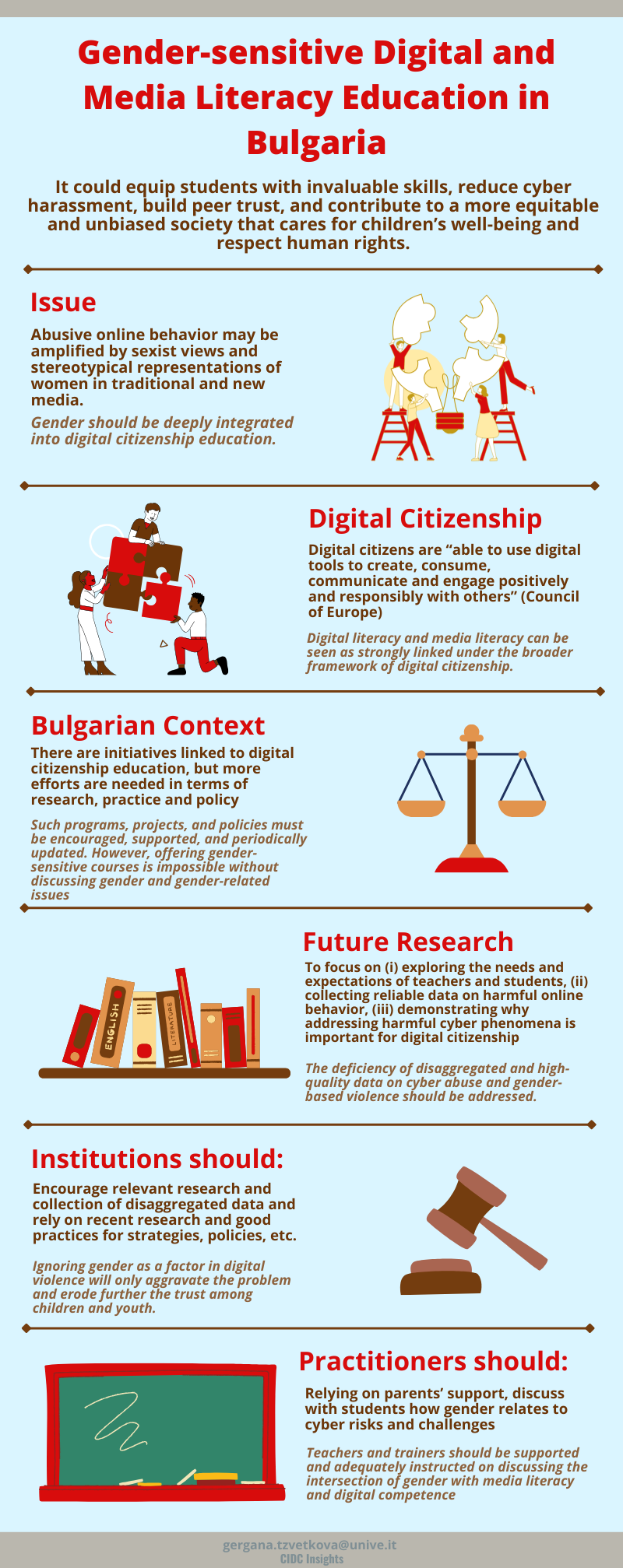
The infusion of digital spaces with disinformation and harassment urges policies and initiatives aimed at fostering digital skills and media literacy. State and local institutions and public and private schools in many countries, Bulgaria included, are incorporating, to varying degrees, these topics in school curricula, ideally in collaboration with civil society, business, and media. Here, I highlight the importance of integrating gender in digital literacy and media literacy programs and argue gender-sensitivity could increase their effectiveness and educate young people as digital citizens. I also propose actionable steps for several key actors and identify future research that can help implement these steps.
REVIEW OF LITERATURE, EXISTING FRAMEWORKS, AND DEFINITIONS
Both offline and online gender-based violence (GBV) affect primarily women and girls (MenABLE, 2024, p. 33). The gender aspect of risks in the digital space (sharing intimate images or gendered disinformation) must be part of conversations with children and youth. These phenomena are often driven and amplified by entrenched prejudice, patriarchal and sexist views (CoE, 2024a) and stereotypical representations of women in both traditional and social media (EIGE, 2020). This is what makes the inclusion of gender in lectures and trainings on safe and responsible online behavior and media literacy so essential.
Digital literacy comprises “computer literacy, ICT literacy, information literacy and media literacy” (Law et al., 2018, p. 6). The valuable EU DigComp framework identifies five areas of digital competence: 1) Information and data literacy; 2) Communication and collaboration; 3) Digital content creation; 4) Safety and 5) Problem-solving (European Commission, n.d.). In addition, media literacy should “aim to equip people with the critical thinking skills required to exercise judgment, analyse complex realities and recognise the difference between opinion and fact” (European Commission, 2023a, p. 1).
Digital literacy and media literacy are strongly intertwined. Firstly, both embrace critical thinking, analytical skills, fact-based decisions, and ethical behavior. Secondly, presently both legacy and new media use digital tools and platforms. Hence, the ability to find content and assess its reliability is a key digital skill. For example, being able to spot an AI-generated image is quite useful when checking the accuracy of information. Digital citizenship is a broader, overarching framework that demonstrates the interconnection between digital and media literacy. According to the Council of Europe, digital citizens are “able to use digital tools to create, consume, communicate and engage positively and responsibly with others” (CoE, 2024b). Digital citizenship competences encompass 10 domains under three umbrellas: Being online, Well-being online, and Rights online (Ibid). Elsewhere, it is argued that “digital citizenship education can contribute to raising awareness of discrimination and bias based on gender stereotypes and their effects on the online and offline world” (CoE, 2020, p. 7).
ANALYTICAL METHODS AND DISCUSSION
In Bulgaria, there are initiatives linked to digital citizenship education, but more efforts are needed in terms of research, practice and policy. The 2022 Bulgarian Recovery and Resilience Plan envisages funding and activities to speed up digital transition and improve the digital skills of citizens. However, observers note that the plan’s adoption and implementation is hindered by delays and unmet requirements (EPRS, 2024) largely driven by the political instability in the last few years. The Strategic Framework for the Development of Education, Training and Learning in the Republic of Bulgaria 2021-2030 mentions “digital media literacy” and lists as a sub-objective “integrating digital and media literacy all curricular subjects” (p. 22). The strategy’s implementation will be monitored through two interim reports and a final report. As of August 2024, no report has been published; therefore, it is difficult to evaluate the progress made.
Referring to the World skills clock, UNICEF (2023) reported that almost half of the young (15-24 y.o.) people in Bulgaria lack basic digital skills. The percentage of cyber bullied (mocked and insulted) children (15%) and teenagers (29%) in Bulgaria is alarming too (Vladkov, 2024). Although cyber violence can affect both men and women, evidence shows that women, girls, and certain minority groups are more likely to experience it (EIGE, 2022, p. 1, 5). Another recent report calls for more efforts to increase media literacy, as Bulgaria ranks last in the EU in this regard (Teach for Bulgaria, 2023).
Programs and projects have already been implemented, often as a partnership between civil society and private companies. The project “Digital Skills in the Age of Artificial Intelligence” for high-school students by the platform prepodavame.bg and the company Yettel, the Digital Literacy Initiative “New Generation with Critical Thinking” led by UNICEF-Bulgaria and supported by several Bulgarian NGOs and companies, and the collaboration between Burgas Municipality and the Telerik Academy to increase students’ digital literacy are noteworthy examples. The Coalition for Media Literacy offers online teaching tools, various trainings, and publishes relevant resources for teachers.
Such programs must be encouraged, supported, and periodically updated. However, recent worrying developments in Bulgaria could greatly restrict the number and the contents of similar initiatives. In August 2024, a controversial law prohibiting “LGBTI+ propaganda” in Bulgarian schools was passed, while certain political actors demand removing NGOs from schools. Obviously, offering gender-sensitive courses will be impossible without discussing gender and gender-related issues.
Furthermore, in Bulgaria, there is still a dearth of comprehensive, disaggregated, and regularly collected data on cyber abuse affecting children and young people – data that can inform policies and trainings. Future studies could focus on (i) exploring the needs and expectations of teachers and students, (ii) collecting reliable, detailed data on harmful online behavior, (iii) demonstrating why addressing harmful cyber phenomena is important for digital citizenship. This could be done through:
- Assessments, grounded in sound methodology, of the digital competences and media literacy of teachers, trainers, and students, which pinpoint basic and well-developed skills;
- Research on the intersection and interaction of gender with specific competences:
- Underlying causes and negative consequences of digital violence and how these intertwine with existing gender dynamics in school and informal settings
- Possible connections between the lack of certain skills and the display and the support of offensive online behavior
- Potential of digital skills to improve gender relations and contribute to a safer online space;
- Gathering high-quality and disaggregated data about the most pervasive forms of malicious online behavior, students’, teachers’ and parents’ familiarity with them, and their views on how such acts should be discussed and discouraged;
- Prioritization of participatory and co-creation methods – for instance, students can be asked to classify specific acts as offensive, harmful, etc. and provide a reason. Collecting disaggregate data is essential to integrating gender.
- Gathering insights from students, teachers, and parents on how digital citizenship can be nurtured, which topics relevant to digital citizenship have a distinct gender aspect and how these can be integrated in digital and media literacy trainings. Such participatory exercises could help reduce the hostility to gender- and stereotypes-related issues which some students, school staff, and parents may feel.
STATE INSTITUTIONS SHOULD:
- Rely on relevant research when crafting policies, curricula, action plans on teaching digital skills and media literacy for children and adults.
- Explore, assisted by researchers and practitioners, whether in formal and informal education (in Bulgaria and other countries) there are already lectures/modules on the gender aspect of digital and media literacy that could serve as good practices.
- Encourage and support research on the above-mentioned topics. Governments should regularly collect disaggregated data on perceptions about gender-based violence, responsible online behavior, and gender dynamics at school. Periodic reports on digital and media literacy, including updates on relevant policies, laws, educational strategies, projects, and programs, are crucial; Bulgaria already submitted a national report answering the European Commission’s recommendations on media literacy and this should become routine (European Commission, 2023b).
- Include lectures/modules on gender in curricula, training programs, textbooks, and teaching materials. Ignoring gender as a factor in digital violence will only aggravate the problem and erode further the trust among children and youth. However, relevant institutions should help teachers and trainers acquire knowledge and abilities necessary to teach such subjects and courses.
PRACTITIONERS (TEACHERS, TRAINERS) SHOULD:
- Insist on being adequately instructed on discussing the intersection of gender with media literacy and digital competence and on being provided with age-appropriate teaching resources.
- Discuss with students how gender relates to cyber risks and challenges. Avoiding this could only foster deeper misconceptions about both what is acceptable online and what is a healthy relationship.
- Rely on the parents’ support. Dedicated Q&A sessions can be organized to address possible backlash from parents against integrating a gender component. Lessons for students and sessions for parents could be planned in partnership with civil society organizations. NGOs may help teachers plan and deliver lectures and propose activities to complement them. Possible activities for students involve: developing a digital campaign against online violence, identifying gender stereotypes in TV shows, ads, movies, and thinking how to make such representations less stereotypical.
CONCLUSION
There are numerous ways of incorporating gender in digital and media literacy education and training. The framework for fostering digital citizenship could only become more effective after highlighting the concept of gender. Supported by decision- and policy-makers and the civil sector, teachers and trainers could equip their students with invaluable skills, thus reducing cyber harassment and building peer trust. Importantly, a valuable long-term outcome can be a more inclusive, equitable, unbiased, and responsible society, which cares for children’s well-being and human rights in general.
The increasing discomfort surrounding gender, sexual orientation, and gender identity in school settings, in the family, and in society is troubling and damaging. A climate of fear and hate will only increase misinformation and polarization and suppress rights. The manipulation and illogical rejection of the concept of gender should end and a comprehensive definition of gender-based violence should be adopted.
AUTHOR’S BIOGRAPHY
Gergana Tzvetkova is a researcher working on human rights, women’s rights, and countering violence against women and disinformation. Currently, she is a Marie Skłodowska-Curie – COFUND fellow at Ca’ Foscari University, where she is implementing the project RESIST. Gergana graduated from AUBG in 2003.
Funding
The research for this paper has been carried out within the framework of the project Stereotyping, Disinformation, and Politicisation: links between attacks against the Istanbul Convention and increased online gender-based violence (RESIST), which has received funding from the European Union’s Horizon 2020 research and innovation programme under the Marie Skłodowska-Curie grant agreement No. 945361. This paper reflects only the author’s view and the Agency and the Commission are not responsible for any use that may be made of the information it contains.
LIST OF REFERENCES
Council of Europe (CoE). (2024a). What causes gender-based violence? https://www.coe.int/en/web/gender-matters/what-causes-gender-based-violence
Council of Europe (CoE). (2024b). Digital Citizenship Education. The Concept. https://www.coe.int/en/web/digital-citizenship-education/the-concept
Council of Europe (CoE). (2020, November). Developing and Promoting Digital Citizenship Education. https://rm.coe.int/developing-and-promoting-digital-citizenship-education/1680a236c0
European Commission. (2023a). Media Literacy Guidelines. https://digital-strategy.ec.europa.eu/en/library/media-literacy-guidelines
European Commission. (2023b). National reports on media literacy measures under the Audiovisual Media Services Directive 2020-2022. https://digital-strategy.ec.europa.eu/en/library/national-reports-media-literacy-measures-under-audiovisual-media-services-directive-2020-2022
European Commission. (n.d.). DigComp Framework. https://joint-research-centre.ec.europa.eu/digcomp/digcomp-framework_en#definition-of-digital-competence
European Institute for Gender Equality (EIGE). (2022). Cyber Violence against Women and Girls Key Terms and Concepts.
European Institute for Gender Equality (EIGE). (2020). Area J — Women and the media:
harmful stereotypes persist.
https://eige.europa.eu/sites/default/files/documents/20190452_mh0419050enn_pdf.pdf
European Parliamentary Research Service (EPRS). (2024, March). Bulgaria’s National Recovery and Resilience Plan Latest state of play. https://www.europarl.europa.eu/RegData/etudes/BRIE/2022/733662/EPRS_BRI(2022)733662_EN.pdf
Law, N., Woo, Torre, J. de la, & Wong, G. (2018). A global framework of reference on digital literacy skills for indicator 4.4.2. UNESCO Institute for Statistics. https://unesdoc.unesco.org/ark:/48223/pf0000265403.locale=en
MenABLE. (2024). Beyond words: understanding and responding to gender-based violence online – An empirical study to develop educational approaches. https://www.menable.eu/research-report/
Teach for Bulgaria. (2023). Силата на добрите примери Доклад за дейността на фондация „Заедно в час“ 2022/2023 [The Power of Good Examples Report on the activities of the Teach for Bulgaria Foundation 2022/2023]. https://zaednovchas.bg/wp-content/uploads/2023/08/zvch-doklad-za-deinostta_2023-BG-WEB.pdf
Vladkov, V. (2024, February 21). Къде прекарват онлайн над 3 часа българските деца и защитени ли са [Where Bulgarian children spend more than 3 hours online and are they protected]. Digitalk. https://digitalk.bg/socialni_mreji/2024/02/21/4591934_kude_prekarvat_onlain_nad_3_chasa_bulgarskite_deca_i/
LINKS TO WEBSITES AND INITIATIVES MENTIONED IN THE TEXT
Coalition for Media Literacy. (2024). Resources. http://gramoten.li/ресурси/наръчници-и-методологии/
Council of Ministers of the Republic of Bulgaria (2022). Национален план за възстановяване и устойчивост [National Plan for Recovery and Resilience). https://www.mlsp.government.bg/uploads/3/baneri/natsionalen-plan-za-vzstanovyavane-i-ustoychivost-na-republika-blgariya/bg-finalrrp-2022-04-06-08-30-tca.pdf
National Education Inspectorate. (n.d.). Стратегическата рамка за развитие на образованието, обучението и ученето в Република България (2021 – 2030) [Strategic Framework for the Development of Education, Training and Learning in the Republic of Bulgaria 2021-2030]. https://shorturl.at/5OFQO
UNICEF. (2023, September 14). Poor educational outcomes, dropping out of school, increasing incidences of violence and lack of basic knowledge and skills are among the main challenges facing students in Bulgaria. https://www.unicef.org/bulgaria/en/press-releases/poor-educational-outcomes-dropping-out-school-increasing-incidences-violence-and
UNICEF. (2021). UNICEF launches digital literacy campaign – ‘New generation with critical thinking’. https://www.unicef.org/bulgaria/en/unicef-launches-digital-literacy-campaign-new-generation-critical-thinking?gad_source=1https://prepodavame.bg/courses/digitalni-umenia-izkustven-intelekt/